AI Use: AI tools were used to support source discovery and to structure the article for clarity. All research, verification, drafting, and final editorial decisions are fully human led. Learn about our AI policy.
UKPoliticsDecoded is an IMPRESS regulated public interest publisher. Read our editorial standards.
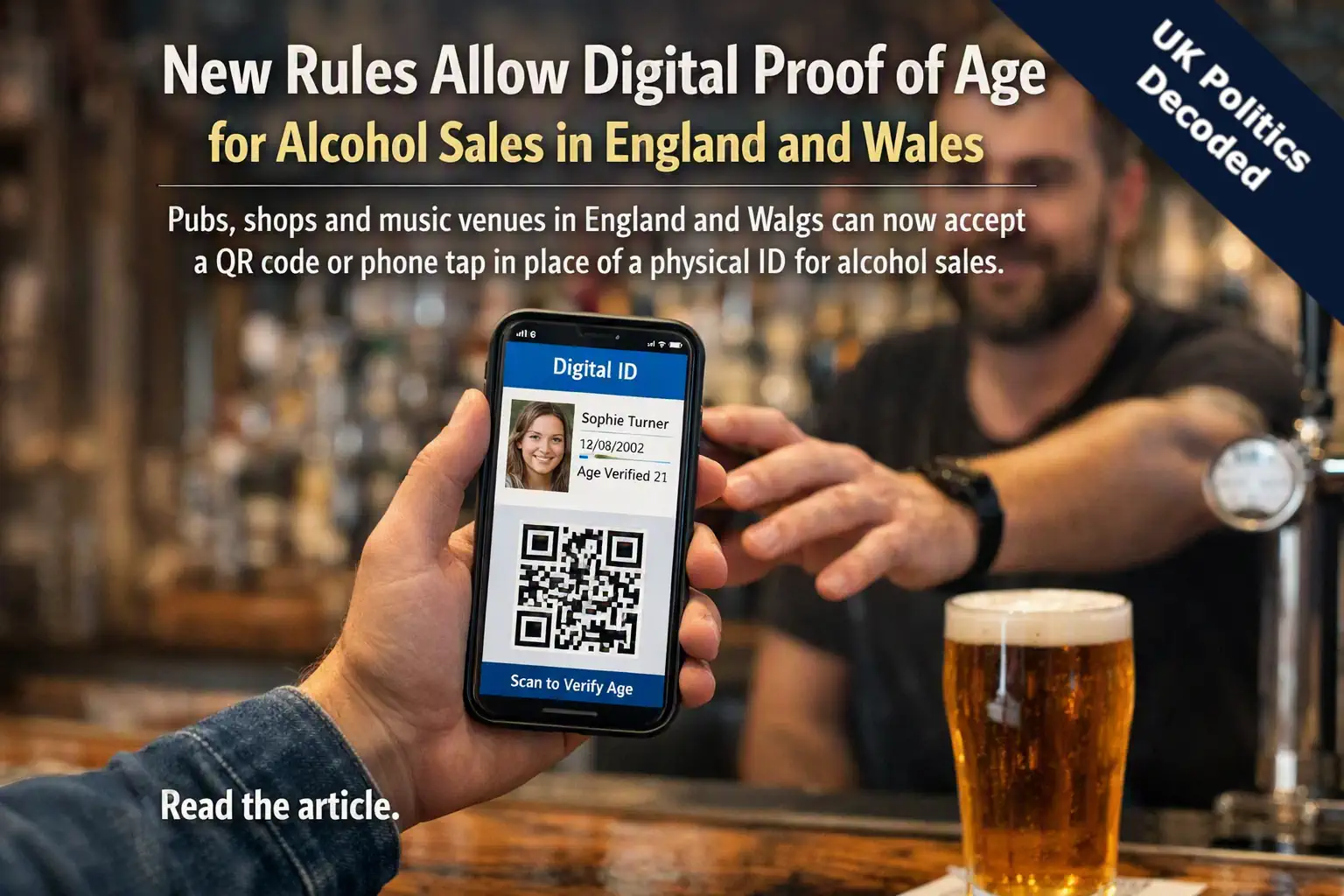
Pubs, shops, festivals and music venues across England and Wales gained a new option today, accepting digital proof of age for alcohol sales, alongside the physical ID checks they've always used. The rules, which came into force on Tuesday 15 September 2026, let customers verify they are over 18 using a certified app on their phone rather than handing over a passport or driving licence.
The change follows a 2024 government consultation in which 72% of respondents supported using digital identities to verify age when buying alcohol, according to the Home Office and Digital Government Minister Stephanie Peacock. It updates the licensing framework under the Licensing Act 2003 without lowering the legal drinking age or loosening the existing duty to prevent underage sales.
At a glance
- From 15 September 2026, licensed premises in England and Wales can choose to accept digital proof of age for alcohol sales alongside physical ID.
- Customers can show a QR code or tap a certified app against a compatible reader instead of handing over a passport or driving licence.
- Digital identification must come from a Digital Verification Service certified against the UK DVS trust framework and listed on the statutory DVS register.
- The change follows a 2024 government consultation in which 72% of respondents backed using digital identities to verify age for alcohol purchases.
- Businesses are not required to adopt digital proof of age, and customers can still rely entirely on physical documents such as passports or driving licences.
How Digital Proof of Age Actually Works at the Till
In practice, the check is designed to be quick. A customer shows a QR code for staff to scan, or taps their phone against a compatible reader, and the person serving them sees a clear pass or fail confirmation rather than examining a physical card. Because the app confirms only that the age threshold is met, without revealing a name or address, the change has been framed as a privacy improvement as much as a convenience one.
The legal basis is the Licensing Act 2003 (Mandatory Licensing Conditions) (Amendment) Order 2026, backed by updated Home Office statutory guidance under section 182 of the Licensing Act 2003. Digital proof of age sits apart from the government's digital driving licence and GOV.UK Wallet, though ministers say it will eventually connect with those tools. One thing does not change, age estimation technology, which guesses someone's age from a photo or facial scan, cannot be used, only a certified, registered Digital Verification Service can carry out the check.
What the Law Requires Before a Pub Can Accept Digital ID
Where a premises chooses to accept digital identification, the law sets a specific standard. Licence holders cannot rely on simply looking at a screen, identification must be verified by a Digital Verification Service certified under the Data (Use and Access) Act 2025 and listed on the statutory DVS register, with any agreement guaranteeing at least a "medium level of confidence" under the UK DVS trust framework. If an intermediary service is involved, it too must be certified and registered, so the chain of verification cannot fall below the required standard.
None of this is retrospective. A premises with an existing licence that expressly rules out digital identification will need to apply for a variation before staff can start accepting it, though Home Office guidance suggests that step should be straightforward where the age verification policy is otherwise unchanged.
Pubs, Yoti and Post Office Back the Switch to Digital ID
Reaction from industry has been broadly positive. Allen Simpson, chief executive of UKHospitality, called it "a positive step for hospitality, providing greater flexibility and convenience for customers and businesses," while urging government to keep the rollout "cost efficient and not burdensome." Julian David, chief executive of techUK, described it as "a practical, everyday example of the value that robust digital identity services can bring to consumers," pointing to a UK digital verification sector he said is worth more than £2 billion a year.
For customers, the appeal is practical rather than dramatic. There's no more patting down pockets for a passport before a night out, and less personal information changes hands, since the app confirms only that the age threshold is met rather than displaying a name or address. It can also mean a faster check during busy periods, such as a festival gate or a Saturday night queue, with certified providers including Yoti ID and Post Office EasyID already available.
What doesn't change is arguably just as important. The legal drinking age and the duty to prevent underage sales are untouched, physical documents such as passports and driving licences remain valid everywhere, and it is entirely up to individual businesses whether they accept digital identification at all. Facial age estimation technology, which guesses someone's age from a photo rather than verifying a certified digital record, still cannot be used to meet the requirement.
How Alcohol Sales Fit Into Britain's Bigger Digital ID Plans
The alcohol rules build on digital identity infrastructure already used elsewhere in the UK to verify who people are online. Robin Tombs, co-founder and chief executive of Yoti, called the change "a landmark moment for digital identity in the UK," noting that businesses can now accept apps such as Yoti ID and Post Office EasyID for alcohol purchases. Jason Sheehy, Post Office's head of identity, said common standards for interoperability would be "critical to building trust and delivering a seamless experience for businesses and consumers alike."
What Happens Next for Pubs, Shops and Customers
Widespread adoption will not happen overnight. The government has said it will take time for businesses to introduce and accept digital proof of age, and premises can keep relying solely on physical ID if they prefer. Where a business does want to switch on digital checks, it needs a formal agreement with a certified provider from the statutory DVS register, and may need to vary an existing licence if its current conditions rule digital identification out. For now, the practical effect is choice rather than obligation, and it will be down to individual pubs, shops and venues how quickly customers start reaching for their phones instead of their wallets.
Key Takeaways
- Licensed premises in England and Wales can now accept digital proof of age for alcohol sales, effective from 15 September 2026, with no change to the legal drinking age.
- Digital identification must be verified by a Digital Verification Service certified under the UK DVS trust framework to at least a medium level of confidence.
- Physical ID remains valid everywhere, and businesses are free to choose whether to accept digital verification at all.
- The rules follow a 2024 consultation in which 72% of respondents supported digital identity for age checks, and providers including Yoti, Post Office EasyID and Luciditi are already involved.
- Age estimation technology that guesses a person's age from their face cannot be used to meet the requirement, only a certified Digital Verification Service check counts.