AI Use & Transparency: AI tools were used to support source discovery and to structure the article for clarity. All research, verification, drafting, and final editorial decisions are fully human led. Learn about our AI policy.
UKPoliticsDecoded is an IMPRESS regulated public interest publisher. Read our editorial standards.
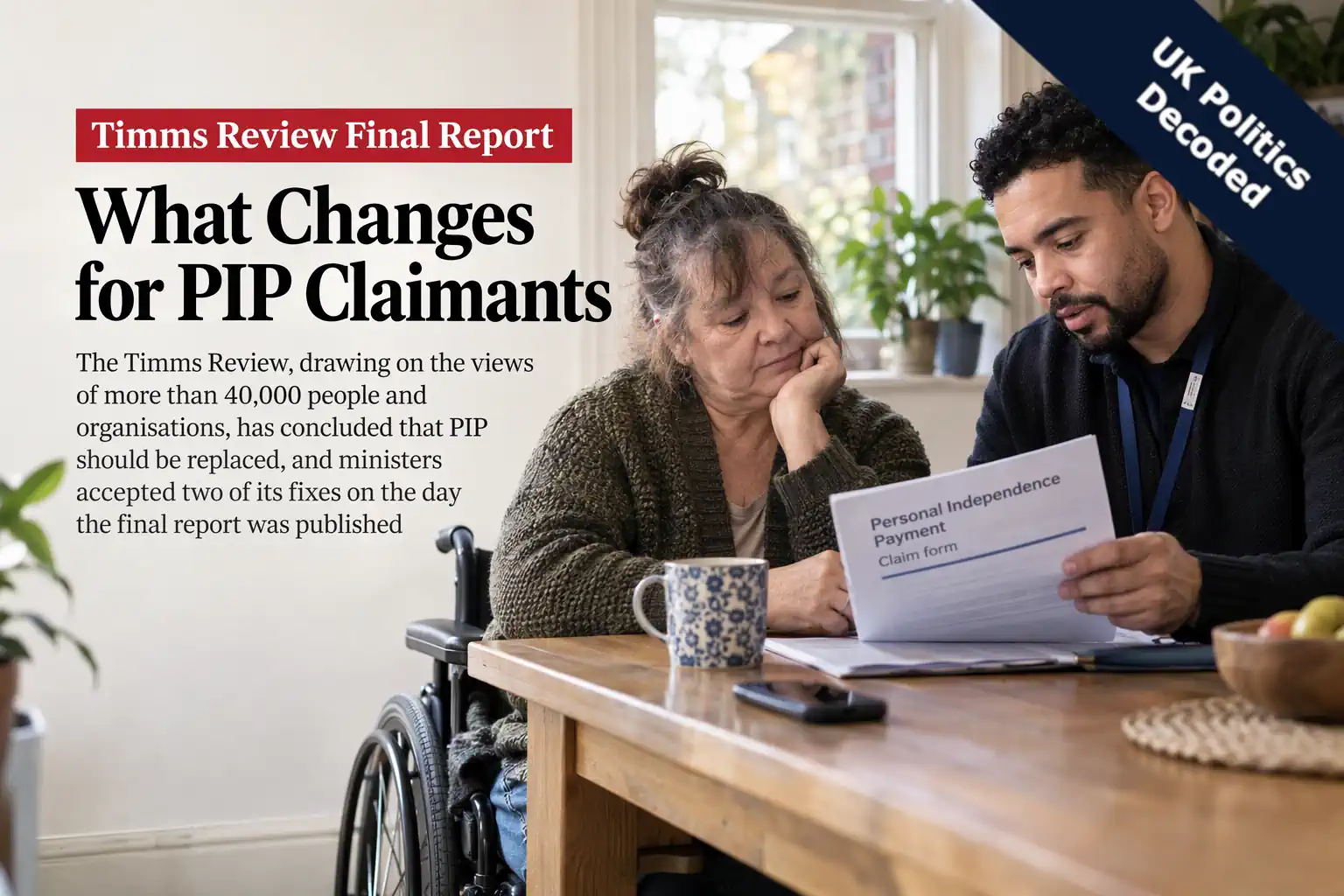
The Timms Review has concluded that Personal Independence Payment should be replaced with a reformed benefit that responds more closely to disabled people's extra costs, and the government accepted two of its recommendations on the day the final report was published. The Department for Work and Pensions released the report, titled Making PIP fit for purpose: a new vision, on 24 November 2026.
PIP is the main benefit for disabled adults in England and Wales and is paid whether or not someone is in work. This is the first full review of it since its introduction 13 years ago. Sir Stephen Timms, the Minister for Social Security and Disability, co-chaired the review with Sharon Brennan and Dr Clenton Farquharson CBE, alongside a steering group of 12 people, almost all of whom live with disability or a long term health condition.
At a glance
- The Timms Review's final report, published on 24 November 2026, recommends replacing Personal Independence Payment with a reformed benefit built around a cash award, optional support and a new assessment.
- The review drew on evidence from more than 40,000 people and organisations, and more than 90% of call for evidence responses that discussed the claims process described it negatively.
- Ministers have accepted two recommendations straight away, a fast track route for people with severe, well evidenced conditions and fewer unnecessary award reviews for people whose conditions are lifelong or progressive.
- The government says it will respond to the wider recommendations in the coming weeks, ahead of a White Paper in the new year, with legislation to follow next year.
- The review's terms of reference require PIP spending to stay within the Office for Budget Responsibility forecast, and the report says that is likely to mean rebalancing awards.
What the Timms Review Final Report Recommends for PIP
The report makes two sets of recommendations. One covers the PIP system claimants deal with today, and the other describes a replacement benefit for the future. The steering group says the first set should not wait for the second, given what it heard about how "dehumanising" the current process feels.
For the current benefit there are 15 recommendations. They include fewer award reviews for people with lifelong or degenerative conditions, and reviews that look only at what has changed rather than starting from scratch. The PIP2 form, "How your disability affects you", would be simplified so that people can describe fluctuating conditions more easily. DWP letters would become more respectful and easier to understand, reasonable adjustments would be identified and monitored properly, and people who need help navigating a claim would have access to independent advocacy.
The list goes on to designated case management teams for people with the greatest support needs, a review of the 28 day hospitalisation rule, better training for assessors and a review of the mandatory reconsideration process. The steering group also wants better use of supporting evidence, a more accurate approach to fluctuating conditions, more capacity for face to face assessments, an online portal and better data on how different groups fare in the system.
Sitting above all of this are five overarching recommendations, build trust, deliver culture change at DWP and its contracted providers, co-produce implementation with disabled people, publish how each change measures up against the group's six tests, and use new technology transparently. Those tests ask whether a proposal reflects real lives, reduces barriers, is fair across groups, protects dignity, supports independent living and can actually be delivered at scale. On technology, the report says AI and automated systems need human oversight and that new technology "must not become a backdoor to creating a digital ID" for disabled people.
Which PIP Changes Has the Government Accepted Already?
Two. Ministers are introducing a fast track route for people with severe, well evidenced conditions, alongside the existing route for people nearing the end of life. They are also committing to cut unnecessary award reviews where there is clear evidence that someone's needs are unlikely to change or are likely to worsen.
Timms described both as "a first step to building a system which gives greater security for those with the most severe conditions". The DWP press release does not give start dates for either change.
The review's own figures show why the second change featured so heavily. As of March 2026, around 32% of the PIP caseload had an ongoing award of 10 years or more. DWP analysis cited in the report found that award reviews ending in no change to the award rose from 40% of claims in the financial year ending 2018 to 75% in the year ending 2026. At the review's shaping recommendations workshops, 95% of participants supported reducing award reviews for people with lifelong or degenerative conditions.
Everything else is still under consideration. The government says it will weigh the wider findings alongside Alan Milburn's Review of Young People and Work and respond in the coming weeks, with a White Paper in the new year. The press release and the minister's own quote differ slightly on timing, the release says the response will come in the coming weeks, while Timms's statement refers to responding in the new year.
How Would the Replacement for PIP Work?
The report is clear on what would stay the same. A reformed benefit would remain a cash award, not means tested, not taxable and available to people in and out of work. Support and services would sit alongside the cash, and the report says entitlement should not depend on taking part in any of them. A non digital route would also remain for people who cannot or do not want to apply online.
What would change is the route through the system. The review proposes a lighter first stage and different pathways depending on circumstances, rather than putting everyone through the same process.
The proposed claimant journey
- A light touch gateway would gather initial evidence, check basic eligibility and start a personal digital profile that follows a "Tell Us Once" approach.
- People with serious, well evidenced conditions would take a fast track pathway, and people receiving end of life care a quicker one, with an award made without a full assessment.
- Everyone else would have an impact assessment looking at how their condition affects daily life, including an extra costs element that does not ask people to calculate costs or produce receipts.
- Awards would be cash first, with optional services or support offered alongside the cash or, under voluntary schemes, in exchange for part of it.
- A locally led supportive conversation would be offered afterwards to anyone who wants help finding local services.
The extra costs element addresses a gap the report states directly. At present, PIP entitlement and award levels are set by how a condition affects someone's ability to carry out specified daily living and mobility activities, not by a direct assessment of what they spend. DWP research cited in the report found that award level is not a consistent proxy for extra cost need. Among people on the enhanced rate of the daily living component, 24% were in the bottom third for care needs and 4% reported no care need at all. Among people with a nil daily living award, 16% were in the top third for care needs.
The review also wants assessments to ask what a person can and wants to do, not only what they cannot. It says people described being afraid that exercising, volunteering or working would be read as proof of lower need. The report says the study with the strongest claim to be representative estimated that 37% of people had that fear, and other studies have estimated higher proportions.
What PIP Claimants Told the Timms Review, and What Official Data Shows
The evidence base runs across several strands. The call for evidence, open from 19 March to 28 May 2026, received 38,713 responses, with roughly 70% of them raising concerns about assessments and around 60% describing psychological or emotional impacts. The review also drew on 138 workshops reaching about 1,240 participants, 26 expert sessions involving 83 people, a NatCen survey of 2,039 working age disabled people, 15 shaping workshops attended by 224 people and five roundtables with 40 stakeholders.
The report is careful to say that the picture is not one sided, and it sets claimant evidence against official data.
What the review heard from respondents
- More than 90% of call for evidence responses relating to the process described it negatively, as stressful, complex, dehumanising or psychologically damaging.
- Around 45% of responses, roughly 17,400, raised difficulty in capturing fluctuating conditions.
- Around 5% of respondents described a positive assessment experience.
- Around 50% to 58% expressed positive feelings about PIP itself as a benefit.
What official and comparative data shows
- In 2025/26, 85% of PIP customers surveyed by DWP were satisfied overall, compared with 88% across DWP services.
- Health Assessment Advisory Service surveys recorded average satisfaction of 93% between September 2024 and August 2026.
- Some 57% of PIP respondents said the claims process worsened their mental health, compared with 34% of Adult Disability Payment respondents in Scotland.
- The report says these sources measure different things and are not directly comparable.
The report acknowledges that call for evidence responses can over represent people with strong views. The official satisfaction survey covers only people with an active award who recently contacted DWP, and the assessment satisfaction figure is taken before respondents know their outcome. The report concludes that, taken together, the evidence still points to considerable scope to make the process more supportive, understandable and fair.
The NatCen survey also tested what people want from a reformed benefit. Some 41% wanted PIP to stay purely a cash benefit, 55% favoured a mix of cash and services and 4% preferred services alone. Among people not receiving PIP or Disability Living Allowance, 64% had never applied, mostly because they believed they were not eligible.
Will the PIP Overhaul Stay Within the OBR Spending Limit? What Is Still Undecided
The review's terms of reference say PIP spending must remain within the OBR forecast. The report cites a rise in working age disability benefit spending from around £14.5 billion in the financial year ending 2020, in 2026 to 2027 prices, to a forecast of over £34.6 billion in the year ending 2032. It says eligibility criteria for a reformed benefit are likely to need a rebalancing process so that awards reflect individual need more accurately, with independent scrutiny, careful testing and transitional protections. Some roundtable participants questioned how the proposals would fit within the OBR projections.
The report is not government policy. It states that its recommendations are those of the steering group and that it is for the government to decide its response. It also sets out where members disagreed. Jean-André Prager dissented from the principle that PIP should stay non conditional, arguing that for some groups entitlement should depend on engagement and participation where reasonable. He also dissented from the co-production recommendation and from the use of disability justice as a framework. Dr Mark Fosbrook raised concerns about how flexible upfront cash payments would protect disabled people experiencing poverty.
On the Work Capability Assessment, the report says the government's aim to abolish it should proceed only if robust safeguards ensure people who cannot work are not subject to work related requirements in Universal Credit. And because PIP is delivered by DWP in England and Wales, by the Department for Communities in Northern Ireland and has been replaced by Adult Disability Payment in Scotland, the steering group asks the government to consider the implications across the devolved administrations.
What Happens Next for PIP Claimants
For now, the concrete changes are the two the government has accepted, and neither has a start date. The wider package depends on a government response, a White Paper and, for some elements, legislation. The report itself says a reformed benefit will take time to implement and suggests any changes to the current system should be evaluated after 12 months.
The report also says some improvements to the current benefit may be possible without primary legislation, following design work and testing, while others will need legislative change. It asks DWP to publish an implementation programme that separates the two and makes clear where further decisions are needed.
The government's own framing is that the final report and the Milburn Review, taken together, point towards what it calls a new settlement that is more humane and personalised. It has not yet said which of the wider recommendations it will adopt, or how a redesigned benefit would be costed against the OBR forecast.
Key Takeaways
- The Timms Review's final report recommends replacing PIP with a reformed benefit that keeps a non means tested cash award but adds a new assessment, an extra costs element and optional support.
- The government has accepted two recommendations immediately, a fast track route for severe, well evidenced conditions and fewer unnecessary award reviews, but has not published start dates for either.
- The review found that the current process is widely experienced as stressful and dehumanising, while official DWP satisfaction surveys show higher scores among the groups they cover.
- Any reformed benefit must stay within the OBR forecast, which the report says is likely to require rebalancing awards.
- The report is the steering group's view rather than government policy, and a government response and White Paper are still to come.
Sources & Further Reading
- GOV.UK - Timms Review recommends overhaul of disability benefits system Archived copy (OGL): archived page
- GOV.UK - Final report of the Timms Review of Personal Independence Payment Archived copy (OGL): archived page