AI Use: AI tools were used to support source discovery and to structure the article for clarity. All research, verification, drafting, and final editorial decisions are fully human led. Learn about our AI policy.
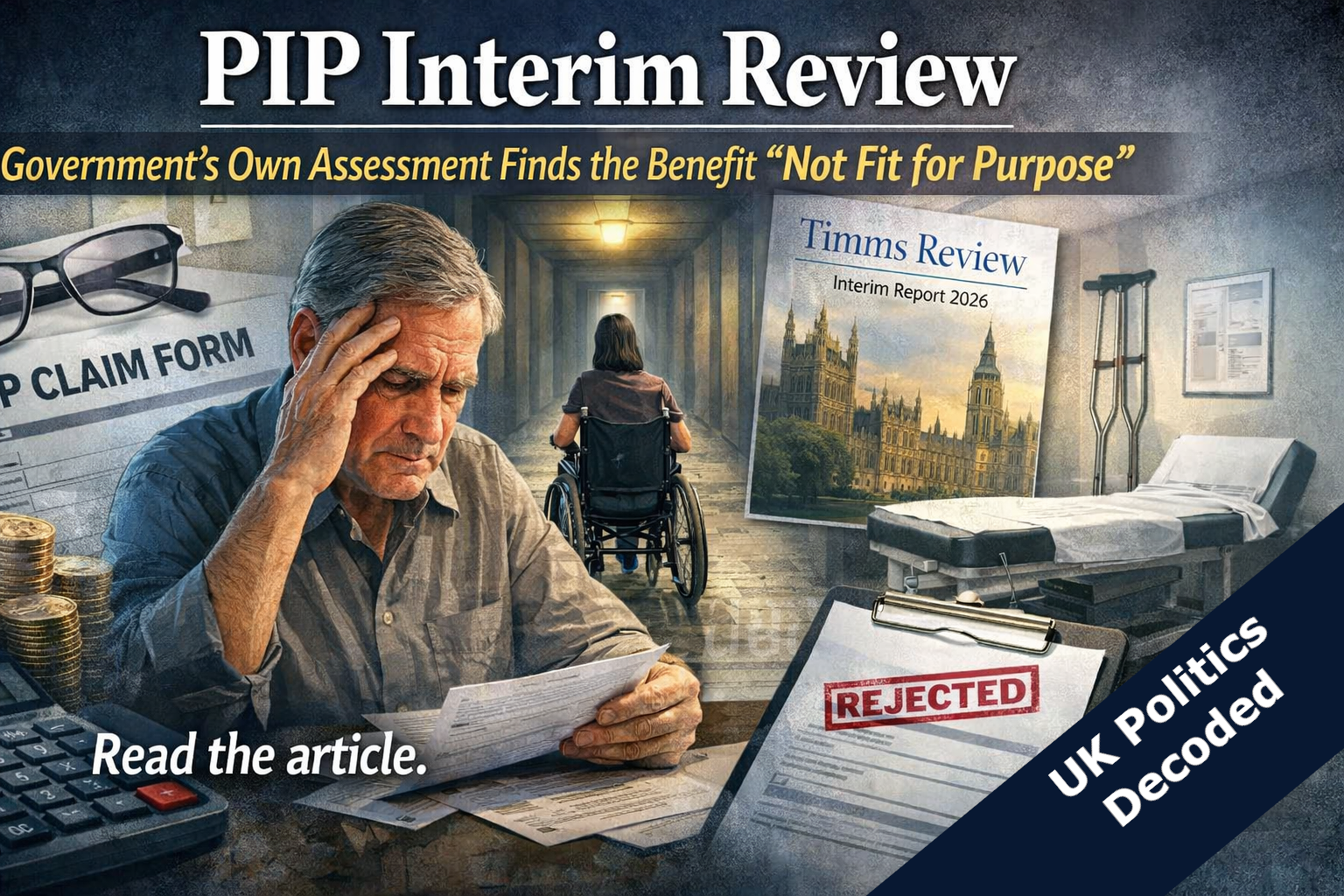
The government's own review of Personal Independence Payment has declared the benefit "not fit for purpose." The Timms Review's interim report, published on 9 July 2026, is the product of the largest co-produced exercise of its kind ever carried out by a UK government, drawing on nearly 40,000 responses, workshops across the country, and sustained engagement with disabled people and their organisations.
PIP was introduced in 2013 to replace Disability Living Allowance. In over a decade, it had never been fully reviewed. The interim report sets out the evidence gathered so far, ahead of final recommendations due this autumn.
At a glance
- What it is: The Timms Review is the first comprehensive examination of PIP since it was introduced in 2013, co-chaired by Minister Sir Stephen Timms, Sharon Brennan, and Dr Clenton Farquharson CBE
- Scale of evidence: The Call for Evidence ran from 19 March to 28 May 2026 and attracted more than 38,000 responses from disabled people, carers, and organisations
- Headline finding: 90% of respondents described the claims process negatively, only 5% were positive
- How it was described: The assessment process was characterised as "dehumanising", "degrading", and "stressful", particularly for people with fluctuating, less visible, or multiple conditions
- Next steps: The steering group moves into a phase of designing and testing recommendations, with the final report due this autumn
PIP is a non-means tested benefit paid to working age disabled people to help cover the extra costs of living with a disability or long term health condition. It replaced Disability Living Allowance from 2013 under the Welfare Reform Act 2012, with a new assessment framework built around functional ability rather than diagnosis alone.
That framework has remained largely unchanged for over a decade, even as the population of disabled people in the UK has shifted significantly. The review was launched in October 2025, tasked with examining whether PIP remains fit for purpose given in the government's own framing, "shifting trends in health and disability, and changes in wider society and the workplace."
The review is co-chaired by Sir Stephen Timms, the Minister for Social Security and Disability Sharon Brennan and Dr Clenton Farquharson CBE. A steering group of twelve appointed members works alongside the three co-chairs, bringing together lived experience, policy expertise, and representatives from Disabled People's Organisations.
The government has described the process as co-produced meaning disabled people helped shape the work from the inside rather than being consulted as an afterthought. It is, according to DWP, the first time co-production has been used on this scale by the UK government.
The headline finding is direct. PIP "is no longer fit for purpose and is failing to keep pace with how disability, health and work have changed over the past decade."
The report identifies a fundamental tension running through the benefit. PIP is widely valued by claimants as a financial lifeline, described by many as the difference between living independently and relying on full time care or becoming housebound. Without it, many said they would need residential care or become entirely dependent on family. Yet the way the benefit is structured and delivered is actively causing harm.
For people with fluctuating conditions, less visible conditions, or multiple overlapping health challenges, the current design fails most acutely. The assessment criteria, designed over a decade ago, do not adequately capture the real life impact of these types of conditions. Low trust in the system runs throughout the evidence, and the report identifies rebuilding that trust, both from disabled people going through the process and from the wider public as a central task for reform.
What the evidence shows about the assessment process
The figures on claimant satisfaction with the claims process are stark:
Assessment process, what respondents said
- 90% negative: Nine in ten respondents described their experience of the claims process in negative terms
- 5% positive: Only one in twenty responses about the process were positive
- Dehumanising and degrading: These were among the most commonly used terms to describe the assessment experience
- Evidence not used consistently: Supporting information submitted by claimants and healthcare professionals was frequently disregarded or applied inconsistently
- Barriers to daily life: Rather than supporting independence, PIP was described as sometimes creating barriers to work, physical activity, and community participation
The report also found that the process added significant stress and anxiety to people already managing serious health challenges particularly through the stages of initial application, formal assessment, and navigating any subsequent appeal.
A number of major organisations submitted evidence or welcomed the interim findings. Their responses reflect the breadth of conditions affected by PIP's current design.
The MS Society, which supported people with MS to contribute to the review, described the current system as "stressful and exhausting" and said the evidence calls for a new approach based on "fairness, dignity and respect." Over 150,000 people in the UK live with MS, many diagnosed in their 30s and 40s, a demographic for whom fluctuating symptoms are a defining feature that the current assessment poorly accommodates.
Mind, the mental health charity, described the system as "dehumanising" and said PIP is a lifeline for people facing the additional costs of living with mental illness. Mencap said the application process is "not accessible" and places an unfair administrative and emotional burden on people with a learning disability and their families, describing unnecessary reassessments as creating deep distrust in the system. Scope said the assessment process "does not reflect the reality of disabled people's lives, especially people with fluctuating conditions."
Parkinson's UK called specifically for unnecessary reassessments to stop for people with progressive conditions that will not improve, noting that the current system requires people to repeatedly prove the impact of a condition that will only worsen over time.
One of the pressures driving the review is a significant shift in the disability claimant population since 2013. Around 10 million working age people in the UK now report living with a disability is equivalent to 24% of the working age population. When PIP launched, the figure was under 17%.
The increase has been particularly pronounced among young people, and there has been a notable rise in mental health conditions. The review must consider how PIP can remain "sustainable within fixed financial limits" while supporting future generations, the language the government has used to signal that any reform will need to operate within budgetary constraints.
What the evidence says PIP does well
- Financial lifeline: Consistently described as vital in enabling disabled people to meet the extra costs of daily life
- Independence: Many claimants said PIP is the difference between living independently and needing residential care
- Cash benefit: The non-prescriptive nature paid directly to claimants to spend as needed was widely valued
- Broad reach: The benefit supports people whether in work, out of work, or unable to work
Where the evidence says PIP is failing
- Assessment criteria: Designed over a decade ago, they do not reflect how many conditions are actually experienced day to day
- Fluctuating conditions: The snapshot approach to assessment is poorly matched to conditions that vary significantly
- Low trust: The process has eroded confidence in the system among both claimants and the wider public
- Barriers created: PIP's current design can discourage engagement with work, social activity, and community life
The Timms Review is running in parallel with the Milburn Review, which is examining the rise in the number of young people not in education, employment or training (NEET). Both reviews are expected to conclude this autumn and will provide a combined evidence base for any subsequent reform programme.
The interim report does not contain firm recommendations, its function is to set out the evidence gathered and signal the direction of travel. The steering group will now move into the next phase, designing and testing proposals for change. Final recommendations are due to be published this autumn.
The review is also clear that reform will need to be considered alongside related work elsewhere in the health and social care system. The Milburn Review into NEET young people is one strand. Broader questions about how the NHS, social care, and the benefits system interact particularly for people with complex or multiple conditions, sit as background to any changes made to PIP specifically.
Sir Stephen Timms, the minister co-chairing the review, said the interim report "delivers a clear message, while PIP is widely valued as a benefit, it is not working as intended and needs fundamental change." Whether that change can be delivered within the financial constraints the review is operating under remains the central question that autumn's final report will need to answer.
Key Takeaways
- The Timms Review interim report, published 9 July 2026, is the first comprehensive assessment of PIP since the benefit was introduced in 2013
- More than 38,000 responses were received, 90% described the claims process negatively, with only 5% positive
- Assessment criteria have not been updated in over a decade and fail people with fluctuating, less visible, or multiple conditions most acutely
- PIP is consistently described as a vital financial lifeline, but the process of claiming it was characterised as dehumanising, degrading, and stressful
- Final recommendations are due this autumn, alongside the parallel Milburn Review into NEET young people
Sources & Further Reading
- GOV.UK - First comprehensive review into PIP finds it is "not fit for purpose" (Department for Work and Pensions, 9 July 2026) Archived copy (OGL): archived page
- GOV.UK - Paul Gray publishes second review of Personal Independence Payment (Department for Work and Pensions, 30 March 2017) Archived internally for verification (9 July 2026)
- PIP Assessment: Second Independent Review - Paul Gray (DWP, March 2017) Archived copy (OGL): archived document