AI Use: AI tools were used to support source discovery and to structure the article for clarity. All research, verification, drafting, and final editorial decisions are fully human led. Learn about our AI policy.
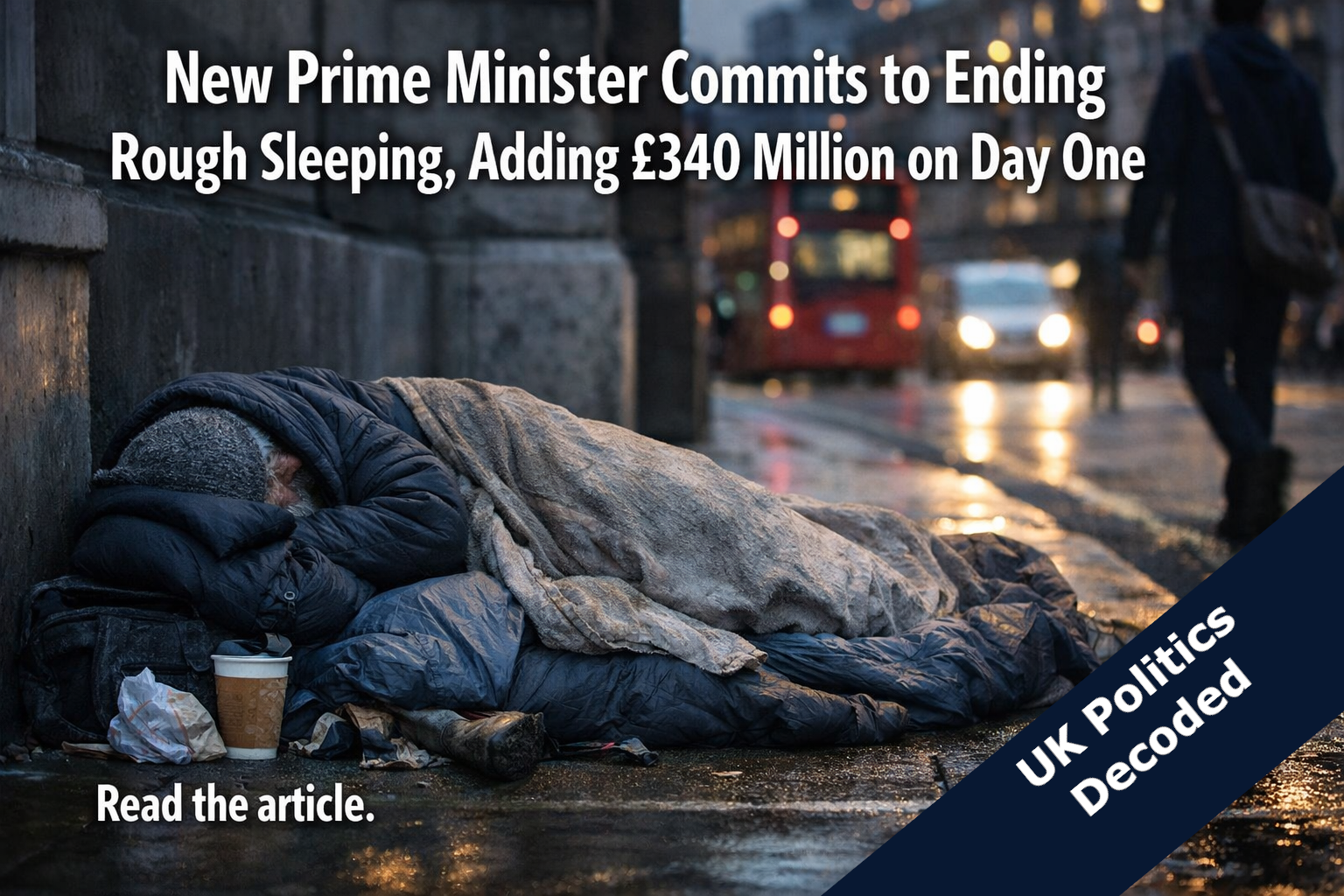
Andy Burnham used his first speech as Prime Minister to announce £340 million in new funding to end long term rough sleeping, taking the overall government investment to what ministers describe as record levels. Speaking on the steps of Downing Street on 20 July 2026, Burnham said ending rough sleeping was not inevitable, it was a political choice and he intended to act immediately.
The announcement continues a programme started under his predecessor. Since December 2025, the government had already committed £3.6 billion over three years through a National Plan to End Homelessness, repealed the 1824 Vagrancy Act in June 2026, and set a parliamentary term target to halve long term rough sleeping. Burnham's day one pledge adds a further tranche of dedicated investment, focused on getting the longest term rough sleepers into secure housing before winter.
Key Announcements
- £340 million new funding: Announced on 20 July 2026, taking total government investment on rough sleeping to record levels
- 1,200 homes: The opening investment will provide homes and intensive support for at least 3,000 people in long term rough sleeping
- Five year programme: Funding is the first phase of a wider programme for thousands of people facing severe and long term homelessness
- Local delivery: Mayors, councils, NHS, and public services will lead delivery, backed by central government support
- Crisis research cited: A year of rough sleeping costs an estimated £20,128 per person, a successful prevention intervention costs £1,426
The £340 million is described by the Prime Minister's office as the opening investment in a broader five year programme. Urgent first steps will begin the acquisition of suitable homes, identification of those most in need, and the provision of housing and support without delay. Further steps are expected to be set out before autumn 2026.
The funding is directed at people who have been sleeping rough for an extended period:
- Long term rough sleepers: People trapped in cycles of crisis, poor health and insecurity over months or years
- Pre winter urgency: Ministers want vulnerable people moved into secure housing before the colder months
- At least 3,000 people: The stated minimum number who will receive homes and intensive support from this phase of funding
- 1,200 homes: The number of suitable properties to be acquired as part of the opening investment
- Local coordination: Local leaders will identify those most in need and match them with housing and wraparound support
Delivery is designed to be locally led, backed by national government resources:
Delivery Structure
- Local leadership: Mayors and councils will lead delivery, building on proven local led approaches already operating across England
- NHS involvement: Health services and public bodies will be brought in to provide urgent support alongside housing
- Home acquisition: Government will begin acquiring suitable homes immediately, not waiting for existing stock to become available
- Further steps: Additional measures will be set out before autumn, with the full five year programme expected to support thousands more people
The incoming Prime Minister is continuing and expanding a programme already under way. Since taking office in 2024, the Starmer government had moved on several fronts before Burnham's appointment.
The National Plan to End Homelessness
Published in December 2025, the National Plan set out a five pillar strategy backed by £3.6 billion over three years:
National Plan Commitments
- Target to halve rough sleeping: Government set a formal target to halve long term rough sleeping by the end of this Parliament
- End unlawful B&B use: Pledge to end the unlawful use of bed and breakfast accommodation for families with children
- £159 million for supported housing: Targeted at 40 local areas with the greatest rough sleeping pressures
- Duty to Collaborate: A proposed new legal duty requiring public bodies including hospitals and prisons to work together to prevent homelessness
- Prison and hospital discharge targets: Formal target to halve the number leaving prison homeless on their first night, and to prevent hospital discharge onto the streets
Two specific changes came into effect in the weeks immediately before the new Prime Minister's appointment.
- Vagrancy Act repeal (29 June 2026): The 1824 Vagrancy Act, which had criminalised rough sleeping and begging for nearly two centuries, was repealed, a step backed by housing charities including Crisis, St Mungo's and Homeless Link
- £50 million community fund (February 2026): A £37 million Ending Homelessness in Communities Fund for voluntary and faith organisations, plus a £15 million Long Term Rough Sleeping Innovation Programme across 28 high pressure local areas
- Renters' Rights Act: Abolition of Section 21 no fault evictions, which ministers said had pushed thousands of renters into homelessness
- £39 billion housing investment: The government's longer term commitment to social and affordable housing, with affordable housing starts up 35% since 2024 according to GOV.UK figures
- £950 million for temporary accommodation: Investment to boost supply and reduce the worst forms of temporary accommodation, including B&B use for families
The Prime Minister specifically rejected the argument that ending rough sleeping would take decades or could not be done. The government cites the 'Everyone In' initiative during the Covid 19 pandemic, when the government housed thousands of rough sleepers rapidly, as evidence that decisive action produces rapid results.
Ministers argue the investment makes financial sense as well as a moral one:
Cost of Rough Sleeping
- £20,128 per person per year: The estimated cost of a year of rough sleeping, according to Crisis research cited in the GOV.UK announcement
- NHS pressure: Repeated crisis interventions place significant demand on emergency health services
- Criminal justice costs: Rough sleeping is associated with repeated contact with policing and the courts
- Long term dependency: Without stable housing, people cycle through costly acute services with little improvement
Cost of Prevention
- £1,426 per person: The estimated cost of a successful prevention intervention, cited from Crisis research
- Community benefit: Ending rough sleeping strengthens towns and communities, according to the government's statement
- Reduced system demand: Stable housing reduces pressure on the NHS, criminal justice system and other public services
- Long term savings: Government argues preventative investment saves significantly more than it costs over time
The repeal of the Vagrancy Act in June 2026 marked a significant shift in the legal framework around rough sleeping. Introduced in 1824 following the Napoleonic Wars, the Act had been used though decreasingly to move people on rather than address the causes of their homelessness. Charities had campaigned for its repeal for decades.
The government has confirmed existing antisocial behaviour powers remain available where behaviour causes harassment or distress, but these are not intended for use against people simply because they are homeless:
Legal Framework After Repeal
- Anti Social Behaviour, Crime and Policing Act 2014: Powers to address behaviour causing harassment or distress remain in force
- Statutory guidance: Updated to ensure these powers are not used simply against people sleeping rough
- Organised crime: New offences in the Crime and Policing Act 2026 target organised begging gangs and exploitation, distinct from individual rough sleeping
- Streetlink: The public alert system allowing anyone to notify their local authority about someone sleeping rough and in need of support remains operational
- Shift in approach: Government policy is now explicitly framed around prevention, support and long term solutions rather than enforcement
Wider Housing Measures
The rough sleeping drive sits alongside a broader government housing programme.
- Renters' Rights Act: Abolished Section 21 no fault evictions, removing one of the most significant pathways into homelessness from the private rented sector
- Social housing starts: Up 35% since 2024, according to government figures, though completions take years to feed through to available supply
- Domestic abuse: Research from the Rough Sleeping Questionnaire 2025 shows nearly 70% of women experiencing rough sleeping had experienced domestic abuse since the age of 16, the Social Housing Bill includes strengthened protections
- Hospital and prison discharge: Formal targets set to prevent discharge directly into homelessness from public institutions
- £39 billion long term housing investment: Government describes this as the biggest boost to social and affordable housing in a generation
The Prime Minister's day one announcement sets a clear political direction, but the full scope of the programme will take time to become clear.
Local authorities and mayors will begin identifying those most in need. Home acquisition will start immediately, with the government aiming to house at least 3,000 people through this first phase before winter. Further measures will be announced before autumn 2026, fleshing out the broader five year plan.
The National Plan to End Homelessness, with its £3.6 billion backing and formal targets, provides the structural framework. Burnham's commitment adds momentum and additional resource, but much of the delivery depends on local capacity, housing availability, and the passage of legislation still moving through Parliament.
Key Takeaways
- Andy Burnham announced £340 million in new rough sleeping funding on his first day as Prime Minister, 20 July 2026
- The funding will provide 1,200 homes and intensive support for at least 3,000 people in long term rough sleeping, ahead of winter
- The new investment builds on the previous government's £3.6 billion National Plan to End Homelessness, published December 2025
- The Vagrancy Act which had criminalised rough sleeping since 1824 was repealed on 29 June 2026, with a shift in policy focus to prevention and support
- Further measures will be set out before autumn, the full five year programme has not yet been published
Sources & Further Reading
- New PM says government can bring back hope to Britain, and launches drive to end rough sleeping at the earliest opportunity Archived copy (OGL): archived page
- Rough sleeping no longer a crime as Vagrancy Act repealed - GOV.UK Archived copy (OGL): archived page
- Over £50 million pumped into the fight to tackle homelessness - GOV.UK Archived copy (OGL): archived page
- A National Plan to End Homelessness - GOV.UK (December 2025) Archived copy (OGL): archived page