AI Use: AI tools were used to support source discovery and to structure the article for clarity. All research, verification, drafting, and final editorial decisions are fully human led. Learn about our AI policy.
Three defence investment announcements published on 7 and 8 July 2026 mark a significant expansion of UK long range strike capability and military medical care. The British Army will acquire the Precision Strike Missile (PrSM), the UK is leading a NATO wide deep precision strike initiative at the Ankara Summit, and £50 million is being directed to frontline battlefield medicine. All three draw from the £298 billion Defence Investment Plan published on 30 June 2026.
The announcements span different parts of the armed forces but share a common thread, improving the UK's ability to strike targets far behind a front line, sustain forces in the field, and contribute to NATO deterrence at a time of heightened threat from Russia.
At a glance
- PrSM: The British Army will acquire the Precision Strike Missile, a supersonic ballistic missile capable of hitting targets at up to 500km, backed by £190m
- Compatibility: PrSM is fully compatible with the UK's upgraded M270A2 Multiple Launch Rocket System launchers, no new vehicles needed
- NATO initiative: The UK is leading around 12 European nations to commit $50bn (£37bn) over 10 years to deep precision strike capability
- Bilateral programmes: Separate UK investments include a 2000km+ hypersonic weapon with Germany (£770m over four years) and the Stratus Storm Shadow successor with France and Italy (£1.4bn over four years)
- Battlefield medicine: £50m over four years covers casualty care kits, dried blood products, tranexamic acid autoinjectors, and field hospital equipment
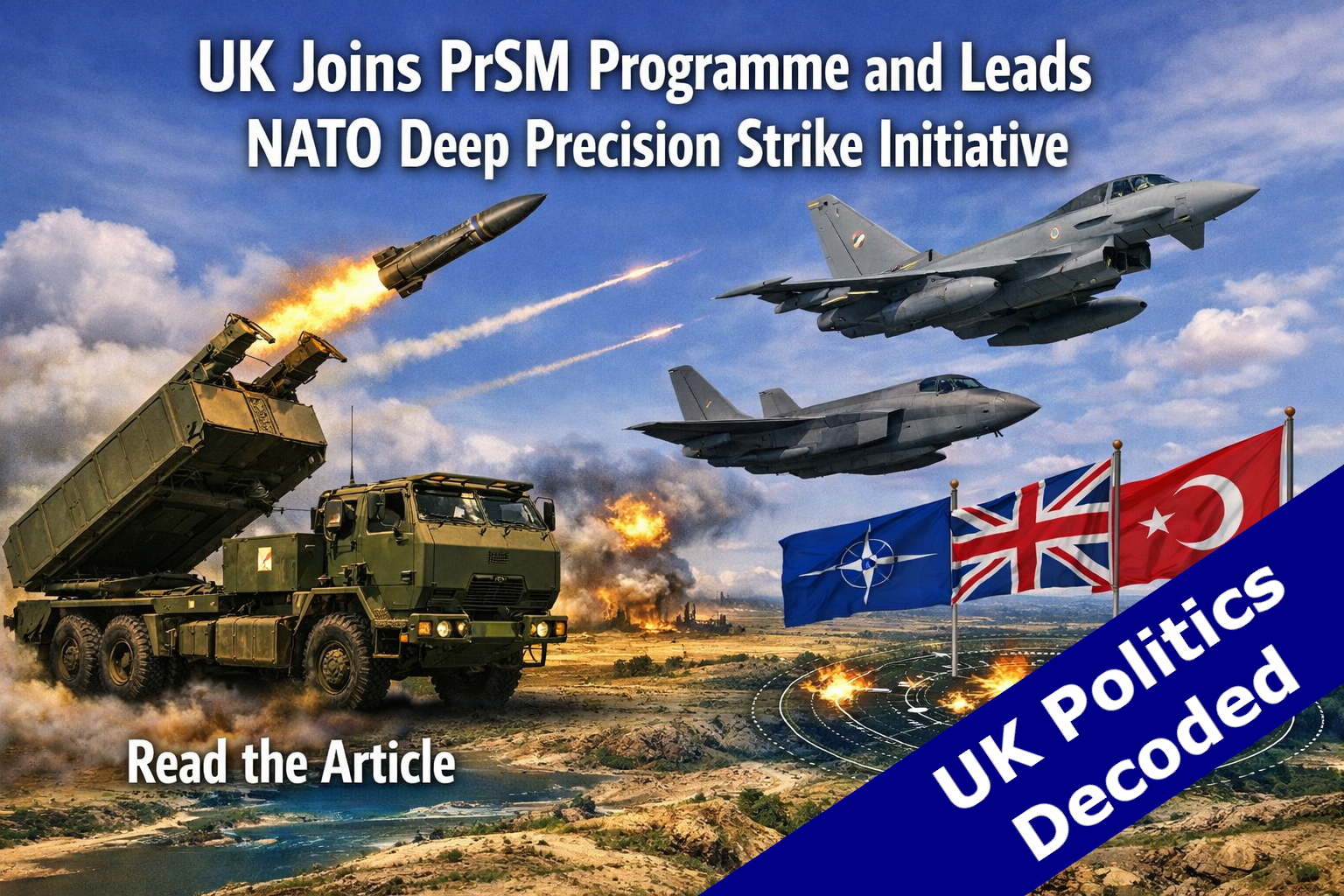
The British Army is joining the Precision Strike Missile programme, a collaborative effort already running between the United States and Australia under AUKUS Pillar 2. The missile is currently built by Lockheed Martin and is a proven supersonic ballistic weapon capable of reaching targets at up to 500 kilometres.
Its key selling point for the UK is immediate compatibility. PrSM works with the Army's existing upgraded M270A2 Multiple Launch Rocket System launchers, meaning no new vehicles or additional infrastructure modifications are needed.
The government has allocated £190 million from the Defence Investment Plan for the procurement. Subject to agreement with the US and Australia, first deliveries could come as early as 2027. Future development work could extend the missile's range further, according to the Ministry of Defence.
Defence Secretary Dan Jarvis MBE MP said the investment would "give our soldiers the weapons they need as they defend our nation and NATO." PrSM is described as a complement to other long range systems already in development rather than a replacement for longer term collaborative programmes.
At the NATO Summit in Ankara on 8 July, Prime Minister Keir Starmer convened European allies to launch a UK led initiative focused on deep precision strike capability. Around twelve countries are expected to commit a combined $50 billion, approximately £37 billion over the next decade to develop and field long range strike weapons across the alliance.
The initiative targets capability able to strike at a minimum of 300 kilometres, with some systems designed for ranges exceeding 2,000 kilometres. The aim is to give NATO forces the ability to degrade enemy logistics, weapons systems, and supply lines well behind a front line before they can threaten allied territory.
UK programmes already in development
The UK's own long range investment forms the backbone of its £3 billion commitment to this area by 2030:
- Trinity House (UK–Germany): A joint programme to develop stealth and hypersonic weapons with a range exceeding 2,000 kilometres, expected to enter service in the 2030s. The UK is investing £770 million over four years.
- Stratus (UK–France–Italy): A trilateral project developing both stealth and high speed variants of a successor to the Storm Shadow cruise missile. Stratus is designed to engage surface targets, warships, and enemy air defences. The UK is investing £1.4 billion over four years, the project sustains more than 1,300 jobs at MBDA facilities in Stevenage and Bolton.
- PrSM (UK–US–Australia): The Army ballistic missile described above, providing an immediately available capability while the longer range bilateral programmes mature.
The Prime Minister said NATO had scrambled fighter jets to intercept Russian aircraft more than 700 times in the past two years and that Russian military activity around UK waters had surged 30 per cent in the same period.
Separately, on 8 July the government published details of £50 million in Defence Medical investment under the Defence Investment Plan. The funding is spread across four specific areas over the next four years:
£50m Battlefield Medicine breakdown
- £20m - Tactical Combat Casualty Care equipment: The latest battlefield medical kits designed to reduce preventable deaths and improve care at the point of injury
- £10m - Dried blood products: Part of the Blood Far Forward programme, enabling blood transfusion care closer to the battlefield by reducing reliance on refrigeration
- £10m - Tranexamic Acid (TXA) autoinjectors: Allows blood clotting medication to be administered rapidly in the field, improving survival from severe blood loss
- £10m - Field hospital equipment: Strengthening deployable medical infrastructure to sustain care during large scale operations
Beyond this four year package, the government has stated an intention to invest at least £3 billion between 2030 and 2035 in Defence Medical capabilities and Joint Support Enablement covering combat medicine advances, protection against chemical, biological, radiological and nuclear threats, and the logistics needed to sustain the Integrated Force on future operations.
These announcements build on the Defence Investment Plan published a week earlier, but several key details remain to be confirmed. PrSM deliveries in 2027 are subject to formal agreement with the US and Australia. Trinity House and Stratus are both multi year development programmes not expected to reach full capability until the 2030s. The NATO Deep Precision Strike initiative sets spending targets across nations but is not a binding procurement programme.
The government has not published a single consolidated timetable for when these capabilities will reach operational service. For the battlefield medicine investments, the four year funding window runs to roughly 2030, with further commitments described as an intention rather than a confirmed allocation.
Key Takeaways
- The British Army will acquire PrSM, a supersonic ballistic missile with a 500km range, at a cost of £190m, compatible with existing M270A2 launchers, with potential first deliveries in 2027
- The UK is leading a NATO European initiative at Ankara in which around 12 nations are expected to commit $50bn (£37bn) over 10 years to deep precision strike capability
- UK bilateral programmes include the Trinity House 2000km+ hypersonic weapon with Germany (£770m) and the Stratus Storm Shadow successor with France and Italy (£1.4bn), both under the broader £3bn long range fires commitment
- £50m in battlefield medical investment over four years covers tactical casualty care, dried blood products for the Blood Far Forward programme, TXA autoinjectors, and field hospital equipment
- A further £3bn for Defence Medical and Joint Support Enablement is planned between 2030 and 2035, though this has been described as an intention rather than a confirmed commitment
Sources & Further Reading
- GOV.UK - Millions invested in new missile to strengthen British Army's capability and NATO deterrence (Ministry of Defence, 7 July 2026) Archived copy (OGL): archived page
- GOV.UK - $50bn boost for European deep precision strike capabilities as UK leads new initiative (Prime Minister's Office, 8 July 2026) Archived copy (OGL): archived page
- GOV.UK - Defence Investment Plan boosts battlefield medicine by £50 million (Cyber & Specialist Operations Command, 8 July 2026) Archived copy (OGL): archived page