AI Use: AI tools were used to support source discovery and to structure the article for clarity. All research, verification, drafting, and final editorial decisions are fully human led. Learn about our AI policy.
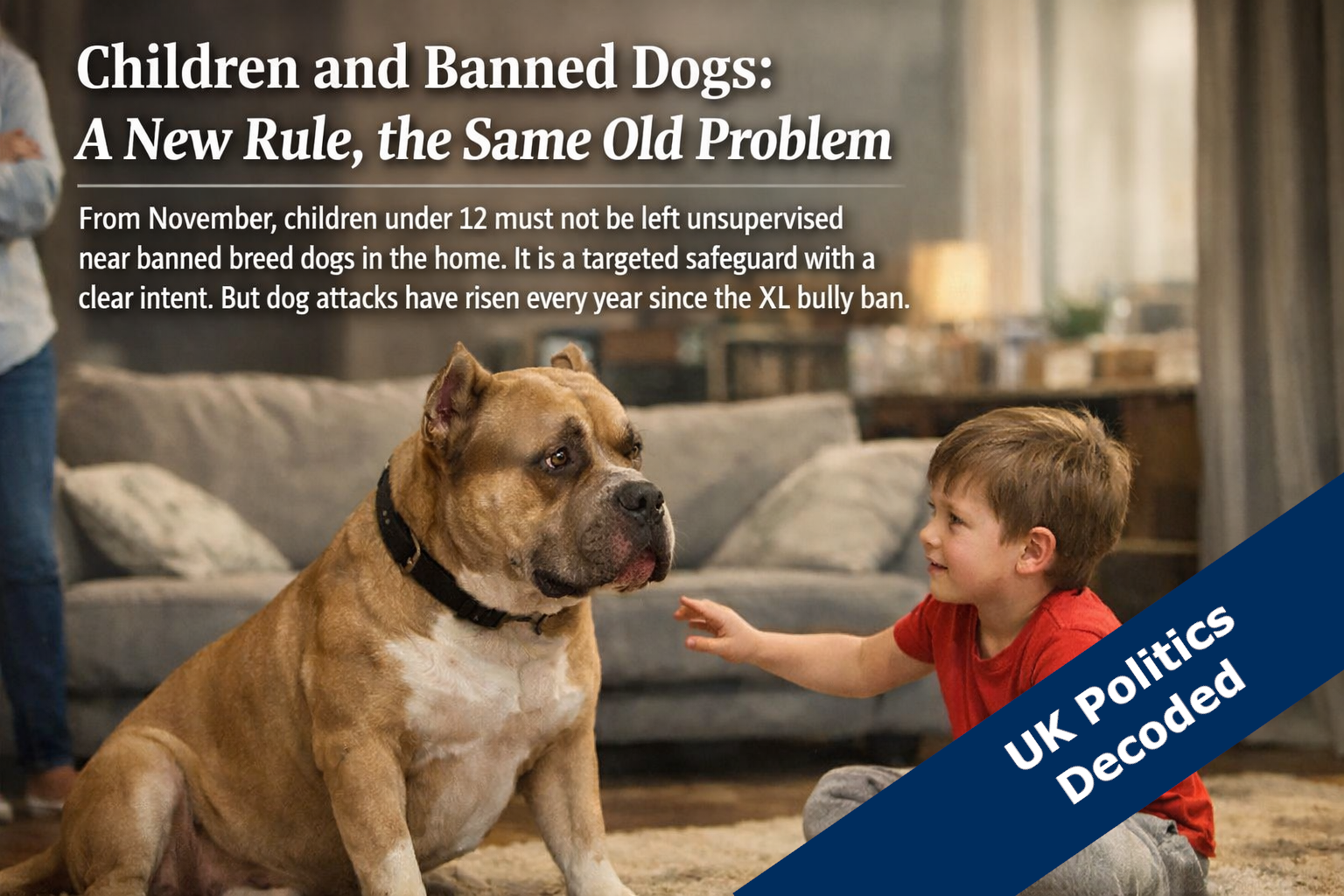
The government announced on 9 June that owners of banned breed dogs will face a new legal obligation from 1 November 2026. Under the change, children under the age of 12 must not be left in close proximity to a banned breed dog in a domestic or private setting without an adult present. The requirement will be added as a condition of the Certificate of Exemption, the document that allows owners to legally keep a banned breed such as an XL Bully. Failure to comply could result in the dog being seized and the owner prosecuted under the Dangerous Dogs Act 1991.
Animal Welfare Minister Baroness Hayman described the move as placing the safety of children first. She said any attack on a child by a dangerous dog was unacceptable, and that while many owners act responsibly, those who do not should face legal consequences. A separate change announced alongside the supervision rule removes the requirement for third party public liability insurance for banned breed owners from 1 July. The government acknowledged that the only provider of such insurance has withdrawn from the market and no suitable alternative currently exists.
What Is Changing
- New supervision rule: From 1 November 2026, children under 12 must not be left alone with a banned breed dog in a domestic or private setting. This applies to all breeds on the banned list, including XL Bully types.
- Certificate of Exemption condition: The rule will be added as a formal condition of the exemption. Breach of exemption conditions can result in seizure and prosecution.
- Insurance requirement removed: Third party public liability insurance will no longer be required from 1 July 2026, after the only provider withdrew from the market.
- All other requirements remain: Muzzling and keeping on a lead in public, microchipping, and neutering obligations continue unchanged.
- Further guidance: The government has said it will publish additional implementation guidance ahead of the November start date.
To understand why a new supervision condition is being added now, it helps to look at what has happened since the XL Bully ban came into force in England and Wales in February 2024. The breed was added to the Dangerous Dogs Act following a spike in serious attacks, including 16 fatalities in 2023. The expectation from government was that around 10,000 XL Bullies would be registered under the exemption scheme. The actual figure reached 57,000.
The ban was supposed to reduce attacks. It has not done so in any measurable way. Freedom of Information data obtained by BBC News showed 31,920 dog attacks on people were recorded across England and Wales in 2024, a 2% rise on 2023. The figure has been climbing for years. NHS England recorded nearly 11,000 hospital admissions for dog bites in 2023-24 alone. In Wales the figure was over 600. In Scotland, over 1,100. The Office for National Statistics recorded seven deaths from dog attacks in England and Wales in 2023-24, noting that figure is likely an underestimate due to registration delays.
Police forces have been significantly burdened by the enforcement costs. The National Police Chiefs' Council reported that forces seized 4,586 suspected banned dogs in just the first eight months after the ban, compared to 283 in the whole of 2023. By April 2025, forces were estimated to have spent £25 million as a direct consequence of the legislation, a 500% increase on 2018 levels. The NPCC's own lead on dangerous dogs said at the time that the legislation would be no "overnight fix" and that there was no evidence yet of a reduction in attacks.
The Numbers Since the XL Bully Ban (February 2024)
- Dog attacks recorded in England and Wales in 2024: 31,920 up 2% on 2023, and up significantly from 14,212 five years earlier.
- Banned dogs seized in first 8 months of ban: 4,586, compared to 283 in all of 2023.
- Estimated policing cost by April 2025: £25 million, a 500% rise on 2018.
- XL Bullies registered under exemption scheme: 57,000, far exceeding the government's original estimate of 10,000.
What experts have been saying and what governments have chosen to ignore
The evidence against breed specific legislation has been building for more than three decades. Before the Dangerous Dogs Act was introduced in 1991, just 6% of dogs involved in recorded bite incidents were of a banned breed type. After the Act came into force, that figure rose to 11%, and A&E attendance rates for dog bites did not decrease. Hospital admissions from dog attacks increased by 25% between 1997 and 2002. Between 1999 and 2019, they rose by 154%.
The British Veterinary Association and the British Small Animal Veterinary Association have both called on UK governments to move away from breed based restrictions. Their joint position paper recommends a nationwide education initiative developed in collaboration with the veterinary profession, animal welfare organisations, and dog behaviour specialists, focused on responsible ownership across all ages and all breeds. The RSPCA has campaigned against breed specific legislation for years, arguing that the approach "fails to protect public safety" and has resulted in thousands of dogs with no dangerous behaviour being euthanised solely on the basis of their appearance.
Parliamentary evidence submitted on the Dangerous Dogs Act pointed to a specific and significant gap in the data. There is no mandatory requirement in the UK to report dog bites. Studies suggest that attacks involving larger breeds are recorded more frequently because they are more likely to require medical treatment. Smaller breed incidents, nips, bites to hands and ankles, those dealt with at home, largely go uncounted. The result is bite data that overrepresents large breeds not because they bite more often, but because their bites are more likely to end up in a hospital record or a police report. As one parliamentary submission put it, "the bite occurrence data versus the number of dogs of particular breeds within the population are not both collected, which makes it difficult to know if a particular breed is actually more aggressive or is just an over represented breed within a population."
The XL Bully itself has a complex reputation. The breed, when properly socialised and trained, has been described by owners and some trainers as a loyal, affectionate family dog. It has carried the informal label of a "nanny dog" in some communities, a reference to its reputation for being gentle and protective around children in homes where it has been raised responsibly. The issue, professionals have long argued, is not the breed, it is the absence of any structured requirement around how dogs are raised, socialised, and trained.
The case for mandatory training to acutally protect people and children, and why it keeps being shelved
Animal welfare professionals and dog behaviourists have repeatedly made the case for mandatory owner training, not as a replacement for all other measures, but as a foundational requirement that currently does not exist. The argument is straightforward, dogs that are poorly socialised, inadequately trained, and kept in environments that reinforce aggression are dangerous regardless of breed. Ownership standards that apply only to banned breeds ignore the much larger population of dogs that bite.
The BVA and BSAVA's joint position is that a nationwide education and responsible ownership campaign should be developed and implemented for all dog owners, not just those with breeds on a list. The RSPCA has called for the Dangerous Dogs Act to be urgently reviewed and reformed rather than extended. Parliamentary committees have received expert evidence concluding that legislation targeting specific breeds "has less of an effect" than broader dog control measures, and that future policy should explore "imposing more extensive restrictions for all dogs rather than solely based on breed."
That advice has been available to ministers for years. It was available to the Conservative government when it made the decision to add XL Bullies to the banned list in 2023. It remains available to the current Labour government. Neither administration has acted on it in any substantive way. The new supervision rule for children is targeted at a genuine risk, children left alone with powerful dogs in a domestic setting but it addresses the consequences of the existing framework rather than the framework itself. It does nothing for the family whose Labrador, Jack Russell, or Staffordshire Bull Terrier bites a child, because those breeds are not on the list.
What the New Rule Does
- Targets a specific risk: Children under 12 unsupervised with banned breeds in domestic settings.
- Enforceable: Breach of Certificate of Exemption conditions can lead to seizure and prosecution.
- Applies from November: Gives owners time to adjust before enforcement begins.
- Guidance to follow: Government has committed to publishing implementation guidance ahead of the start date.
What It Does Not Address
- Attacks by non-banned breeds: The supervision rule does not apply to the far larger number of dogs not on the banned list, including breeds responsible for many recorded bite incidents.
- Owner training: There is still no mandatory training requirement for any dog owner in England and Wales.
- Rising attack trend: Total recorded dog attacks rose again in 2024, despite the XL Bully ban.
- Reporting gap: There is still no mandatory requirement to report dog bites, making the true scale of the problem unknown.
What the facts and evidence say needs to happen
The research on dog bite prevention points consistently in the same direction. Breed specific laws have never demonstrated a sustained reduction in bites or hospital admissions in any jurisdiction that has adopted them. Evidence based approaches focus on the owner and the environment, socialisation of dogs from puppyhood, structured training, mandatory reporting, accreditation of trainers, and education for dog owners and the general public about safe dog-human interaction.
The British Veterinary Association has been explicit that defining specific breeds as inherently dangerous creates a misleading assumption that unlisted breeds are safe. That assumption is, in itself, a public safety risk. A child told that only certain dogs are dangerous is a child who may not recognise warning signs from any other dog. Parents who believe the legal framework has addressed the danger may be less vigilant around dogs that are not on any list.
The government's announcement on 9 June includes a line that applies beyond banned breeds, "Young children should be supervised around all breeds of dog." It is correct. It is also a quiet acknowledgement that the legislation it is adding to does not reflect that reality.
Key Takeaways
- From 1 November 2026, owners of banned breed dogs must not leave children under 12 unsupervised with those dogs in domestic settings. Breach could lead to seizure and prosecution.
- Third party public liability insurance will no longer be required from 1 July 2026, after the only available provider withdrew from the market.
- Dog attacks in England and Wales rose again in 2024, reaching 31,920 recorded incidents despite the XL Bully ban that came into force that February.
- The RSPCA, BVA, BSAVA, and parliamentary evidence have all concluded that breed specific legislation has not reduced hospital admissions for dog bites and that policy should focus on responsible ownership across all breeds.
- There is still no mandatory training requirement for dog owners in England and Wales, and no mandatory reporting system for dog bites, gaps that experts have flagged for years and that successive governments have declined to close.
Sources & Further Reading
- GOV.UK – New safety measures introduced to protect children around banned dog breeds (9 June 2026) Archived copy: UK Politics Decoded archive
- BBC News – Why dog attacks are still rising even after the XL bully ban
- The Independent – No evidence that XL Bully ban has lowered rate of dog attacks, police admit
- RSPCA – End Breed Specific Legislation for Dogs campaign
- UK Parliament – Written evidence on Dangerous Dogs: Breed Specific Legislation (DDL0293) Archived copy: UK Politics Decoded archive
- British Veterinary Association / BSAVA – Joint position on the Dangerous Dogs Act and dog control