AI Use: AI tools were used to support source discovery and to structure the article for clarity. All research, verification, drafting, and final editorial decisions are fully human led. Learn about our AI policy.
Around four million people in Great Britain receive Personal Independence Payment. It is a non-means tested benefit designed to help with the extra costs of living with a disability or long term health condition. The government launched a formal review of PIP in autumn 2025, and it is not a small undertaking, the benefit's caseload has grown sharply, the conditions it supports have shifted, and the system has never been comprehensively reviewed since it replaced Disability Living Allowance in 2013.
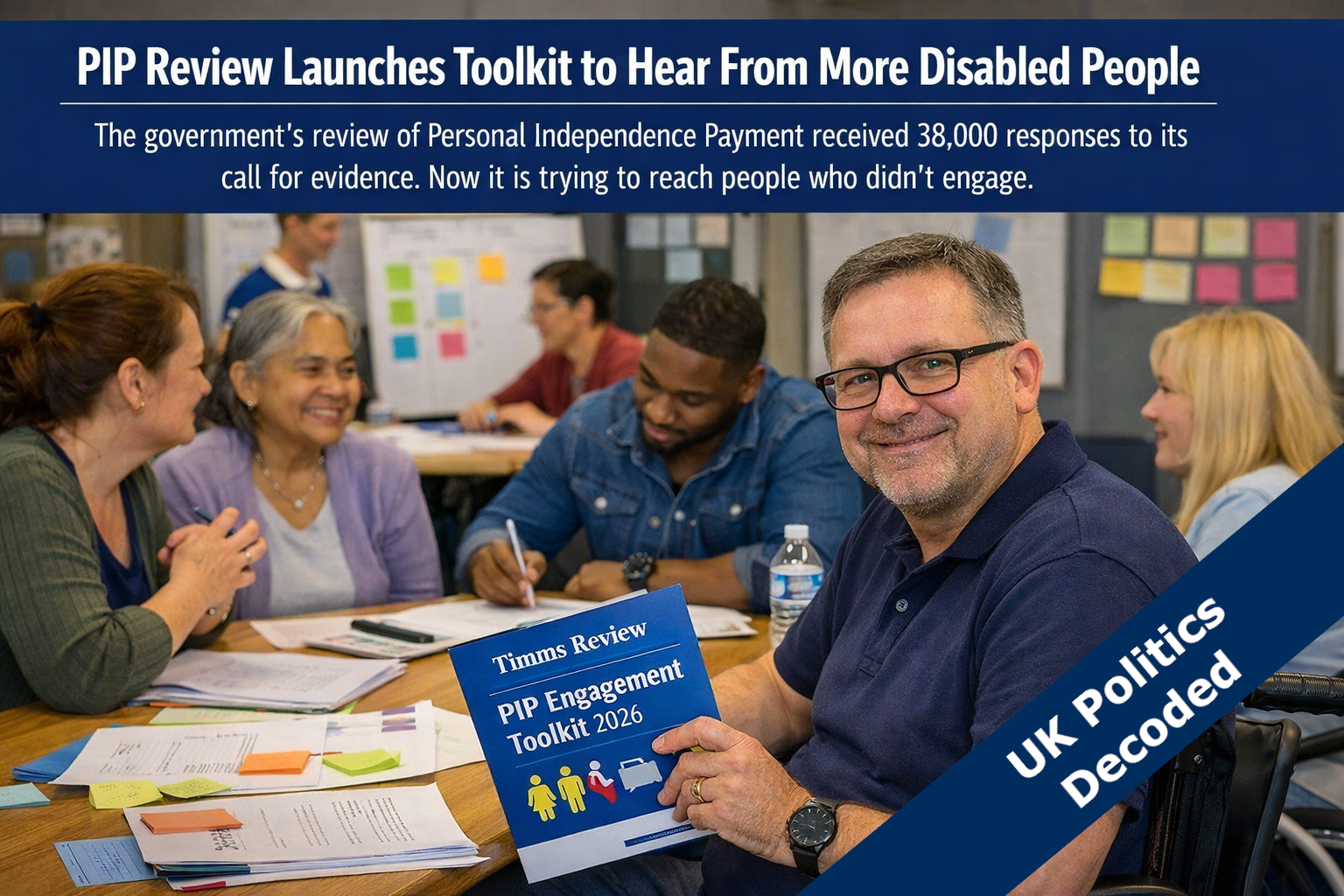
The Timms Review named after Sir Stephen Timms, the Minister for Social Security and Disability who is co-chairing it closed its public call for evidence on 28 May 2026. That process drew 38,000 responses. On 8 June, the DWP announced a new phase, a downloadable "Workshop in a Box" toolkit that lets charities, disabled people's organisations, and community groups run their own structured consultation sessions and submit findings directly to the review's steering group.
Key Facts
- What it is: A ready to use engagement pack for organisations to run workshops with disabled people and those with long term health conditions.
- Three themes: What PIP is for, what it is like to apply, and how decisions are made.
- Deadline: Organisations must submit their findings by 17 July 2026.
- Information sessions: The DWP is running online sessions on 10 and 16 June to help organisations run their workshops.
- Who can take part: Anyone, including disabled people's organisations, health charities, community groups, and elected representatives.
Second engagement phase
Formal public consultations, however well publicised, tend to reach people who are already confident engaging with government processes. Written submissions favour those with time, literacy support, and the energy to navigate official channels. For many disabled people, particularly those with severe conditions, cognitive impairments, or limited English, the standard call for evidence format is a genuine barrier.
Co-chair Sharon Brennan said the new method was designed to reach people who have "conversations that matter with the organisations that they most trust." Her point is that a community group, a local disability charity, or a drop in centre carries a kind of trust that a government website does not. The workshop format is intended to use that trust to gather views that would not otherwise make it into the review.
A small number of organisations have been approached by the DWP and offered financial support to run workshops specifically targeting marginalised or underrepresented communities. The government has not published a full list of those organisations.
The pack is structured around three themes. The first is the purpose of PIP, what the benefit is actually for, and whether recipients feel it reflects the real costs of living with their conditions. The second is the application process, which has been a sustained source of criticism from disability charities and claimants for years. Assessment processes, waiting times, the reliance on paper based evidence, and the distress caused by face to face assessments have all featured heavily in previous research. The third theme is decision making, how eligibility is determined, why so many decisions are overturned at appeal, and whether the criteria are understood by those applying.
Organisations are encouraged to adapt the materials for carers, advisors, and others who have relevant knowledge and experience of the system, not only PIP recipients themselves.
The wider review
The Workshop in a Box is one of six evidence strands feeding into the Timms Review. The others are, analysis of existing data and research, new quantitative survey research, expert evidence sessions and deliberative events. The steering group will use the combined findings to inform recommendations it expects to submit to the Secretary of State for Work and Pensions in autumn 2026. An interim report is expected before then.
The Review's Six Evidence Strands
- Existing data and research: DWP analysis of current evidence on PIP and disability.
- Quantitative survey: New research commissioned by the review.
- Expert evidence: Structured sessions with clinicians, academics, and policy specialists.
- Deliberative events: Facilitated discussions with disabled people.
- Call for evidence: 38,000 responses received. Closed 28 May 2026.
- Workshop in a Box: Community run sessions feeding in by 17 July 2026.
The review is explicit that PIP will remain a non-means tested cash benefit. The government has committed to that. What is less settled is how eligibility should be determined, how the assessment process should work, and whether the current criteria still accurately reflect the conditions and circumstances of the people claiming it today.
Those questions carry significant political weight. The caseload growth in PIP driven partly by mental health conditions, neurodivergent conditions, and fluctuating health has become a central tension in welfare policy. The government faces competing pressure to control expenditure and to protect support for those who need it. The Timms Review is supposed to navigate that tension by grounding any changes in evidence gathered directly from disabled people.
Whether the workshop format, with a submission deadline of 17 July and an interim report due within months, leaves enough time to genuinely process and act on what organisations feed back remains to be seen.
Key Takeaways
- The Timms Review of PIP has launched a Workshop in a Box toolkit to reach disabled people who did not engage with the formal call for evidence.
- Any organisation can run a session. Workshop findings must be submitted to the review by 17 July 2026.
- Online information sessions for organisations wanting to participate are on 10 and 16 June.
- The review aims to report to the Secretary of State in autumn 2026, with an interim report expected sooner.
- PIP will remain a non-means tested cash benefit, the review is focused on eligibility criteria, the assessment process, and how decisions are made.