AI Use: AI tools were used to support source discovery and to structure the article for clarity. All research, verification, drafting, and final editorial decisions are fully human led. Learn about our AI policy.
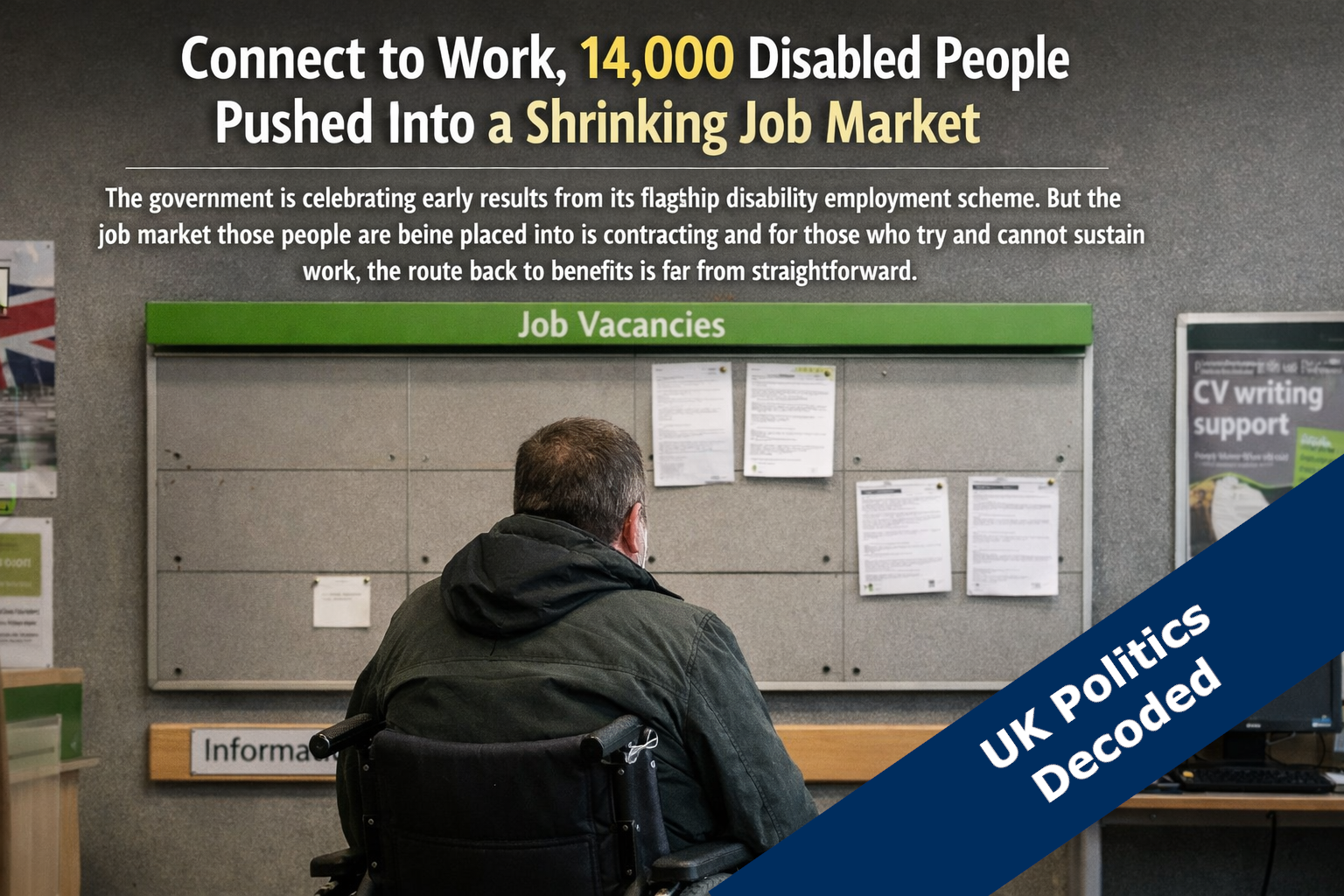
The Department for Work and Pensions announced on 11 June 2026 that 14,000 people had started on the Connect to Work programme since it launched in April 2025. Of those, 1,600 who were out of work at the time they joined have since started a job. The government described this as encouraging early data for a scheme that is still in its first year, and confirmed it is on track to support 300,000 people across England and Wales by the end of the decade.
Connect to Work is a voluntary, locally commissioned employment support scheme, backed by £1 billion over this parliament, sitting within the government's broader £3.5 billion Pathways to Work package. It offers one to one support from specialist advisers meeting participants wherever feels comfortable, whether that is a GP surgery, a community hub, or a local café and participants do not need to be claiming benefits to take part. The programme covers everything from CV writing to direct employer engagement and post employment support to help people stay in their roles.
Connect to Work, First Year Figures
- Started on programme: 14,000 participants between April 2025 and March 2026.
- Into employment: 1,600 out of work participants started a job.
- Young participants: Over a quarter of starts were people aged 16 to 24.
- Coverage: Now active across England and Wales, with the final funding agreement for South East Wales (up to £32.5m) confirmed alongside this announcement.
- Target: 300,000 people supported by the end of the decade.
A tightening job market
The political framing around Connect to Work is one of unlocking potential and breaking down barriers to opportunity. What it does not address is the state of the labour market those people are being placed into.
According to the Office for National Statistics, there were an estimated 705,000 job vacancies in the UK during February to April 2026, a fall of 28,000 (3.9%) on the previous quarter, and 54,000 (7.1%) below the same period a year earlier. That figure is the lowest recorded since February to April 2021. Across the year, vacancies fell in 13 of the 18 industry sectors tracked by the ONS, and in four of the five employment size bands. The total number of vacancies is now more than 10% below the pre-pandemic level of early 2020.
This is not a short term blip. The ONS data shows a sustained contraction that has been running for more than a year, following the post pandemic hiring surge. Geopolitical uncertainty and economic pressures have led employers to delay recruitment decisions. Sectors that once absorbed large numbers of entry level workers, retail, hospitality, construction, have all seen some of the steepest declines.
ONS Job Vacancies: Key Figures (February-April 2026)
- Total vacancies: 705,000, the lowest since February-April 2021.
- Quarterly fall: Down 28,000 (3.9%) from November 2025-January 2026.
- Annual fall: Down 54,000 (7.1%) on the year.
- Versus pre-pandemic: More than 83,000 (10.6%) below January-March 2020 levels.
Fewer vacancies means more competition for each available role. For disabled people or those with long term health conditions, whose employability is often constrained by specific accessibility needs, working hours, or the physical or cognitive demands of available work, a tighter job market does not just mean it takes longer to find a job. It may mean that suitable jobs simply are not there at all.
When work does not work out
Connect to Work continues to offer support once participants are in a job, with advisers working to help people stay in their roles. That matters, because the transition into work for someone with a long term health condition is rarely straightforward. Conditions fluctuate. Jobs that initially seem manageable can become unsustainable. Employers who appeared supportive during recruitment may not extend the same flexibility once a person is in post.
When a disabled person finds that their health condition cannot accommodate the demands of a role, or that competition in the job market means they cannot find work that fits their needs they face a problem. To access welfare support, they typically have to go through the Work Capability Assessment (WCA) process again.
The WCA determines whether a claimant has limited capability for work, and it is notoriously slow. There is a significant backlog, with many claimants waiting well beyond the standard assessment window. The government announced in its autumn 2025 budget that it would increase WCA reassessment capacity, with plans to conduct an additional 122,000 assessments for existing claimants by 2029-30. That expansion is being explicitly framed as a cost saving measure, not purely a support improvement. The government's own projections show that reassessments are expected to remove a substantial number of people from the Universal Credit health element, the payment that supports those assessed as having limited capability for work related activity.
For someone who entered work in good faith through a scheme like Connect to Work, found it unsustainable, and now needs to claim again, the process they must restart is the same one they already went through and one that, by the government's own planning, is being accelerated partly to cut costs.
What the government says
- Voluntary: Connect to Work is not mandatory. No one is compelled to take part.
- Post employment support: Advisers continue working with participants after they start a job.
- Personalised matching: Jobs are matched to individual health needs and circumstances.
- Wider package: Connect to Work sits alongside WorkWell and Pathways to Work advisers within a £3.5bn employment support package.
What the data shows
- Vacancy contraction: 705,000 vacancies, the lowest in five years and still falling.
- Reassessment expansion: 122,000 additional WCAs by 2029-30, explicitly tied to welfare savings.
- Youth competition: Youth unemployment stands at 14.3%, with young people competing for the same entry level roles.
- Backlog pressure: Significant delays remain in the WCA process for those who need to re-enter the benefit system.
The gap between the headline and the reality
There is nothing in the Connect to Work model that is, on its face, unreasonable. Personalised, voluntary employment support for disabled people and those with complex barriers is not a bad idea. Some of the 1,600 people who have found work through the scheme will be in sustainable, meaningful employment that genuinely improves their lives.
But the government's press release is presented against a backdrop it does not mention. When 2.8 million people are out of work due to ill health, and total job vacancies are at their lowest in five years, pushing more people into the labour market is not automatically a route out of poverty. It can become a route into a different, more precarious kind of it, short term work that ends, followed by a re-engagement with a welfare system that is simultaneously being squeezed and accelerated.
Work Pensions Secretary Pat McFadden said that Connect to Work is "built on a simple belief that with the right support, people can and do get into work." That belief is not wrong. But getting into work and staying in work are different things, and the stability of that outcome depends heavily on what the job market looks like and what happens when the job does not last.
Key Takeaways
- Connect to Work has supported 14,000 participants in its first year, with 1,600 starting employment but the programme is still at an early stage and numbers are expected to grow significantly.
- UK job vacancies stood at 705,000 in February–April 2026, the lowest level since 2021 and more than 10% below pre-pandemic levels, with declines across most sectors.
- Disabled people and those with health conditions face the tightest labour market in years, where competition for accessible, suitable roles is more intense than at any point since the post pandemic recovery ended.
- Those who enter work and find it unsustainable typically have to restart the Work Capability Assessment process, a system with a significant backlog that the government is simultaneously accelerating as part of its welfare cost saving plans.
- The WCA is planned for abolition in 2028, to be replaced by eligibility linked to the PIP daily living component but that transition depends on the outcome of the Timms Review, which has not yet reported.
Sources & Further Reading
- GOV.UK – Thousands moved closer to work with support from landmark employment scheme (11 June 2026) Archived copy: UK Politics Decoded archive
- ONS – Vacancies and Jobs in the UK, May 2026 Archived copy: UK Politics Decoded archive
- ONS – Labour Market Overview, UK: May 2026 Archived copy: UK Politics Decoded archive
- Child Poverty Action Group – Welfare reform: health related and disability benefits
- Disability Rights UK – Work Capability Assessment