AI Use: AI tools were used to support source discovery and to structure the article for clarity. All research, verification, drafting, and final editorial decisions are fully human led. Learn about our AI policy.
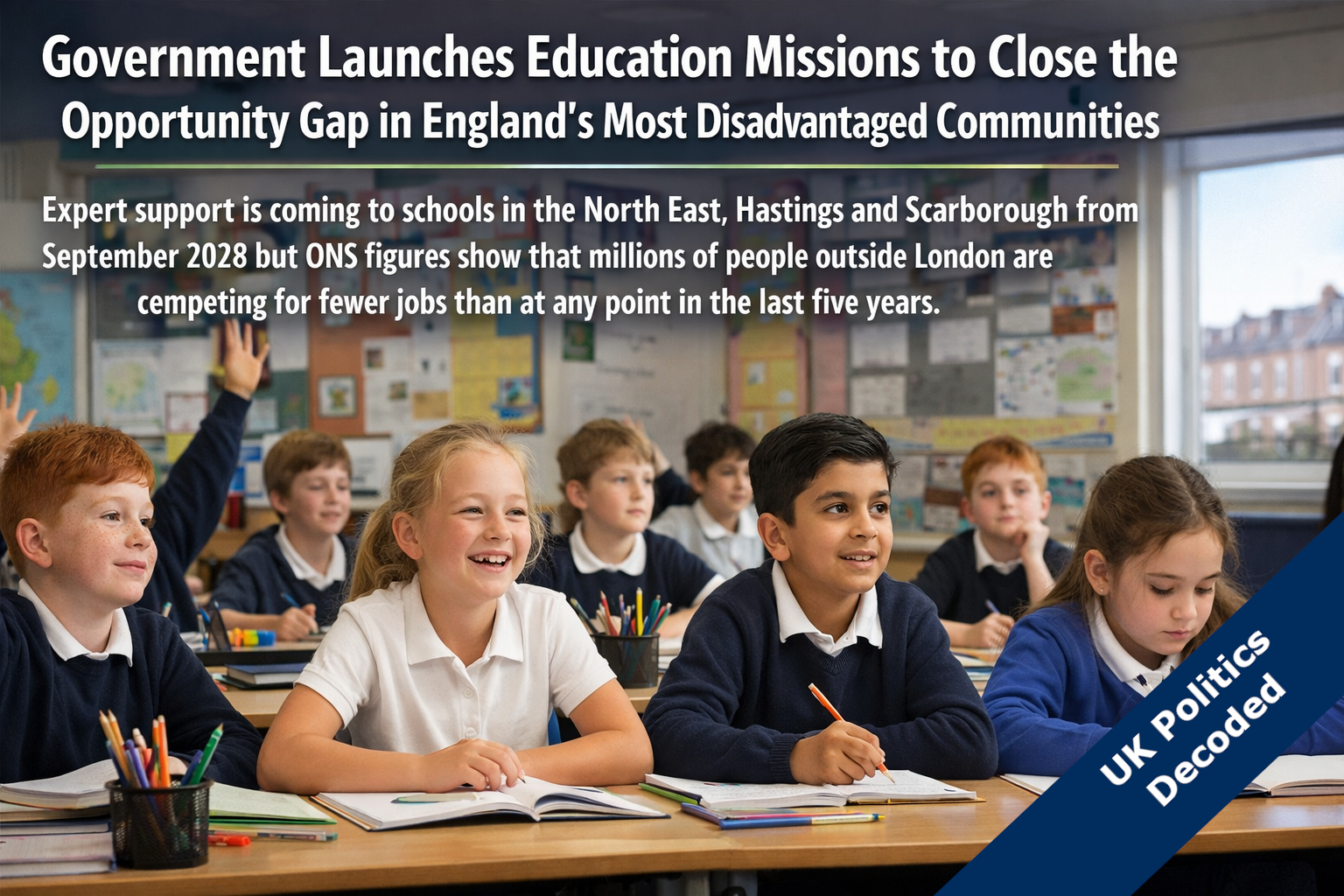
The government has announced two new targeted education programmes Mission North East and Mission Coastal that will send expert practitioners into schools in some of England's most persistently underperforming communities from September 2026. The announcement, made by Education Secretary Bridget Phillipson on 10 May 2026, forms part of the government's Schools White Paper and its stated ambition to halve the disadvantage gap for the current generation of children in England.
The programmes target three specific areas, the North East region, Hastings in East Sussex, and Scarborough in North Yorkshire. All three have been identified on the basis of exam result data that shows children from disadvantaged backgrounds performing well below the national average in some cases, scoring roughly half what their better off peers achieve at GCSE level.
Key Points at a Glance
- What was announced: Two new place based education programmes, Mission North East and Mission Coastal, launching September 2026 in the North East, Hastings and Scarborough.
- What they will do: Deploy expert education practitioners directly into schools, create clusters of schools learning from each other, and build partnerships with employers, sports clubs and community organisations.
- What the data shows: Disadvantaged pupils in Hastings average an Attainment 8 score of 26.0 and in Scarborough around 27.0, against a national average of 46.0.
- The model: Based on the London Challenge, a 2003 programme widely credited with transforming outcomes in the capital's most deprived schools.
- The jobs context: ONS figures show UK job vacancies fell to 711,000 in January to March 2026 the lowest level since early 2021 and now below prepandemic levels with the sharpest falls in the small businesses that dominate employment in these communities.
What the Government Has Announced
Both missions are designed around a model the government describes as "Test, Learn and Grow". Rather than a fixed programme rolled out uniformly, the approach is intended to identify what works quickly in each local context, share those lessons back into national policy, and eventually extend the model to similar communities across England.
What the Missions Will Deliver
The programmes have three interconnected elements:
- Expert practitioners in schools: Specialist education professionals will work directly with school leaders and teachers to build classroom capability and raise standards, rather than imposing a top down inspection or intervention model.
- School clusters: Local schools will be grouped together to share knowledge and approaches, with the explicit aim of making collaboration the norm rather than the exception in areas where schools have historically worked in isolation.
- Community partnerships: New connections with local employers, sports clubs, faith groups and youth organisations will provide children with mentoring, careers guidance and enrichment activities beyond the school gates.
The Legislation Behind the Missions
The missions sit within a broader legislative and policy framework that has already taken effect:
What Is Already in Law and Policy
- Children's Wellbeing and Schools Act 2026: Now on the statute book, this Act introduced free breakfast clubs in all primary schools in England and placed new limits on the cost of branded school uniform items reducing direct costs of education for low income families.
- Schools White Paper (April 2026): Sets the government's ten year vision for education, including the target to halve the disadvantage gap, recruit 6,500 more teachers, and ensure every child benefits from an enrichment entitlement.
- Mission North East and Mission Coastal: Named explicitly in the White Paper as place based pilots, these are now the first two missions to be formally launched with a confirmed September 2026 start date.
- Coastal expansion planned: The government intends to form a wider alliance of other coastal areas with similar challenges over time, using the Hastings and Scarborough experience as a blueprint.
Why These Communities, and Why the Data Is Stark
The three target communities were selected on the basis of Attainment 8 scores a measure of GCSE performance across eight subjects that is used as the main indicator of secondary school outcomes in England. The government's own figures make the scale of the problem clear.
The Attainment Gap in Numbers
The disparity between the national average and outcomes in the target areas is significant:
Attainment 8 Scores: How These Areas Compare
- National average: 46.0, the benchmark all schools in England are measured against.
- North East region: The lowest performing region in England, sitting 1.9 points below the national average at 44.1.
- Disadvantaged pupils in Hastings: An average score of just 26.0, approximately 43% below the national average.
- Disadvantaged pupils in Scarborough: An average score of around 27.0, similarly well below the national figure.
- Disadvantaged White British pupils nationally: An average score of 30.9, compared with 48.6 for their better off peers, a gap the Education Secretary described as "a generational injustice".
The London Challenge Precedent
The government has been explicit that these missions are built on the model of the London Challenge, launched in 2003. That programme concentrated expert led, place based support in London's most deprived schools over a sustained period. It is now widely credited with transforming outcomes in what were, at the time, some of the worst performing schools in England. The government's argument is that the same intensive, locally rooted approach can work in the North East and in coastal communities, areas that have not previously received comparable levels of targeted support.
Education Secretary Bridget Phillipson, who grew up in the North East, said: "I grew up in the North East and know the challenges families face. I want every child there, and in coastal communities like Hastings and Scarborough, to have the same opportunities I was lucky enough to have. That is not a matter of ability. It is a matter of justice."
The Wider Picture: A Shrinking Job Market Outside London
The education missions are being launched at a moment when the employment landscape outside London and the South East is contracting. Office for National Statistics (ONS) data published in April 2026 shows that the post pandemic recovery in job vacancies has fully reversed and that the areas the government is targeting with these programmes are among those most exposed to the wider jobs squeeze.
What the ONS Vacancy Data Shows
The ONS Vacancies and Jobs in the UK bulletin, released 21 April 2026, contains several figures relevant to the communities these missions are targeting:
The Headline Figures
- Total UK vacancies: Fell to 711,000 in January to March 2026, a decrease of 29,000 (3.9%) on the previous quarter and the lowest level since February to April 2021.
- Year on year fall: Vacancies are down 65,000 (8.3%) compared with the same period in 2025, falling in 14 of 18 industry sectors.
- Below prepandemic levels: Total vacancies are now 78,000 (9.9%) below the January to March 2020 level, meaning the recovery from Covid has fully unwound.
- Unemployment to vacancy ratio: There are now 2.5 unemployed people for every available vacancy, up from 2.0 a year ago meaning competition for available jobs has intensified significantly.
The Small Business Problem
- Sharpest falls in smallest employers: Businesses with 1 to 9 employees accounted for 21,000 of the overall 29,000 quarterly fall in vacancies, a 16.8% drop in a single quarter.
- Why this matters locally: Small businesses are the dominant source of employment in communities like the North East, Hastings and Scarborough, where large corporate employers are relatively scarce.
- Hardest hit sectors: Construction fell 38.7% on the year; arts, recreation and entertainment fell 25.7%, both sectors significant for the coastal towns targeted by Mission Coastal.
- Only large employers stable: The only size band to show any increase in vacancies was businesses with 2,500 or more employees, organisations rarely present in the communities these missions serve.
What This Means in Context
The ONS data does not provide a regional breakdown of vacancies in this release. But the structural picture is consistent with what has been documented over many years in post industrial and coastal areas, economic activity and job creation are concentrated in London and the South East, while communities like those targeted by the new education missions face a shallower pool of local employment opportunities.
Better qualifications increase an individual child's ability to compete for jobs in that constrained market. They do not, by themselves, create more jobs. That distinction matters for how the government's wider economic and education agendas connect and whether children who do benefit from Mission North East and Mission Coastal find that better exam results translate into meaningful opportunity when they leave school.
Conclusion: Real Policy, Honest Limitations
Mission North East and Mission Coastal are evidence based, targeted programmes responding to a documented and longstanding injustice in educational outcomes. The attainment data is not contested, and the London Challenge model on which they are based has a genuine track record of improving outcomes in deprived communities.
The programmes begin from September 2026. Their impact on exam results will take years to measure fully. The government's ambition to halve the disadvantage gap for this generation is ambitious by any standard, and there is no guarantee the London Challenge model will transfer to post industrial and coastal communities in the same way it worked in London.
What the ONS vacancy data adds to the picture is not a reason to dismiss the education missions, but a reason to take the wider economic context seriously alongside them. The children these programmes are designed to help are growing up in communities where the number of jobs available to them, when they eventually leave school with better qualifications, is currently falling, not rising.
Key Takeaways
- Mission North East and Mission Coastal were announced on 10 May 2026 and will launch in September 2026, targeting schools in the North East region, Hastings and Scarborough.
- They are based on the London Challenge model, which transformed outcomes in London's most deprived schools from 2003 onwards.
- Disadvantaged pupils in Hastings average an Attainment 8 score of 26.0 and in Scarborough around 27.0, against a national average of 46.0, with disadvantaged White British pupils nationally averaging 30.9 compared with 48.6 for their peers.
- ONS figures show UK job vacancies fell to 711,000 in January to March 2026, the lowest since early 2021 and now below prepandemic levels, with the sharpest falls in the small businesses that dominate employment in these communities.
- The programmes sit within the government's Schools White Paper and the Children's Wellbeing and Schools Act 2026, which also introduced free breakfast clubs in all primary schools and new limits on branded uniform costs.
Sources & Further Reading
-
GOV.UK - New missions to transform childhoods of most disadvantaged (10 May 2026, Department for Education)
Archived copy (OGL): archived page -
GOV.UK - Every Child Achieving and Thriving: Schools White Paper (Department for Education, April 2026)
Archived copy (OGL): archived page -
legislation.gov.uk - Children's Wellbeing and Schools Act 2026 (2026 c. 21)
Archived copy (OGL): archived page -
ONS - Vacancies and Jobs in the UK: April 2026 (Office for National Statistics, released 21 April 2026)
Archived copy: archived page