AI Use: AI tools were used to support source discovery and to structure the article for clarity. All research, verification, drafting, and final editorial decisions are fully human led. Learn about our AI policy.
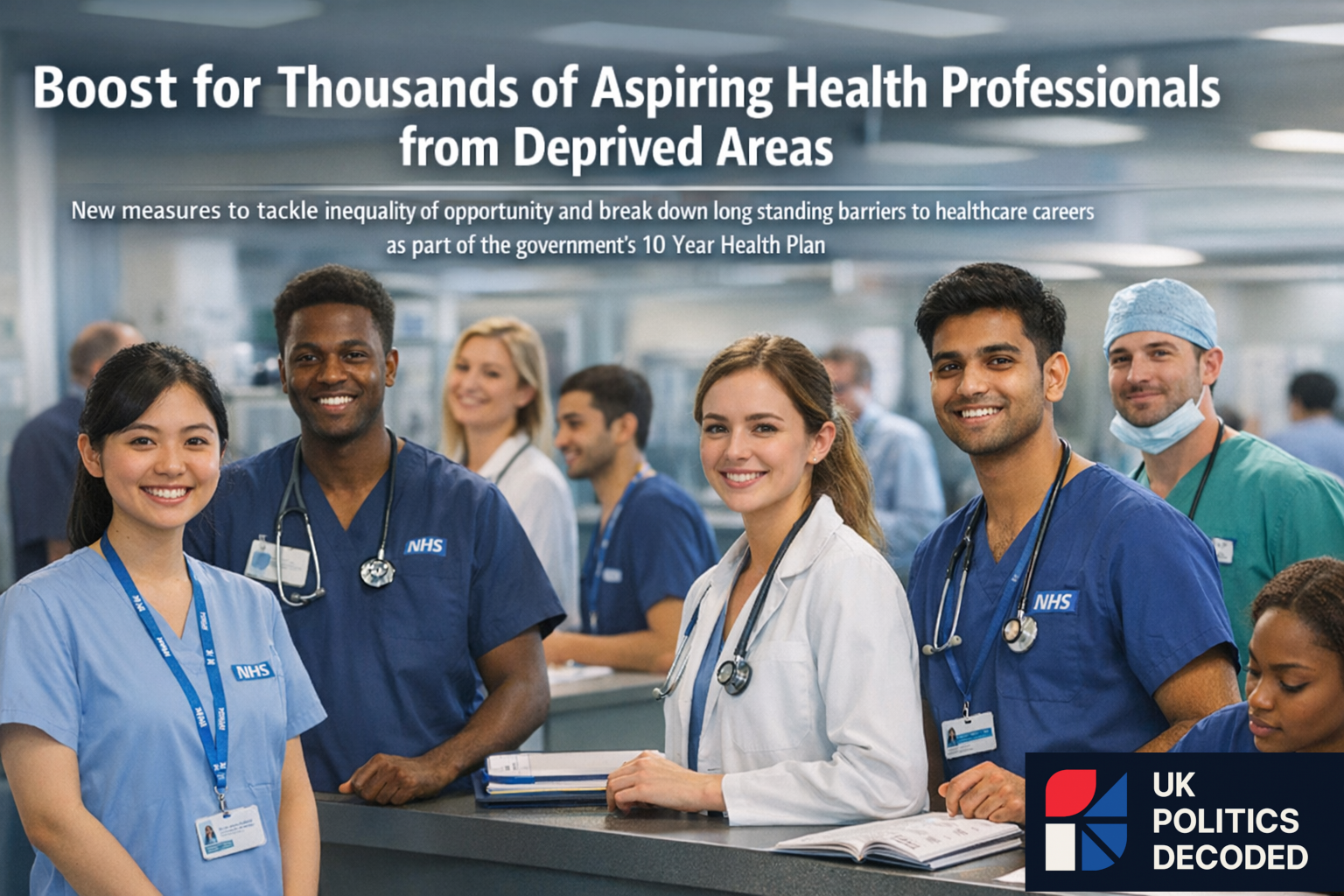
The Government has announced a comprehensive package to break down long standing barriers into NHS healthcare careers, targeting young people from England's most deprived communities. The measures published on 17 April 2026 as part of the 10 Year Health Plan include 2,000 new nursing apprenticeships, government funded medicine access courses for 2,000 students, and a pledge to increase the proportion of free school meal recipients entering medical school by 50% by 2035.
The announcement responds to stark structural inequality in healthcare recruitment. Data shows one third of schools have never had a pupil apply to medical school, and around half have never had a student accepted, suggesting the problem runs far deeper than individual aspiration and reflects systemic gaps in early guidance, subject selection, and financial access.
Package at a Glance
- 2,000 nursing apprenticeships: Backed by £65.4 million, concentrated in areas with the highest deprivation and nursing shortages
- 2,000 medicine access course places: Supported by £2.3 million over three years for students from England's most deprived areas
- 50% free school meal target: Pledge to increase FSM students accepted into medical school by 2035
- 3,000 NHS entry level placements: £15 million to expand pathways into back office and support roles
- Resident Doctor pilot: Three year programme letting doctors from disadvantaged backgrounds stay in one location longer to cut relocation costs
What the Package Contains
The measures operate across three distinct entry points into healthcare nursing, medicine, and entry level NHS roles reflecting an acknowledgement that the barriers to each are different and require targeted interventions rather than a single policy lever.
Nursing Apprenticeships
The largest single element is the creation of 2,000 new nursing apprenticeships, funded by £65.4 million:
- Earn while you learn model: Apprentices receive a salary while training, eliminating upfront tuition costs
- Geographic targeting: Placements concentrated in areas with the worst nursing shortages and highest deprivation indices
- Delivery partnerships: NHS trusts working with higher education institutions and local training providers
- No relocation requirement: Designed so trainees can build careers without leaving their communities
- Workforce planning alignment: Targeted at areas where nursing shortfalls have the greatest impact on local services
Medicine Access Courses
For aspiring doctors, a separate £2.3 million fund will support 2,000 young people from England's most deprived areas to apply to university medical courses over three years:
What Medicine Access Courses Offer
- Summer schools: Intensive preparation to build academic knowledge and university application skills
- NHS placements: Work experience opportunities within health settings to strengthen personal statements
- Partner organisations: Delivered through NHS England with the Sutton Trust, Social Mobility Foundation, and Medical Schools Council
- Proven track record: Existing NHS funded partnerships have seen around 75% of participants go on to study medicine or related degrees
The Scale of the Problem
The policy is a direct response to entrenched inequality in who enters healthcare. The government's own data makes the structural nature of the problem clear, and points to early years guidance and subject choices as critical failure points not just financial barriers at the point of university application.
School Level Disparities
The headline statistics reveal how concentrated medical school applications are in a narrow band of schools:
Key Inequality Data
- One third of schools: Have never had a single pupil apply to medical school
- Half of schools: Have never had a student accepted into medical school
- Subject gap: Disadvantaged schools less likely to steer students towards biology, chemistry, and physics essential prerequisites for medicine
- Knowledge gap: Families in deprived communities often lack the navigational knowledge to guide students towards healthcare career pathways
- Relocation costs: Junior doctors from disadvantaged backgrounds disproportionately affected by the financial burden of rotational training moves
Why the Gap Persists
The problem is self reinforcing, schools that have never produced medical applicants have no staff experience to draw on, and students from those schools have no visible role models to signal that medicine is an achievable path. The government's package attempts to interrupt this cycle at multiple points.
- Early subject guidance: The medicine access courses aim to reach students early enough to influence A level choices
- Visibility and aspiration: NHS placements give students direct exposure to health careers they may never have considered
- Financial barrier removal: Apprenticeships eliminate the debt burden that deters many from nursing degrees
- Geographic anchoring: Allowing nurses and doctors to train locally removes the relocation costs that compound financial disadvantage
- Institutional partnerships: Working through the Sutton Trust and Social Mobility Foundation brings established expertise in widening participation
Medical School Reform and the FSM Pledge
Beyond the immediate measures, the government has committed to structural changes to how and where medical school places are distributed, with a specific long term target tied to free school meal eligibility as a proxy for socioeconomic disadvantage.
Reallocation of Medical School Places
The government plans to expand or reallocate medical school places to better match population need:
Geographic Rebalancing
- Poorer health outcomes: Areas with higher disease burden to gain more training places
- Ageing populations: Regions with higher elderly populations prioritised for local doctor training
- Local retention: Doctors trained locally more likely to remain and practice locally
- Workforce planning: Aligning training supply with projected regional demand
The FSM 50% Pledge
- Baseline target: 50% increase in FSM students accepted into English medical schools by 2035
- Proxy measure: Free school meal eligibility used as a socioeconomic disadvantage indicator
- Decade timeline: Long term commitment signalling sustained policy intent beyond a single parliament
- Accountability mechanism: Creates a measurable benchmark for progress reporting
Resident Doctor Pilot Programme
A three year pilot will allow Resident Doctors from disadvantaged backgrounds to remain in one location for longer during their training rotations, addressing a financial pressure unique to medicine
- Rotational training burden: Standard NHS junior doctor training requires moves between hospitals and regions every few months
- Relocation costs: Each move involves deposits, removal costs, and temporary accommodation disproportionately affecting those without family financial support
- Family disruption: Repeated moves strain relationships and make it harder to maintain support networks
- Pilot scope: Three year programme to test whether geographic stability improves recruitment and retention from disadvantaged backgrounds
- Evidence gathering: Results will inform whether the approach is rolled out more broadly
NHS Entry Level Roles and the Broader Workforce Strategy
The package extends beyond traditional clinical training pathways. A separate £15 million strand targets the thousands of back office, administrative, and support roles that form the NHS's operational backbone and which offer a realistic first step into the health service for people without prior qualifications.
Entry Level NHS Pathways
The £15 million programme builds on a scheme that has already demonstrated strong demand
Programme Scale
- Target cohort: Around 3,000 young people from deprived communities into NHS roles or training
- First year performance: Nearly 3,500 people were offered care paths into the health service in year one, exceeding the initial target
- Role types: Vital back office and support functions, not only clinical positions
- Progression routes: Entry level positions designed as stepping stones to further training and qualification
Wider Policy Connections
- Maintenance grants: Minister for Skills Jacqui Smith confirmed reintroduction of maintenance grants for most disadvantaged students
- Two thirds ambition: Government target for two thirds of young people to be on a gold standard apprenticeship or at university by age 25
- 10 Year Health Plan: Measures explicitly framed as part of the long term NHS workforce strategy
- Spring 2027 launch: Medicine access course applications to open from spring next year
What Ministers Said
The announcement drew senior ministerial statements that framed the policy in explicitly personal and class based terms:
- Wes Streeting (Health Secretary): "Talent is everywhere in our country, but opportunity isn't" and referenced his own experience growing up in poverty on a council estate before attending Cambridge University
- "Break the class ceiling": Streeting's phrase positioned the NHS as an institution that must become "elite, not elitist"
- Duncan Burton (Chief Nursing Officer): Highlighted apprenticeships as opening nursing to people with "the skills, commitment, and compassion to care for patients" who might not otherwise consider the NHS
- Jacqui Smith (Skills Minister): Confirmed maintenance grant reintroduction and stated that "aspiration and hard work should decide a young person's future"
- Framing choice: The emphasis on personal ministerial experience (Streeting's council estate background) signals an intent to make the policy feel authentic rather than technocratic
Policy Context: Social Mobility and the NHS Workforce
The announcement sits within a broader government agenda on social mobility and NHS workforce planning. It connects the 10 Year Health Plan's staffing goals directly to the wider mission of reducing inequality of opportunity a framing that distinguishes it from purely operational workforce policies.
Why the NHS Workforce Has a Diversity Problem
Healthcare, and medicine in particular, has long standing under representation of people from lower socioeconomic backgrounds:
Structural Barriers to Healthcare Careers
- A level prerequisites: Biology, chemistry, and physics requirements for medicine are less commonly offered or encouraged in schools serving deprived areas
- Application knowledge gap: Medical school applications are complex, students without guidance from schools or families with medical professionals are at a systematic disadvantage
- Debt aversion: Nursing degree costs have historically deterred applicants from low income households, a problem exacerbated by the removal of bursaries in 2017
- Geographic concentration: Medical schools and teaching hospitals are clustered in certain cities, requiring relocation that is financially prohibitive for many
- Role model deficit: Without visible peers or family members in healthcare, aspiration to medical careers is harder to cultivate
Connecting Workforce Planning to Social Policy
The government's framing explicitly links NHS staffing needs to the social mobility agenda arguing that a more diverse workforce is not only fairer but functionally better for patients:
- Workforce shortfalls: Nursing shortages in deprived areas are both a recruitment problem and a consequence of low local supply of trained professionals
- Local workforce retention: Evidence suggests healthcare workers trained locally are more likely to remain in local services, addressing geographic maldistribution of staff
- Patient connection: A workforce that reflects the communities it serves may improve trust and healthcare seeking behaviour among underserved populations
- Dual dividend: Tackling healthcare career inequality simultaneously addresses NHS staffing gaps and reduces broader inequality
- 10 Year Health Plan integration: Workforce diversity positioned as a core component of long term NHS sustainability, not a separate equality initiative
Conclusion: A Meaningful Start, but Long Term Commitment Will Define Success
The government's package is one of the most comprehensive attempts in recent years to address social mobility barriers in healthcare careers simultaneously across nursing, medicine, and entry level roles. The combination of financial support (apprenticeships, maintenance grants), structural reform (medical school place reallocation), and direct intervention (access courses, NHS placements) reflects a more systems level approach than previous initiatives.
The headline numbers, 2,000 nursing apprenticeships, 2,000 medicine access course places, 3,000 entry level NHS pathways are substantial but must be seen in the context of a health system employing over 1.5 million people. The measures represent a meaningful injection of opportunity, but their impact will depend entirely on implementation quality, the depth of community outreach in genuinely deprived areas, and whether the apprenticeship placements translate into long term NHS careers rather than short term training completions.
The FSM 50% pledge and the medicine access course target are the most politically significant elements because they create measurable accountability benchmarks. If future governments choose to deprioritise this agenda, the data will show it. The Resident Doctor pilot is the most novel element addressing a financial barrier specific to medical training that has received little policy attention and its evaluation will be worth watching closely.
Key Takeaways
- 2,000 nursing apprenticeships backed by £65.4 million target areas with worst deprivation and nursing shortfalls, eliminating upfront training costs
- Medicine access courses backed by £2.3 million aim to reach students early enough to influence A level choices and university applications
- Government pledges a 50% increase in free school meal students entering medical school by 2035, creating a long term measurable accountability target
- Resident Doctor pilot addresses the largely overlooked financial burden of rotational training moves on doctors from disadvantaged backgrounds
- Success will depend on sustained political commitment beyond the current parliament and rigorous evaluation of whether access gains translate into genuine career outcomes
📚 Sources & Further Reading
- Gov.UK - Boost for thousands of aspiring health professionals from deprived areas Archived copy (OGL): archived webpage
- Commons Library - Research Briefing The 10 Year Health Plan for England Archived copy (OGL): archived webpage
- Gov.UK - Policy Paper - The 10 Year Health Plan for England Archived copy (OGL): archived webpage
- Commons Library - Research Briefing Full Report (PDF)