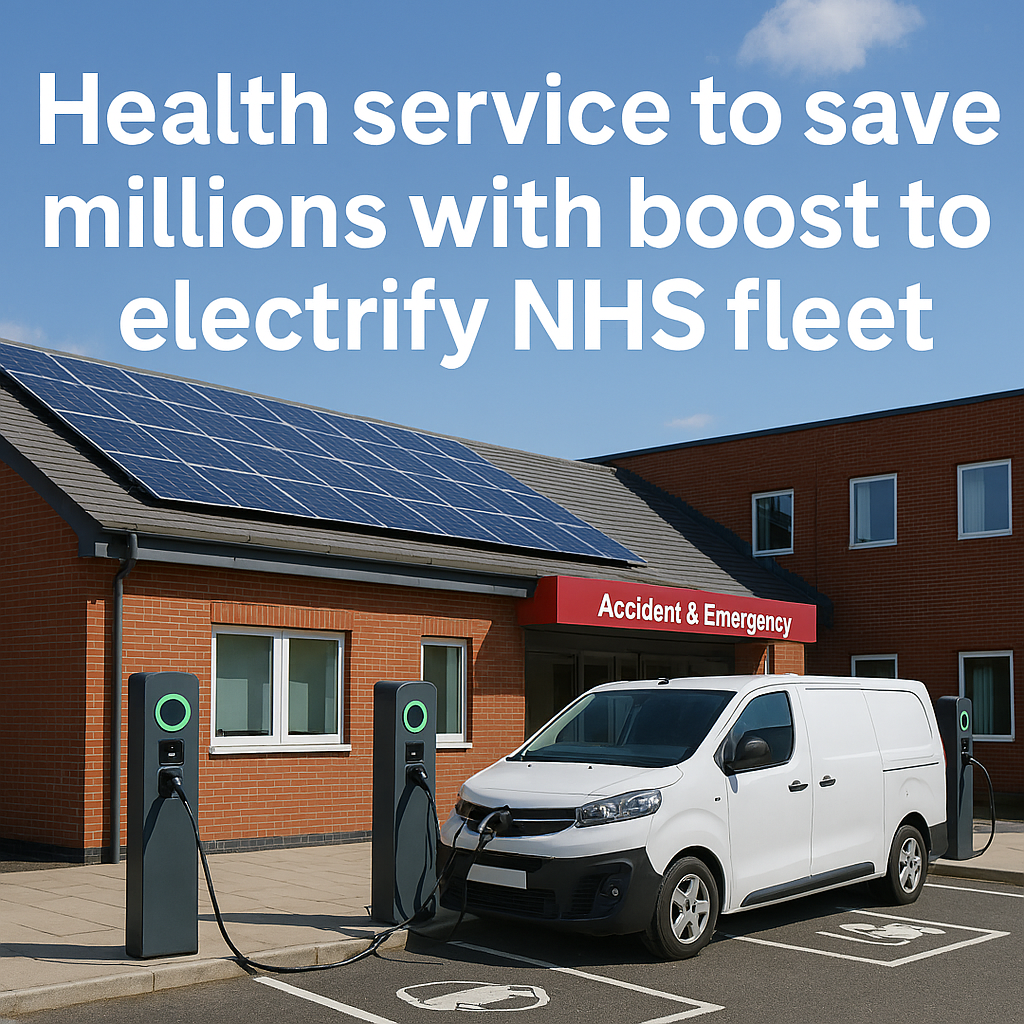
The Government has announced a further £4 million for the NHS Chargepoint Accelerator Scheme, expanding the rollout of electric vehicle (EV) charging infrastructure across NHS England. This brings total investment to £22 million, following earlier allocations of £10 million from the Department of Health and Social Care (DHSC) and £8 million from the Department for Transport (DfT).
The funding will support the installation of hundreds of new EV charging sockets, building on more than 1,000 chargers already delivered. These upgrades will help modernise the NHS's 20,000 vehicle fleet, which collectively covers 460 million miles each year, generating millions of pounds in fuel and maintenance cost savings that can be reinvested into frontline care.
🚗 Funding Package Overview
- £4 million additional funding for NHS Chargepoint Accelerator Scheme expansion
- £22 million total investment combining DHSC and DfT contributions
- 20,000 vehicle NHS fleet covering 460 million miles annually across England
- Hundreds of new charging sockets building on 1,000+ chargers already installed
- Millions in projected savings from fuel and maintenance cost reduction
🔌 What the Expanded Funding Will Deliver
The NHS Chargepoint Accelerator Scheme represents one of the UK's largest public sector fleet electrification programmes, targeting comprehensive charging infrastructure across NHS England's extensive healthcare estate.
Charging Infrastructure Expansion
The additional £4 million will accelerate charging point installation across NHS sites:
- Hospital charging hubs: Multi socket installations serving major acute trusts
- Community health centres: Smaller scale charging for local NHS services
- Emergency services integration: Dedicated charging for ambulance and urgent care fleets
- Staff vehicle provision: Charging infrastructure supporting NHS employee electric vehicles
- Visitor accessibility: Public charging contributing to local EV infrastructure
Fleet Modernisation Scale and Scope
The NHS England fleet represents significant electrification potential:
📊 Fleet Statistics
- 20,000 vehicles total across NHS England operations
- 460 million miles annually representing substantial fuel consumption
- Multiple vehicle types: Ambulances, patient transport, maintenance, and administration
- Geographic coverage: Urban and rural healthcare delivery across England
🎯 Modernisation Priorities
- Emergency service vehicles: Ambulance and rapid response fleet electrification
- Patient transport services: Non-emergency medical vehicle conversion
- Community care fleets: District nursing and home care vehicle electrification
- Support services: Maintenance, logistics, and administrative vehicle replacement
Operational Benefits Already Delivered
NHS England's Chief Sustainability Officer reports immediate improvements from existing electric vehicle deployment:
- Air quality enhancement: Reduced emissions around hospital sites improving patient and staff health
- Emergency response improvement: Faster acceleration and quieter operation for urgent care vehicles
- Maintenance cost reduction: Lower servicing requirements for electric drivetrains
- Reliability improvements: Reduced breakdown rates compared to diesel equivalents
- Staff satisfaction: Improved working conditions for drivers using electric vehicles
💰 Financial Impact: Millions in Cost Savings
Government ministers emphasise that electrifying the NHS fleet will generate substantial financial benefits, with long term savings expected to reach tens of millions annually that can be reinvested directly into frontline care.
💬 Minister of State for Health, Karin Smyth
"With cleaner vehicles and lower fuel bills for the NHS, everybody wins. Savings made from this investment will be redirected back to where they're needed, getting patients seen on time again.
With taxpayers getting more bang for their buck and more money for patient care, there is not just a moral case for this investment, but a pragmatic one, too.
This funding is clear proof we're upgrading and modernising the NHS and making it fit for the next century and beyond."
Fuel and Maintenance Cost Reduction
The scale of potential savings reflects the NHS fleet's extensive annual mileage:
- 460 million miles annually: Representing significant fuel consumption and cost
- Electric vehicle efficiency: Lower cost per mile compared to diesel and petrol
- Maintenance simplification: Fewer moving parts reducing servicing costs
- Predictable energy costs: Electricity pricing more stable than fossil fuel volatility
- Reduced breakdown costs: Higher reliability reducing emergency repair expenses
Reinvestment into Frontline Care
The Government links fleet electrification cost savings to broader NHS performance improvements:
📈 NHS Performance Context
- 5 million extra appointments delivered in the last year through efficiency improvements
- Waiting lists down by 330,000 since July 2024 through enhanced capacity
- 2.8% productivity growth between April and October 2025 from modernisation
- Cost reduction strategy: Operational savings enabling frontline service expansion
Long term Financial Sustainability
Ministers present fleet electrification as part of making the NHS "fit for the next century":
- Recurring cost reduction: Annual savings accumulating over vehicle lifespans
- Budget predictability: Stable electricity costs versus volatile fossil fuel prices
- Capital efficiency: Lower total cost of ownership for electric vehicles
- Investment multiplier effect: Savings enabling additional healthcare capacity
- Future proofing strategy: Avoiding stranded assets as EV adoption accelerates
🔋 Integration with NHS Solar Energy Strategy
The fleet electrification programme complements the Government's broader plan for NHS sites to receive Great British Energy solar installations, creating a coherent cost reduction model combining clean energy generation with efficient fleet operation.
Synergistic Cost Reduction Approach
The combined solar and fleet electrification strategy delivers multiple financial benefits:
Integrated Energy Cost Model
- Solar generation reduces NHS electricity bills: Lower costs for buildings and equipment operation
- Fleet electrification replaces diesel mileage: Cheaper electric operation across 20,000 vehicles
- On site solar offsets charging costs: Self generated electricity reducing net EV charging expenses
- Grid independence benefits: Reduced exposure to commercial electricity rate increases
Operational and Environmental Coordination
The NHS benefits from dual cost reduction across its estate and fleet:
- Daytime charging optimisation: Vehicle charging aligned with peak solar generation
- Grid balancing contribution: NHS sites supporting renewable energy integration
- Carbon footprint reduction: Clean generation powering clean transport
- Energy security enhancement: Reduced dependence on external energy suppliers
- Technology integration: Smart charging systems coordinating with solar output
Long term Infrastructure Vision
The combined approach positions the NHS as a leader in public sector decarbonisation:
- Financial resilience: Reduced recurring energy and fuel costs
- Technological modernisation: Advanced energy and transport systems
- Environmental performance: Significant carbon emission reductions
- Economic development: Supporting UK clean energy and automotive sectors
- Innovation demonstration: Proving public sector clean technology adoption
🌍 National EV Infrastructure Context
The NHS charging expansion occurs within a broader national EV infrastructure boom, with government reporting significant milestones in public charging availability.
National Charging Capacity Milestone
New figures show the UK now has 116,052 public EV chargers:
- Accurate counting methodology: Individual chargers recorded rather than multi socket devices
- Capacity milestone: More EV chargers than traditional fuel pumps nationally
- Infrastructure confidence: Supporting wider electric vehicle adoption
- Range anxiety reduction: Comprehensive charging network access
- Economic transition indicator: Infrastructure leading transport transformation
Government EV Support Framework
The NHS programme sits within comprehensive national EV promotion measures:
💷 Financial Support Measures
- £600 million national charging rollout funding comprehensive infrastructure
- £400 million local authority support delivering 100,000 local chargepoints
- Home and Workplace Grant expansion offering up to £500 off installation
- Electric Car Grant continuation providing up to £3,750 off eligible vehicles
🎯 Strategic Objectives
- Acceleration of EV adoption across households, businesses, and public services
- Running cost reduction for electric vehicle users
- Infrastructure confidence supporting purchase decisions
- Economic development in clean automotive and energy sectors
NHS as Public Sector Leadership
The NHS fleet electrification demonstrates public sector leadership in clean transport adoption:
- Scale demonstration: 20,000 vehicle fleet proving EV viability
- Cost savings validation: Public sector financial benefits from electrification
- Operational performance: Emergency services using electric vehicles effectively
- Market development: Large scale procurement supporting EV industry
- Policy coordination: Aligning transport and health objectives
Conclusion: NHS Modernisation Through Strategic Investment
The £4 million expansion of the NHS Chargepoint Accelerator Scheme represents strategic investment in long term cost reduction and operational modernisation for England's health service. With total funding reaching £22 million, the programme demonstrates government commitment to comprehensive NHS fleet transformation that delivers both financial and operational benefits.
The integration with Great British Energy solar installations creates a coherent approach to reducing NHS operating costs, combining clean energy generation with efficient transport to deliver sustained financial savings that can be reinvested into frontline care. This dual strategy addresses both electricity and fuel costs across the NHS estate.
For emergency services, fleet electrification offers immediate operational advantages through improved performance, reliability, and patient comfort. The quiet operation, instant acceleration, and reduced emissions particularly benefit ambulance and patient transport services operating in urban environments.
The NHS programme occurs within broader national EV infrastructure expansion, with the health service demonstrating public sector leadership in clean transport adoption. The 20,000 vehicle fleet covering 460 million miles annually provides compelling validation of electric vehicle viability for large scale public service delivery.
Most critically, the programme must deliver on promised cost savings while maintaining service quality and reliability. Success requires demonstrating that environmental and financial benefits can be achieved simultaneously without compromising patient care or emergency response capability.
The NHS fleet electrification programme represents a model for public sector modernisation, combining immediate operational improvements with long term financial sustainability through strategic technology adoption. By integrating transport and energy strategies, the NHS positions itself as both financially resilient and environmentally responsible while continuing to expand healthcare capacity and reduce waiting times.
🎯 Key Takeaways
- £4 million expansion brings total NHS charging infrastructure investment to £22 million for 20,000 vehicle fleet
- Integration with solar energy strategy creates dual cost reduction across NHS electricity bills and transport costs
- Emergency services benefit from electric vehicle performance advantages including faster acceleration and quieter operation
- Fleet electrification supports NHS modernisation delivering 5 million extra appointments and reduced waiting lists
- Success depends on sustained implementation and coordination between energy generation and transport electrification
📚 Sources & Further Reading
- Gov.UK - Health service to save millions with boost to electrify NHS fleet Archived copy (OGL): archived page
- NHS England - Greener NHS Programme Archived copy (OGL): archived page
- Gov.UK - NHS sites to cut bills with Great British Energy solar panels Archived copy (OGL): archived page