AI Use: AI tools were used to support source discovery and to structure the article for clarity. All research, verification, drafting, and final editorial decisions are fully human led. Learn about our AI policy.
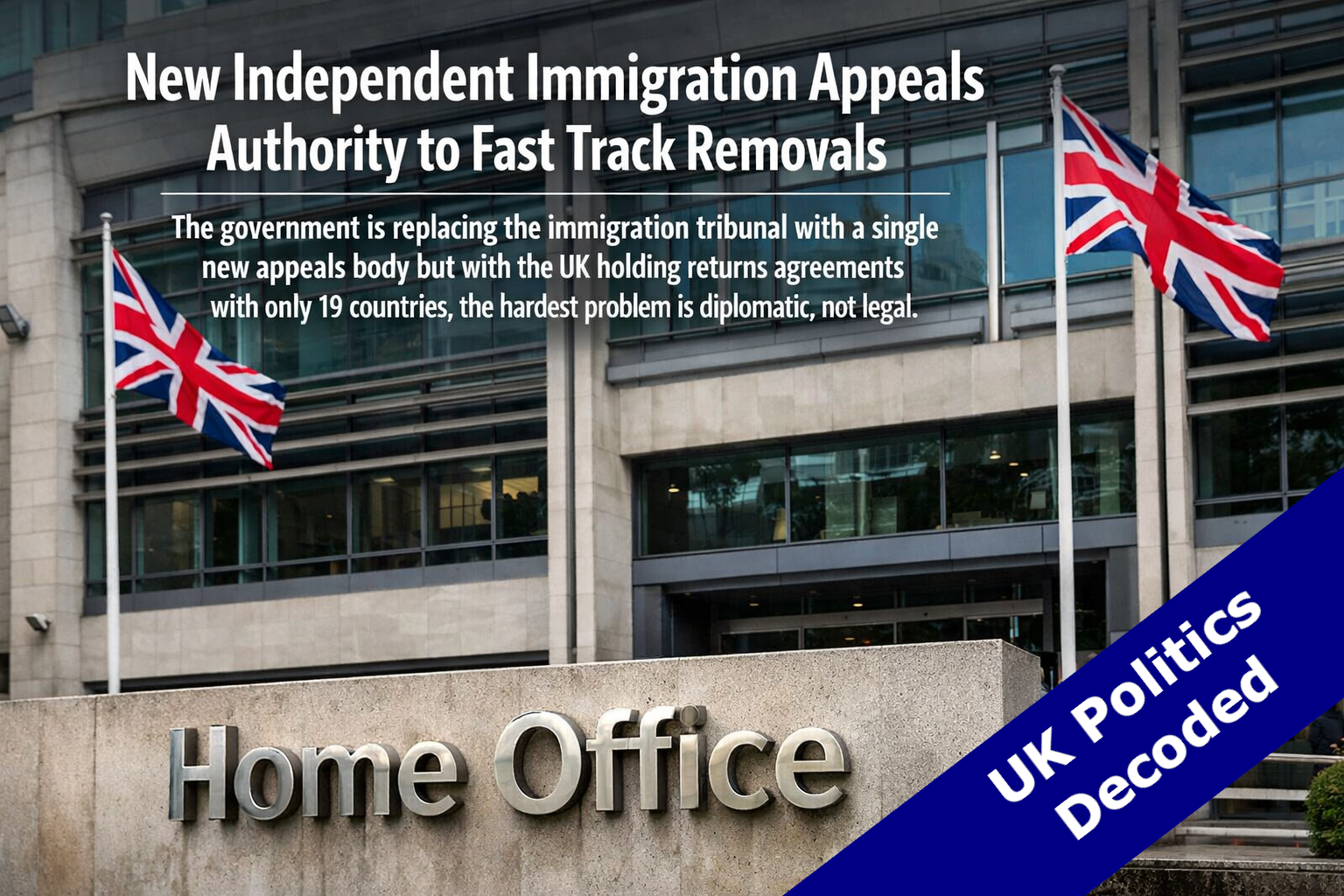
The government has announced a new independent body to replace the existing immigration appeals tribunal, aiming to speed up the removal of foreign criminals and failed asylum seekers. The Independent Immigration Appeals Authority, the IIAA will be created through the Immigration and Asylum Bill and is expected to begin hearing cases from late 2027. At present, more than 150,000 immigration and asylum appeals are waiting to be heard, with the average case taking 61 weeks to resolve.
Home Secretary Shabana Mahmood confirmed the plans on 30 June 2026, describing the reform as a once in a generation overhaul. Under the new system, all grounds of appeal must be raised in a single process ending the current practice where applicants can file successive claims, raising new issues after an initial rejection, in order to delay or prevent removal.
At a glance
- New authority: The IIAA will replace the First tier Tribunal (Immigration and Asylum Chamber), with the first cases expected from late 2027
- Single route: All appeal grounds must be brought together, no more sequential claims to delay removal
- Scale of the backlog: Over 150,000 cases awaiting appeal, the average wait currently 61 weeks
- Adjudicators: Independently appointed professionals drawn from a wider eligibility pool, modelled on the magistracy
- Removals to date: Nearly 70,000 people removed or deported since the current government took office
The new authority will sit outside the traditional court structure, staffed by independently appointed adjudicators with a broader range of professional backgrounds than the current tribunal allows. The government says this will substantially increase capacity to hear and decide cases.
How the new system will work
The biggest structural change is the single appeal route:
- Consolidation: All grounds of appeal including human rights claims must be raised together in a single process
- Prioritisation: High harm foreign offenders and clearly unmeritorious human rights claims will be fast tracked
- Scalability: The IIAA can expand or reduce adjudicator numbers based on caseload demand
- Direct pipeline: Cases will move from the IIAA directly to removal where appeals are unsuccessful
- Interim: Sitting days in the existing tribunal are rising by 19% in 2024/25 while the new authority is established
The appeals backlog
Current tribunal capacity:
- Outstanding appeals: More than 150,000 cases waiting as of June 2026
- Average wait: 61 weeks per case
- Sitting days: Up 19% in 2024/25 a bridging measure, not a long term fix
- Government position: The existing system cannot sustainably manage the current volume
The government has made substantial progress at the initial decision stage. The number of people waiting for a first asylum decision has fallen 72% since June 2023. In the past year, 128,000 initial decisions were issued, an 32% increase on the year before, and more than four times the annual average recorded in the decade to 2020.
Key enforcement and decision data
- Removals: Nearly 70,000 people removed or deported since July 2024
- Initial decisions: 128,000 issued in the last year, up 32% year on year
- Appeals outstanding: More than 150,000 cases in the pipeline
- Average duration: 61 weeks to clear an appeal hearing
- Historical comparison: More than four times the annual average decisions made in the decade to 2020
The government is adding capacity in the existing First tier Tribunal while the IIAA is being built. Sitting days are rising 19% in 2024/25 compared with the previous year. The Home Office describes this as necessary but insufficient, the scale of the caseload, it says, requires structural reform rather than incremental expansion.
The IIAA announcement follows UK led reforms to the European Convention on Human Rights framework, which gave signatory states greater latitude when deporting foreign nationals on Article 8 grounds, the right to private and family life. Those reforms were designed to narrow the scope for last minute human rights challenges to block removals, making it easier in principle to pursue deportation of foreign criminals and failed asylum seekers. The IIAA is built to operate within that changed legal environment, with the ability to fast track cases where Article 8 claims are clearly without merit.
What the reforms enable
- Article 8 discretion: States have greater leeway balancing deportation against family and private life rights
- Fast track route: IIAA can prioritise cases with clearly unmeritorious human rights grounds
- High harm cases: Foreign offenders can be moved to the front of the queue
- Reduced delay: Narrower scope for last minute ECHR based injunctions in clear cut cases
What remains unchanged
- ECHR membership: The UK has not left the Convention
- Human Rights Act 1998: Courts must still apply the Act in all proceedings
- Judicial review: IIAA decisions remain subject to challenge in the higher courts
- Genuine claims: Individuals with substantive grounds retain the right to a fair hearing
The harder constraint is diplomatic rather than legal. The UK currently holds formal readmission or returns agreements with just 19 countries. For nationals from outside that group, removal orders however quickly reached can be difficult to enforce in practice. The government made no announcement of new returns agreements alongside the IIAA launch. Until that list expands, the new authority will deliver faster decisions in cases where the practical ability to carry out the removal remains unresolved.
The problem the IIAA is designed to address has accumulated over many years. The number of people awaiting an initial asylum decision peaked at more than 160,000 in 2023. Progress at that stage has since been significant, the backlog fell 72% from its peak. But clearing initial decisions faster has pushed more cases into the appeals pipeline, which now holds more than 150,000 unresolved cases. That is the bottleneck the IIAA is built to address.
- Backlog peak: More than 160,000 people awaiting an initial decision in 2023
- Current initial backlog: Down 72% since June 2023 following accelerated decision making
- Appeals now: 150,000+ cases in the appeals pipeline as of June 2026
- Annual decisions: 128,000 initial decisions issued in the past year, more than 4x the pre 2020 annual average
- Appeal wait: Average 61 weeks to clear, the longest stage in the current process
The IIAA represents a genuine structural shift in how immigration appeals are handled. A consolidated route, independently appointed adjudicators, and the ability to prioritise high harm cases should reduce both average case length and the scope for deliberate procedural delay.
But faster adjudication only addresses part of the problem. With formal returns agreements covering just 19 countries, the government faces a practical and diplomatic constraint that the IIAA alone cannot resolve. A removal order that cannot be enforced is still an unresolved case, whatever speed it was decided at. The government's own data, nearly 70,000 people removed since taking office shows what's possible when the returns machinery works. Scaling that up requires agreements, not just law reform.
Parliamentary progress on the Immigration and Asylum Bill, and whether the government secures new returns agreements in parallel, will ultimately determine whether faster decisions translate into faster removals.
Key Takeaways
- The IIAA will replace the immigration appeals tribunal, with cases phased in from late 2027 under the Immigration and Asylum Bill
- A single appeal route will require all grounds to be raised together ending the ability to file successive claims to delay removal
- More than 150,000 appeals are currently outstanding, with the average case taking 61 weeks
- UK led ECHR reforms give states more discretion in deportation cases involving Article 8, but the Human Rights Act and judicial review remain fully in place
- The UK holds returns agreements with only 19 countries, the key practical constraint on enforcing removal decisions at scale
Sources & Further Reading
- GOV.UK - New independent appeals body to speed up removals (Home Office, 30 June 2026) Archived copy (OGL): archived page
- Parliament.uk - Immigration and Asylum Bill Archived copy (OGL): archived page
- GOV.UK - Immigration statistics: quarterly release (Home Office) Archived copy (OGL): archived page
- GOV.UK - UK Led changes to the ECHR framework to secure British borders Archived copy (OGL): archived page
- Migration Observatory - Deportation and returns of unauthorised migrants from the UK Archived internally for verification (01 July 2026)