AI Use: AI tools were used to support source discovery and to structure the article for clarity. All research, verification, drafting, and final editorial decisions are fully human led. Learn about our AI policy.
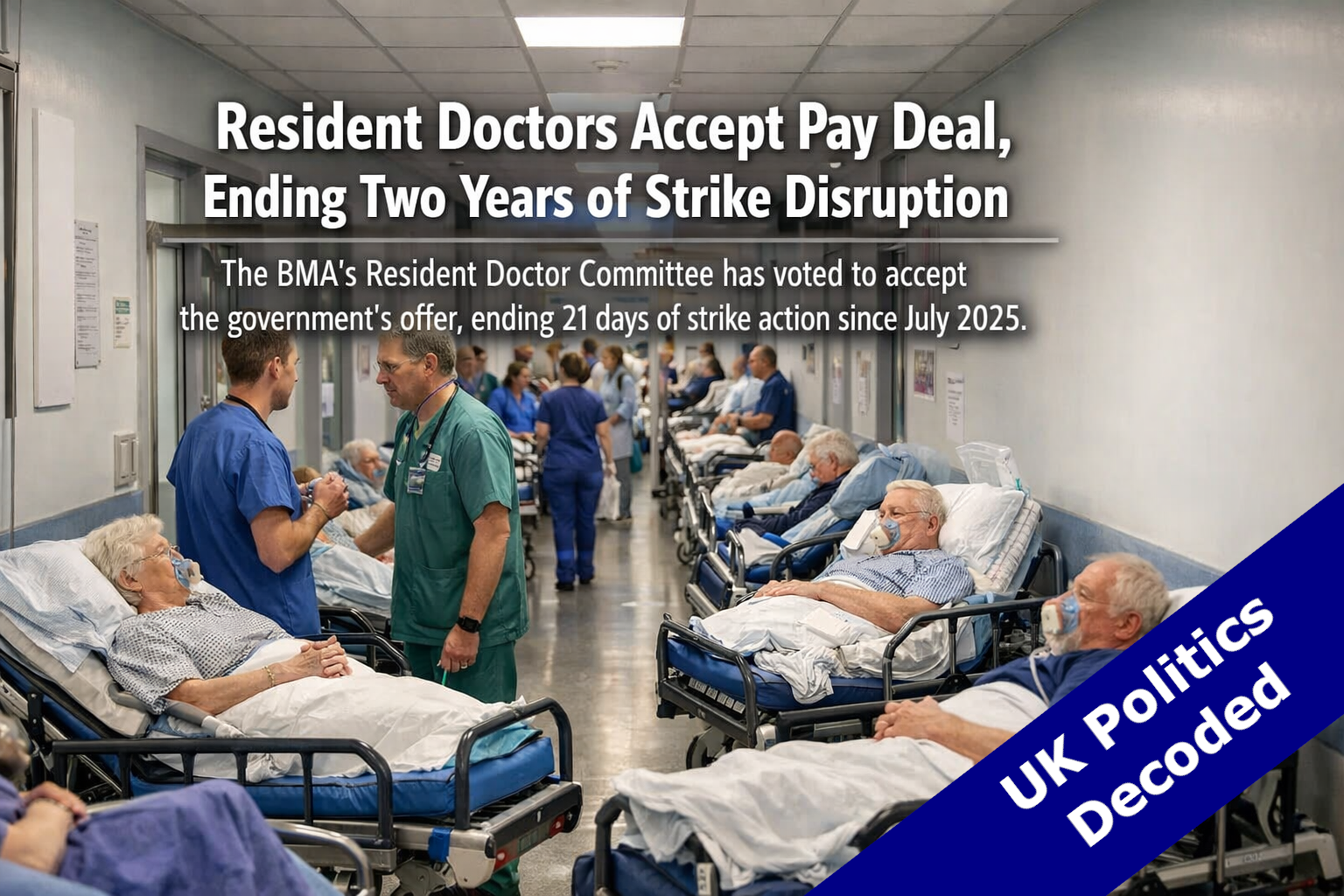
Resident doctors have voted to accept a pay deal with the government, bringing an end to a prolonged period of industrial action that has cost the NHS an estimated £50 million per strike day. The British Medical Association's Resident Doctor Committee announced the result on 29 June 2026, closing a dispute that has run since July 2025 and generated 21 days of walkouts.
Health and Social Care Secretary James Murray described the outcome as "very good news for resident doctors, patients and the NHS as a whole." The government said it would now work closely with the BMA and other stakeholders to implement the deal and establish what it called a "new working relationship" with the medical workforce.
At a glance
- Pay rise: Resident doctor pay will be 35.2% higher on average compared with four years ago
- Pay structure: Reformed to deliver more frequent pay increases as doctors progress and gain new skills
- Training places: Up to 4,500 additional training places to be created, improving career progression to senior roles
- Fee reimbursement: Mandatory Royal College portfolio fees and mandatory examination costs reimbursed, often worth thousands of pounds
- Other improvements: Better conditions for Locally Employed Doctors and those working Less Than Full Time
The headline figure is a 35.2% average pay increase over four years. But the government has also committed to structural changes designed to make progression more financially rewarding. Under the reformed pay structure, resident doctors will receive more frequent wage rises as they move through training and acquire skills that the health service relies on.
Competition rates for training places have already halved this year, the government said. That follows legislation prioritising UK graduates and those who have spent a significant period working in the NHS, a measure introduced earlier in 2026 to address what the BMA had identified as a bottleneck in career progression. The deal builds on that with up to 4,500 additional training places.
On fees, the government will reimburse mandatory Royal College portfolio fees and mandatory examination costs. These charges, which doctors are required to pay as part of their training and progression, can amount to thousands of pounds and had been a specific BMA grievance. The deal also commits to improving working conditions for two groups who sit outside the standard resident doctor contract, Locally Employed Doctors, who are hired directly by NHS trusts rather than through national training programmes, and those working Less Than Full Time.
The BMA Resident Doctor Committee has staged 21 days of industrial action since July 2025. Each strike day costs the NHS approximately £50 million, according to the government's own figures. That covers cancelled appointments, emergency cover arrangements, and the administrative cost of managing disruption.
Despite repeated rounds of action, NHS waiting lists are more than 400,000 lower than they were in June 2024, the government said attributing that to the efforts of NHS staff broadly, including those who continued working through strike periods. The government argued the cost of settling the dispute is a fraction of the cost of continued industrial action.
NHS National Medical Director Professor Frankie Swords said the acceptance of the offer meant the NHS could now "focus on providing high quality care for patients and the best working environment for all of our staff." She noted that despite the disruption, staff had been "delivering record numbers of tests and checks despite facing record demand on services due to the warm weather."
The resident doctor settlement does not resolve wider NHS pay pressures. The NHS Staff Council has been issued with a mandate to negotiate changes to the Agenda for Change pay structure, which covers nurses, midwives, and paramedics. The government said it wants those changes to ensure these workers are "fairly compensated for the invaluable work they do."
Separately, the government said it is working with trade unions on options for consultant contract reform and on improving career progression for Staff and Associate Specialist doctors, a group sometimes referred to as SAS doctors who hold significant clinical experience but have historically faced limited formal progression routes.
Murray said the deal marked "the beginning, not the end of the journey," and confirmed an intention to keep working constructively with NHS staff and unions to improve working conditions across the health service.
Key Takeaways
- Resident doctors voted to accept the government's offer on 29 June 2026, ending 21 days of BMA strike action since July 2025
- Pay will be 35.2% higher on average than four years ago, with a reformed structure to deliver more frequent wage progression
- Up to 4,500 additional training places will be created, competition rates for existing places have already halved following government legislation
- Mandatory Royal College portfolio fees and examination costs will be reimbursed, conditions improved for Locally Employed Doctors and Less Than Full Time workers
- The NHS Staff Council has been mandated to negotiate Agenda for Change reforms for nurses, midwives, and paramedics, a separate process still under way