The UK government has announced it is considering accession to the Pan-Euro Mediterranean (PEM) Convention, a framework designed to simplify trade rules and reduce red tape for exporters. Ministers argue that joining could "unlock opportunities" for British businesses and strengthen the UK's global trade position.
Yet for many workers, the reality is stark: job opportunities are shrinking, wages remain stagnant, and regional economies outside London continue to struggle. The question is whether trade liberalization can meaningfully address these challenges or whether it risks becoming another symbolic gesture in the face of deeper structural problems.
🔍 PEM Convention at a Glance
- Framework to harmonize rules of origin across 25 member countries
- UK trade with PEM countries worth over £500bn in 2024
- Government launching Call for Evidence on potential accession
- Aims to reduce tariffs and export complexity for UK businesses
- Questions remain about regional distribution of benefits
What is the PEM Convention?
The Pan-Euro Mediterranean Convention on Rules of Origin is a multilateral agreement that allows participating countries to cumulate production across member states when determining whether goods qualify for preferential tariffs. Currently covering 25 countries including EU member states, Turkey, and several North African nations, the convention simplifies complex origin requirements for exporters.
How It Works
Under the PEM system, a UK manufacturer could potentially:
- Source components from any PEM member country without affecting tariff eligibility
- Combine inputs from multiple member states in their production process
- Export finished goods to any PEM country under preferential terms
- Reduce administrative burden of proving origin for complex supply chains
- Access streamlined customs procedures across member territories
Government's Case for Joining
The Department for International Trade argues that PEM accession would:
- Boost Export Competitiveness: Reduced tariffs making UK goods more competitive in key markets
- Simplify Supply Chains: Easier integration with European production networks
- Support Manufacturing: Particular benefits for automotive, textiles, and machinery sectors
- Enhance Trade Relationships: Stronger commercial ties with Mediterranean partners
- Reduce Business Costs: Lower compliance burdens for exporters
Jobs Impact: Winners and Losers
Trade agreements inevitably create sectoral winners and losers, with benefits rarely distributed evenly across industries, regions, or worker groups.
Potential Winners
🏭 Export-Oriented Industries
Sectors with strong export potential could see genuine benefits:
- Advanced Manufacturing: Aerospace, automotive, and precision engineering
- Pharmaceuticals: Access to Mediterranean markets for UK drug exports
- Technology Services: Digital and financial services with European integration
- Creative Industries: Media and software exports to expanding markets
- Professional Services: Legal, accounting, and consultancy exports
Potential Losers
⚠️ Import-Competing Sectors
Industries facing increased competition may struggle:
- Domestic Agriculture: Mediterranean agricultural imports competing with UK farmers
- Textiles and Clothing: Low-cost imports from North African producers
- Basic Manufacturing: Simple products facing price pressure from cheaper imports
- Regional Services: Local businesses unable to compete with larger exporters
- Low-Skilled Workers: Employment in import-competing industries at risk
The SME Challenge
Small and medium-sized enterprises often struggle to capitalize on trade deals:
- Resource Constraints: Limited capacity to navigate complex export procedures
- Market Knowledge: Lack of information about opportunities in new markets
- Financial Barriers: Upfront costs of international expansion
- Regulatory Complexity: Difficulty understanding and complying with foreign regulations
- Scale Disadvantages: Large corporations better positioned to exploit new markets
Economic Stagnation: The Deeper Problem
While trade liberalization may create new export opportunities, it cannot address the fundamental drivers of UK economic stagnation that affect workers across all sectors.
Structural Economic Challenges
The UK economy faces deep-rooted problems that trade deals alone cannot solve:
- Low Productivity Growth: UK productivity has stagnated since 2008, limiting wage growth potential
- Weak Business Investment: UK investment as a percentage of GDP remains below OECD averages
- Skills Mismatches: Education and training systems not aligned with modern economic needs
- Infrastructure Deficits: Transport, digital, and energy infrastructure limiting business potential
- Regional Imbalances: Economic activity increasingly concentrated in London and the South East
Past Trade Deal Performance
Evidence from previous trade agreements suggests modest benefits:
- GDP Impacts: Typical trade deals deliver 0.1-0.5% GDP growth over 10-15 years
- Employment Effects: Net job creation often minimal, with gains offset by losses
- Wage Impacts: Benefits typically concentrated among high-skilled workers
- Regional Distribution: Gains often concentrated in already prosperous areas
- Adjustment Costs: Significant short-term disruption for displaced workers and communities
📊 Trade Deal Reality Check
"Studies of recent UK trade agreements show that while they generate positive economic effects, these are typically small and concentrated among businesses already engaged in international trade. For most workers, the benefits are negligible compared to domestic policy changes affecting wages, skills, and local economic development."
UK Trade Policy ObservatoryRegional Perspective: Who Benefits Where?
The benefits of trade liberalization are rarely evenly distributed geographically, often exacerbating existing regional inequalities.
London and South East Advantages
The capital region is best positioned to benefit from PEM accession:
- Financial Services Hub: London's role in international finance facilitates trade growth
- Professional Services Cluster: Concentration of legal, accounting, and consulting firms
- Transport Links: Better connectivity to international markets
- Skilled Workforce: Higher education levels and language skills
- Business Networks: Existing international commercial relationships
Northern Regions: Barriers to Benefits
Areas like Yorkshire, the North East, and Hull face structural disadvantages:
- Industrial Legacy: Decline of traditional manufacturing reducing export capacity
- Infrastructure Gaps: Weaker transport links limiting market access
- Skills Challenges: Workforce skills not aligned with emerging export opportunities
- Investment Deficits: Lower levels of business R&D and innovation
- Market Distance: Geographic and cultural distance from Mediterranean markets
Widening Regional Inequality
Without deliberate intervention, trade liberalization could worsen regional disparities:
- Agglomeration Effects: Export benefits concentrate where businesses already cluster
- Brain Drain Acceleration: Skilled workers migrate to areas with better opportunities
- Investment Diversion: Capital flows toward already prosperous regions
- Service Sector Concentration: High-value services increasingly London-focused
- Manufacturing Decline: Continued erosion of regional manufacturing base
Government Call for Evidence: Your Chance to Input
The government has launched a formal consultation process to assess the merits of PEM Convention accession, providing an opportunity for businesses and stakeholders to influence policy.
How to Participate
🗳️ Make Your Voice Heard
The Department for International Trade is seeking evidence from:
- Businesses: Exporters, importers, and supply chain participants
- Trade Bodies: Industry associations and chambers of commerce
- Regional Organizations: Local economic development agencies
- Worker Representatives: Trade unions and professional associations
- Academic Experts: Researchers studying trade and economic development
Consultation Deadline: Check gov.uk for current submission dates
Submit Evidence: Official Call for Evidence Page
Key Questions to Address
Submissions should consider:
- Business Impact: How would PEM accession affect your industry or region?
- Implementation Costs: What resources would businesses need to adapt?
- Competitive Effects: Would you face increased competition or new opportunities?
- Employment Implications: How might jobs and wages be affected?
- Regional Distribution: How can benefits be spread more evenly across the UK?
Current Situation Of The UK
According to the Office for National Statistics (ONS), the number of job vacancies has fallen for 39 quarters (nearly 10 years) to around 717,000 nationwide, the lowest level in nearly a decade.
- This reflects a labour market under strain, with employers offering fewer opportunities each month since the post-pandemic peak of 1.3 million vacancies in 2022.
- For workers, this means greater competition for fewer roles, stagnant wages, and limited mobility.
- The Benefits reform bill will see more people taken from the welfare system and pushed into work, potentially increasing the number of job seekers.
- For policymakers, it underscores the challenge: trade deals may expand markets, but they do not automatically create new jobs in a contracting labour environment.
De-industrialisation of the UK
The UK’s industrial decline limits its ability to compete in global markets. Without a strong manufacturing base, trade agreements risk benefiting importers more than domestic producers. Minimum wage rises and taxation policies, while socially important, add cost pressures that make UK industries less competitive internationally.
- Manufacturing as a share of GDP has fallen from 30% in 1970 to just 8% in 2024
- Traditional industries: steel, coal, textiles, and automotive have shrunk dramatically, leaving entire regions with fewer industrial anchors.
- Rising minimum wages and taxation burdens have made UK production less competitive compared to lower-cost economies, particularly in the Mediterranean and North Africa.
This has contributed to offshoring and import reliance, with domestic producers squeezed by cheaper imports and higher operating costs.
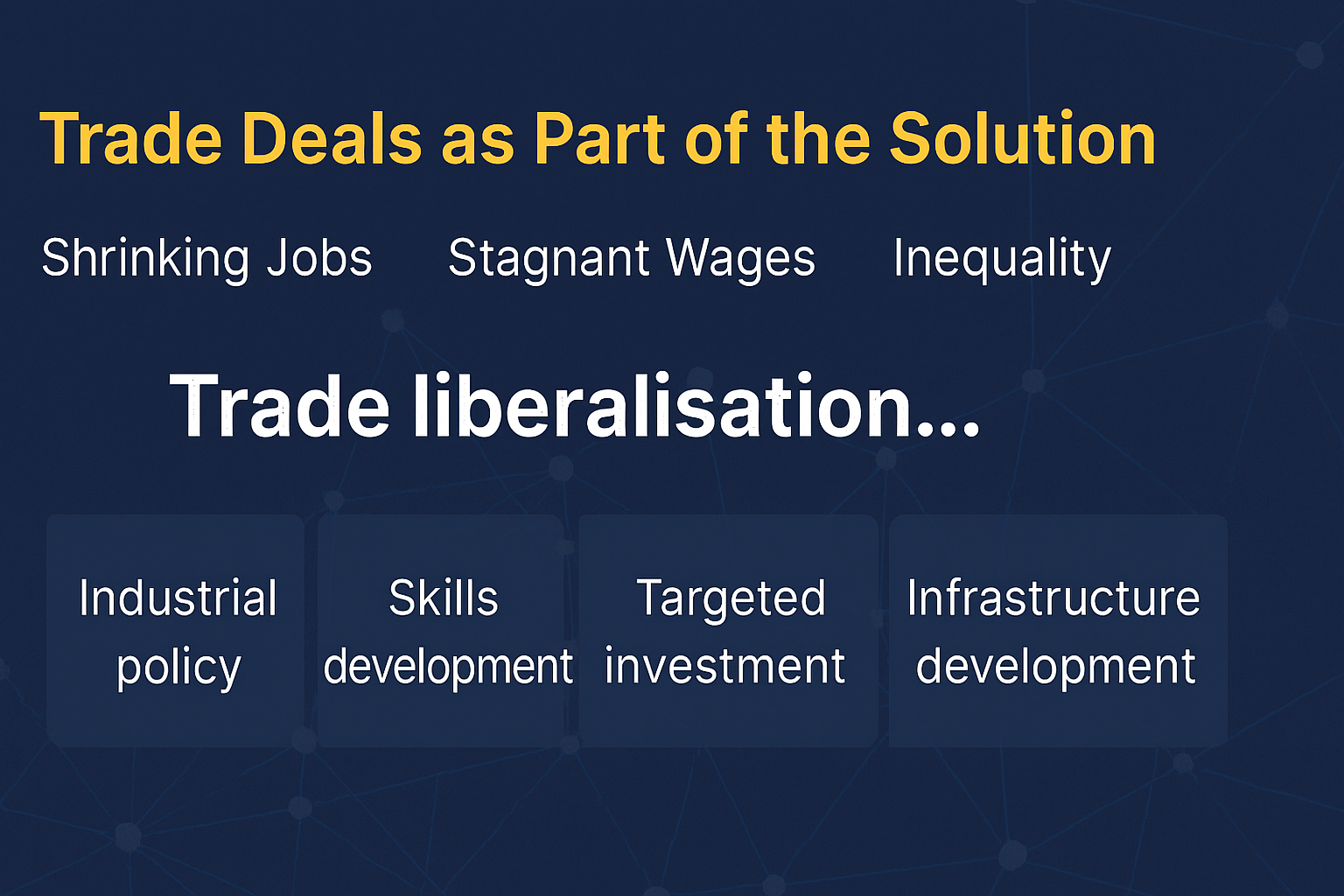
Conclusion: Trade Deals as Part of the Solution
Joining the PEM Convention could help UK exporters by reducing tariffs and simplifying trade rules. It is a useful step for businesses already active in Mediterranean markets.
But trade liberalisation alone will not fix the UK’s deeper problems: shrinking job opportunities, stagnant wages, and widening regional inequality. These stem from low productivity, weak investment, skills gaps, and poor infrastructure issues that require domestic policy solutions.
For trade deals to deliver real benefits, they must be part of a wider strategy that includes:
- Industrial policy to support competitive sectors
- Investment in skills and training
- Regional development to spread opportunities
- Strong protections for workers
- Infrastructure upgrades to connect all regions
Without these, trade deals risk reinforcing existing inequalities helping those already positioned to benefit while leaving struggling communities behind
The PEM Convention is worth considering, but it should be seen as one tool among many, not a cure-all. Citizens engaging in the government’s Call for Evidence can push for these broader concerns to be part of the debate.