AI Use: AI tools were used to support source discovery and to structure the article for clarity. All research, verification, drafting, and final editorial decisions are fully human led. Learn about our AI policy.
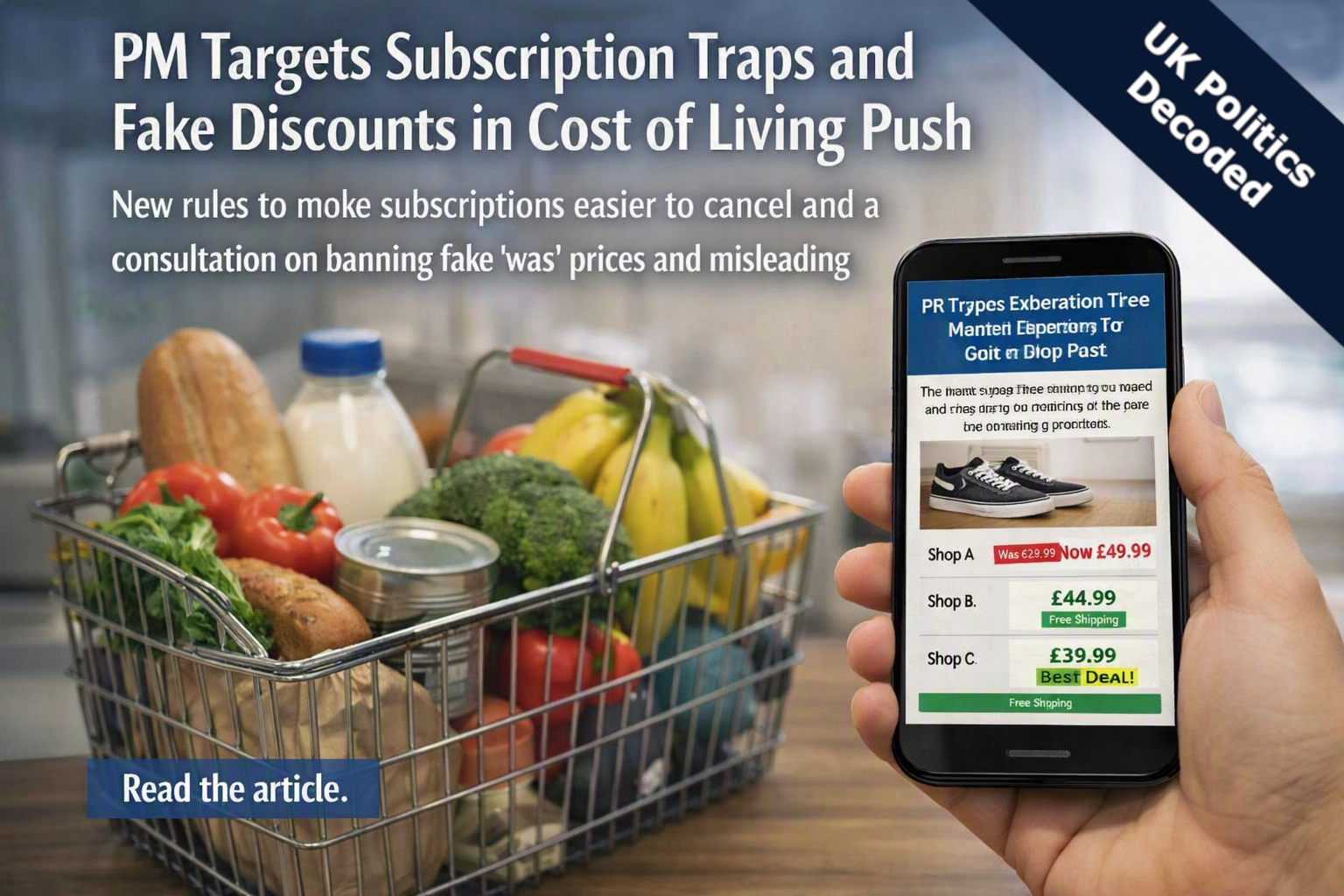
The government announced on 9 August 2026 that new rules on subscription contracts will take effect in January 2027, alongside a consultation on banning retailers from using misleading discount tactics. Prime Minister Andy Burnham framed the moves as the first in a series of 'everyday fixes' intended to ease pressure on household budgets.
There are around 155 million active subscriptions in the UK. Consumers are estimated to spend £1.6 billion a year on subscriptions they no longer want, according to figures cited in the government announcement. The new rules aim to cut that cost by saving people an average of £14 a month for every unwanted subscription they cancel.
What was announced on 9 August 2026
- Subscription rules: New requirements take effect January 2027, covering clearer upfront information, regular reminders before renewal, and a straightforward exit process
- Cooling off period: A new 14 day right to cancel will apply after a free trial ends or a long term contract renews
- Misleading discounts: A consultation will launch this autumn on adding fake 'was' prices and invented discounts to the list of banned practices under the Digital Markets, Competition and Consumers Act (DMCCA)
- Charitable exemption: Cultural and heritage membership organisations will be excluded from the subscription rules
- Savings estimate: The government says the subscription changes could save an average of £14 per month for every unwanted subscription cancelled
Subscription contracts have long drawn complaints from consumers who find it difficult to cancel or who are automatically rolled onto higher priced renewals without clear warning. The new rules, brought forward under the DMCCA, aim to address those specific problems.
Under the incoming rules, subscription providers must:
- Clearer upfront terms: Provide clear information about the contract at the point of sign up, including price, renewal terms and how to cancel
- Renewal reminders: Send regular reminders before a subscription renews, giving consumers the opportunity to opt out
- Easy exit: Make cancellation as straightforward as signing up, removing complex multi step processes designed to discourage people from leaving
- 14 day cooling off: Allow a new 14 day cancellation window after a free trial ends or a long term contract auto renews
- Charitable carve outs: Certain cultural and heritage membership organisations such as those preserving historic sites and collections will be exempt from the new requirements
Key figures from the announcement
- 155 million: Estimated number of active subscriptions in the UK
- £1.6 billion: Amount consumers are estimated to spend each year on subscriptions they do not want
- £14 per month: Average estimated saving per unwanted subscription cancelled under the new rules
- 26%: Proportion of UK adults (over 13 million people) who Citizens Advice found had accidentally taken out a subscription in a given year
Alongside the subscription changes, the government announced a separate consultation due to launch this autumn into whether misleading pricing tactics should be formally prohibited under the DMCCA.
The government has identified specific practices it wants to address:
Pricing practices under review
- Fake 'was' prices: Advertising an item as discounted when the 'original' price was either never charged or charged only briefly
- Invented discounts: Displaying a percentage saving that does not reflect the actual reduction from a genuine prior price
- Misleading RRPs: Using inflated recommended retail prices to make a deal appear more valuable than it is
- DMCCA route: Adding these tactics to the Act's list of automatically unfair practices would make enforcement faster and simpler for regulators
- Current difficulty: Under existing law, enforcement bodies have found it difficult to bring cases involving misleading pricing, limiting accountability
Consumer groups have been pressing for action on both fronts for several years. Which? has previously exposed household brands using discount tactics that do not represent genuine savings. Citizens Advice said it had "sounded the alarm" on subscription traps and welcomed the accelerated timeline for action.
- Which?: Called on the government to implement rules swiftly and ensure regulators have the tools to fine businesses that fall short
- Citizens Advice: Welcomed the announcement but said it "can't be the end of the story", noting that 26% of adults have accidentally signed up to a subscription
- Money and Mental Health Policy Institute: Highlighted that people with mental health conditions are particularly vulnerable to misleading pricing and subscription traps, and are three times as likely to be behind on household bills
- Jonathan Reynolds: Business, Innovation, Science and Trade Secretary said the government is "on the side of families working hard to make ends meet"
- Level playing field: The government noted that businesses already operating transparently will benefit from clearer rules that prevent competitors with confusing practices from undercutting them
The Prime Minister described 9 August's announcement as just the start of a programme of practical cost of living interventions. He stated his intention to "pull every single lever we can to provide people with some room to breathe."
The government's cost of living actions to date include:
- Bus fare cap: A £2 fare cap on bus journeys was introduced in the government's first week
- Energy bills: Action taken to make energy bills more affordable for millions of households
- Subscription rules: Confirmation that rules bringing forward the DMCCA subscription protections will take effect January 2027
- Discount consultation: Commitment to launch a formal consultation this autumn into banning fake discount pricing under the DMCCA
What still requires legislation or consultation
- Misleading pricing ban: The consultation has not yet launched, new rules would require secondary legislation under the DMCCA
- Enforcement detail: The government has not yet set out the specific penalties or enforcement body responsible for the new subscription rules
- Further fixes: Burnham said more 'everyday fixes' will follow but no specific timeline or scope has been given for future announcements
- Charity exemption scope: The exact definition of eligible cultural and heritage organisations for the carve out has not been published
Both measures rely on the Digital Markets, Competition and Consumers Act, which received Royal Assent in 2024. The subscription rules are being brought forward under powers already in the Act. Adding misleading pricing to the list of automatically unfair commercial practices would require secondary legislation, which is why a consultation is being launched first.
- DMCCA Part 4: Covers consumer rights, subscription contracts and unfair commercial practices
- Automatically unfair practices: Adding a practice to this list removes the need for regulators to prove intent, making enforcement faster
- Autumn consultation: Will assess fake 'was' prices, invented discounts, and misleading RRPs, the outcome will determine whether new secondary legislation follows
- January 2027 target: Chosen partly because it falls when consumers often start new subscriptions, maximising the immediate benefit of the cooling off period
- Commencement order: The subscription rules require a commencement order to bring relevant DMCCA provisions into force on the target date
Consumer protection law in the UK has historically struggled to keep pace with digital subscription models and online retail pricing tactics. The DMCCA, passed by the previous parliament, provided new powers but many of its provisions have not yet been brought into force. The current government is now activating parts of that Act to deliver visible consumer benefits ahead of further legislation.
Key existing provisions relevant to these announcements:
Digital Markets, Competition and Consumers Act 2024
- Subscription contracts: Part 4 of the Act sets out requirements for subscription contracts including pre contract information and cancellation rights
- Unfair commercial practices: Schedule 20 lists practices that are automatically considered unfair, the government wants to extend this to misleading pricing
- CMA powers: The Act significantly expanded the Competition and Markets Authority's enforcement powers in digital markets
- Royal Assent: The Act received Royal Assent on 24 May 2024 under the previous government
- Commencement: Various provisions have different commencement dates, many require secondary legislation to activate
Consumer protection enforcement in the UK is split across several bodies. The Competition and Markets Authority (CMA) handles cases with the most significant market impact. Trading Standards, operated by local authorities, handles a large proportion of individual enforcement. The Financial Conduct Authority (FCA) covers financial services. For subscription and pricing issues outside financial services, the CMA and Trading Standards are the primary regulators.
- CMA: Competition and Markets Authority leads on large scale enforcement and digital markets regulation
- Trading Standards: Local authority bodies that handle consumer complaints and enforce unfair trading regulations
- Which? role: Which? can bring complaints to the CMA where systemic consumer harm is identified
- Private rights: Consumers can already take individual legal action for breach of contract or misrepresentation in some circumstances
- New consultation: The autumn consultation will need to address which body is responsible for enforcing any new misleading pricing rules and what the penalties will be
The subscription rules, taking effect January 2027, are among the most concrete consumer protection changes announced since the government took office. The misleading discount consultation is a commitment to act, but the rules themselves remain some way off.
For consumers, the subscription changes mean that by early next year, providers will be legally required to make cancellation straightforward, send renewal reminders, and honour a 14 day cooling off window. That covers a wide range of everyday services, from streaming platforms and gym memberships to software and insurance renewals.
The misleading discount consultation will determine whether the DMCCA's enforcement framework is extended to cover fake 'was' prices. That process is consultation, secondary legislation, commencement, means any formal ban is unlikely to be in force before 2027 at the earliest.
Key Takeaways
- New subscription rules take effect January 2027, requiring easier cancellation, renewal reminders, and a 14 day cooling off period after trials or auto renewals
- Consumers are estimated to spend £1.6 billion a year on unwanted subscriptions, the changes are projected to save £14 per month per cancelled subscription on average
- A consultation launching this autumn will assess whether fake 'was' prices and invented discounts should be added to the DMCCA list of automatically unfair practices
- Both measures use powers already on the statute books under the Digital Markets, Competition and Consumers Act 2024
- Cultural and heritage membership organisations such as those managing historic landscapes and collections will be exempt from the new subscription requirements
Sources & Further Reading
- GOV.UK – PM starts roll out of 'everyday fixes' on the cost of living (9 August 2026) Archived copy (OGL): archived page
- Digital Markets, Competition and Consumers Act 2024 – legislation.gov.uk Archived internally for verification (11 August 2026)
- Citizens Advice – subscription traps and consumer protection Archived internally for verification (11 August 2026)
- Which? – misleading pricing and subscription research Archived internally for verification (11 August 2026)