AI Use: AI tools were used to support source discovery and to structure the article for clarity. All research, verification, drafting, and final editorial decisions are fully human led. Learn about our AI policy.
UKPoliticsDecoded is an IMPRESS regulated publisher. Read our editorial standards.
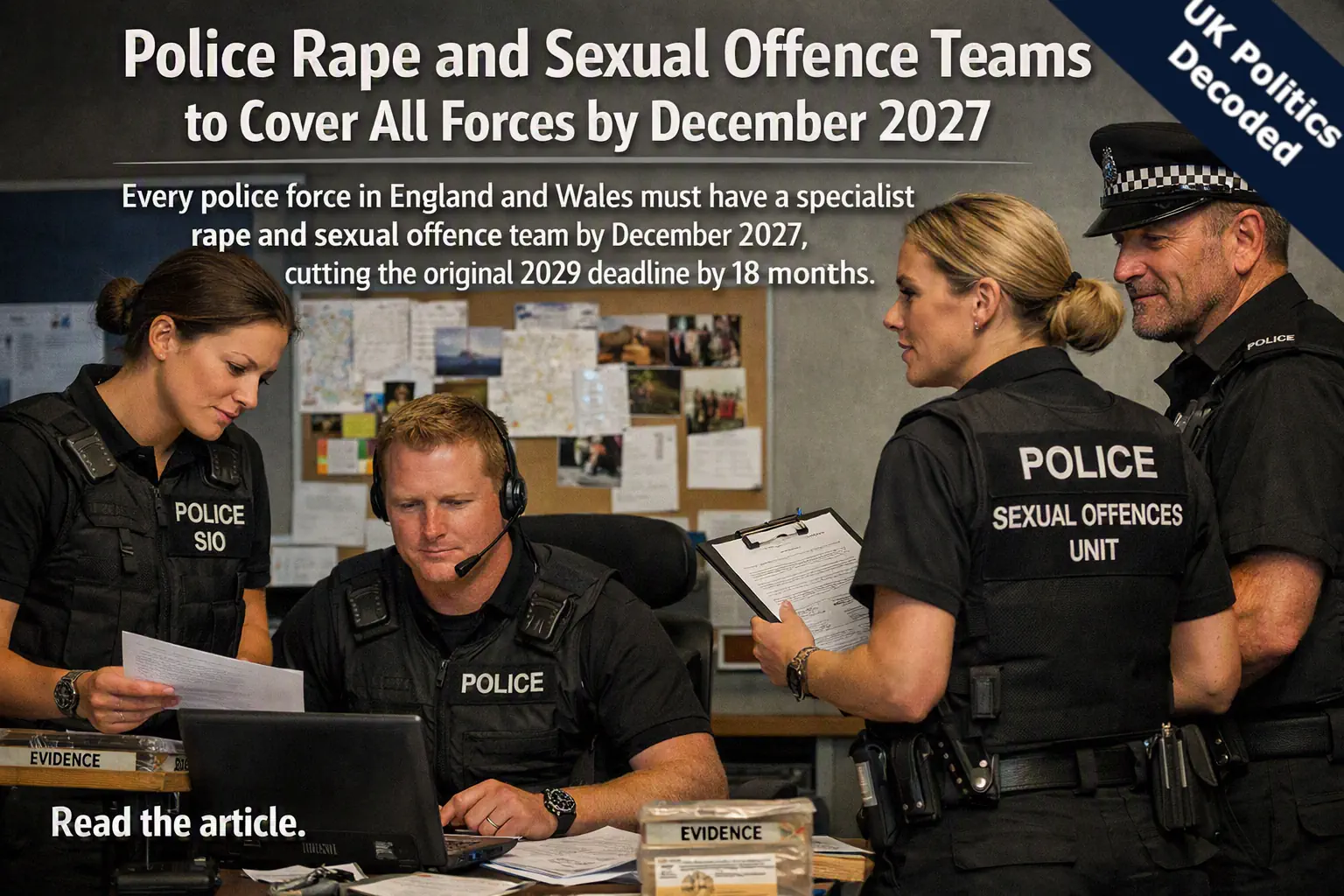
Every police force in England and Wales will have a specialist rape and sexual offence team in place by December 2027, 18 months earlier than planned. The government announced the change on 28 August, alongside a £13.3 million package for pilot protection order teams across up to ten forces.
The original timeline, set when the policy was first committed to as part of the Violence Against Women and Girls Strategy last December, would have seen the rollout completed by summer 2029. Prime Minister Andy Burnham said that pace was simply not good enough.
At a Glance
- Every police force in England and Wales is required to have a specialist rape and sexual offence team in place by December 2027, cutting the original summer 2029 deadline by 18 months.
- Up to ten police forces will share £13.3 million to pilot specialist protection order teams, focused on actively enforcing conditions placed on domestic and sexual abuse offenders.
- New domestic abuse protection orders with no maximum duration are being rolled out, covering all forms of abuse including coercive control, economic abuse and stalking.
- Around 900,000 adults experienced sexual assault in England and Wales last year, 3.8 million experienced domestic abuse, and 1.4 million experienced stalking.
- The Drive Project, which works intensively with high risk perpetrators, has protected close to 7,750 adult victim survivors and more than 14,000 children over the past decade.
What Specialist Teams Mean for Victims Across Every Force
At present, the depth of specialist support available to rape victims is not consistent across England and Wales. How quickly a case is investigated, what help a victim receives from the moment they first report, and how actively a suspect is pursued can vary depending on which police area they fall under. Specialist rape and sexual offence teams are dedicated units trained to investigate these crimes, support victims throughout, and pursue perpetrators to prosecution.
Prime Minister Andy Burnham said "These measures were going to be introduced in 2029, but I think that's too slow. So we're taking action to accelerate the roll out." Satvir Kaur, Minister for Safeguarding and Violence Against Women and Girls, said the government was "going further and faster to ensure victims and survivors of these devastating crimes get the protection and support they deserve." The National Centre for VAWG and Public Protection confirmed it was already working with forces on developing the teams.
Protection Orders and What They Are and How the Pilot Funding Works
Protection orders are civil measures that courts can impose on offenders without requiring a criminal conviction. They can be granted based on the risk a person poses, even where an investigation is ongoing and no prosecution has been brought. Conditions can include electronic tagging, exclusion zones around a victim's home or workplace, and mandatory attendance at behaviour change programmes. Breach of an order can result in imprisonment.
The £13.3 million pilot will fund dedicated enforcement teams within up to ten forces. Their purpose is to manage these orders far more actively, tracking perpetrators, monitoring compliance, and responding quickly when a breach occurs.
How Protection Orders Work
- Courts can grant a protection order without a criminal conviction against the perpetrator.
- Conditions can include electronic tagging, exclusion zones, and mandatory attendance at behaviour change programmes.
- Orders protect victims while police investigations or prosecutions are ongoing.
- Breach of a protection order can result in the offender being sent to prison.
New Domestic Abuse Orders with No Maximum Duration
Alongside the enforcement pilots, the government is rolling out new domestic abuse protection orders. Unlike existing civil orders, which cover specific categories of harm, these apply to all forms of domestic abuse in a single instrument, physical violence, coercive or controlling behaviour, economic abuse and stalking. There is no maximum duration. Victims are no longer required to repeatedly return to court for renewal as their situation evolves.
For Victims
- Specialist rape and sexual offence teams will operate in every police force from December 2027, ending the geographic variation in specialist support.
- New domestic abuse protection orders cover all forms of abuse with no expiry date, removing the need to repeatedly return to court.
- Domestic abuse specialists are being placed in 999 control rooms, improving the response from the moment a call is made.
- Each victim will have dedicated investigative and support resources from first contact through to any prosecution.
For Perpetrators
- Active enforcement teams in up to ten pilot forces will monitor protection order compliance far more closely than before.
- Conditions can include electronic tagging, strict exclusion zones, and mandatory attendance at behaviour change programmes.
- Breach of a protection order carries the risk of imprisonment regardless of whether a criminal conviction exists.
- Online operatives will use covert intelligence techniques to identify and pursue perpetrators active online.
The government is also investing in perpetrator management through the Drive Project. Over the past decade it worked with almost 7,000 high risk perpetrators, helping to protect close to 7,750 adult victim survivors and more than 14,000 children.
What the Figures Say and What Happens Next
The government's own figures place the policy in context. Around 900,000 adults experienced sexual assault in England and Wales last year. Some 3.8 million experienced domestic abuse and 1.4 million experienced stalking. These figures are not aberrations, they represent the sustained background level of harm the strategy is designed to reduce over a decade.
The government has committed to halving violence against women and girls within ten years. The specialist team rollout, protection order pilots, and new domestic abuse orders are presented as concrete delivery steps within that ambition. Also part of the same programme, domestic abuse specialists in 999 control rooms, and online operatives deployed to identify and pursue perpetrators through covert intelligence work.
The National Centre for VAWG and Public Protection said work on developing the specialist teams was already under way alongside forces. The December 2027 deadline gives those forces just over a year to have units fully operational. How many reach that point and how quickly the protection order pilots demonstrate results will be the first test of whether the accelerated timetable holds.
Key Takeaways
- Every police force in England and Wales must have a specialist rape and sexual offence team operational by December 2027, cutting 18 months from the timeline set in the VAWG Strategy last December.
- Up to ten police forces will pilot specialist protection order teams using a share of £13.3 million, enforcing civil orders that can be granted without a criminal conviction.
- New domestic abuse protection orders cover all forms of abuse, including coercive control and economic abuse, with no maximum duration, ending the need for repeated court renewals.
- Around 900,000 adults experienced sexual assault last year and 3.8 million experienced domestic abuse, establishing the scale of harm the decade long strategy is designed to address.
- The broader package includes domestic abuse specialists in 999 control rooms, online operatives tackling digital abuse, and continued Drive Project investment in intensive perpetrator management.
Sources & Further Reading
-
GOV.UK - PM accelerates roll out of police rape and sexual offence teams (28 August 2026)
Archived copy (OGL): archived page -
GOV.UK - Freedom from violence and abuse: a cross-government strategy to build a safer society for women and girls (accessible)
Archived copy (OGL): archived page -
ONS - Crime Survey for England and Wales: latest release
Archived copy (OGL): archived page -
The Drive Project - High Risk Perpetrator Programme
Archived internally for verification (29 August 2026)