AI Use: AI tools were used to support source discovery and to structure the article for clarity. All research, verification, drafting, and final editorial decisions are fully human led. Learn about our AI policy.
Every year, around four million calls to the 101 non emergency police line are answered by handlers who cannot help. The callers needed a council, NHS 111, or the 105 power outage helpline, not the police. At present, none are filtered out until a handler has already picked up.
On 18 August 2026, the Home Office announced a new AI powered call routing system to change that. Backed by £1.4 million in government investment and built jointly with the National Police Chiefs Council, with Vodafone Business as the delivery partner, the system will intercept misdirected calls before they enter a queue, getting callers to the right agency faster and freeing handlers to focus on crime reports, safeguarding, and victims.
At a Glance
- Scale: 101 receives around 20 million calls a year, roughly one in five is intended for another organisation entirely
- Investment: £1.4 million government funding to develop and deploy the system
- Projected savings: Up to £8.5 million a year for policing nationally
- Tested across 15 forces before wider rollout, with specific checks on accent and phrasing recognition
- Part of a wider package: One element of a £16.5 million Home Office investment in police contact modernisation
The 101 line launched in 2012 as a single non emergency number for police contact. In the years since, volumes have grown and so has the proportion of calls that handlers field without being able to help. The Home Office estimates around 20% of the line's 20 million annual calls go to the wrong place entirely, callers who needed a local council, NHS 111, or the 105 power outage line, not the police.
The problem runs beyond genuine misdials. The government's announcement cited complaints about delayed pizza deliveries, slow pub service, and callers asking officers for a lift. None of those can be resolved by the police but at present they are only identified as wrong numbers after a handler has already picked up. The caller queues with everyone else, a handler answers, and the redirect happens with time already lost on both sides.
Multiply four million of those calls across 43 territorial forces and the drag becomes significant. The Home Office puts the cost of the current inefficiency at the equivalent of £8.5 million a year, the same figure the new system is expected to recover.
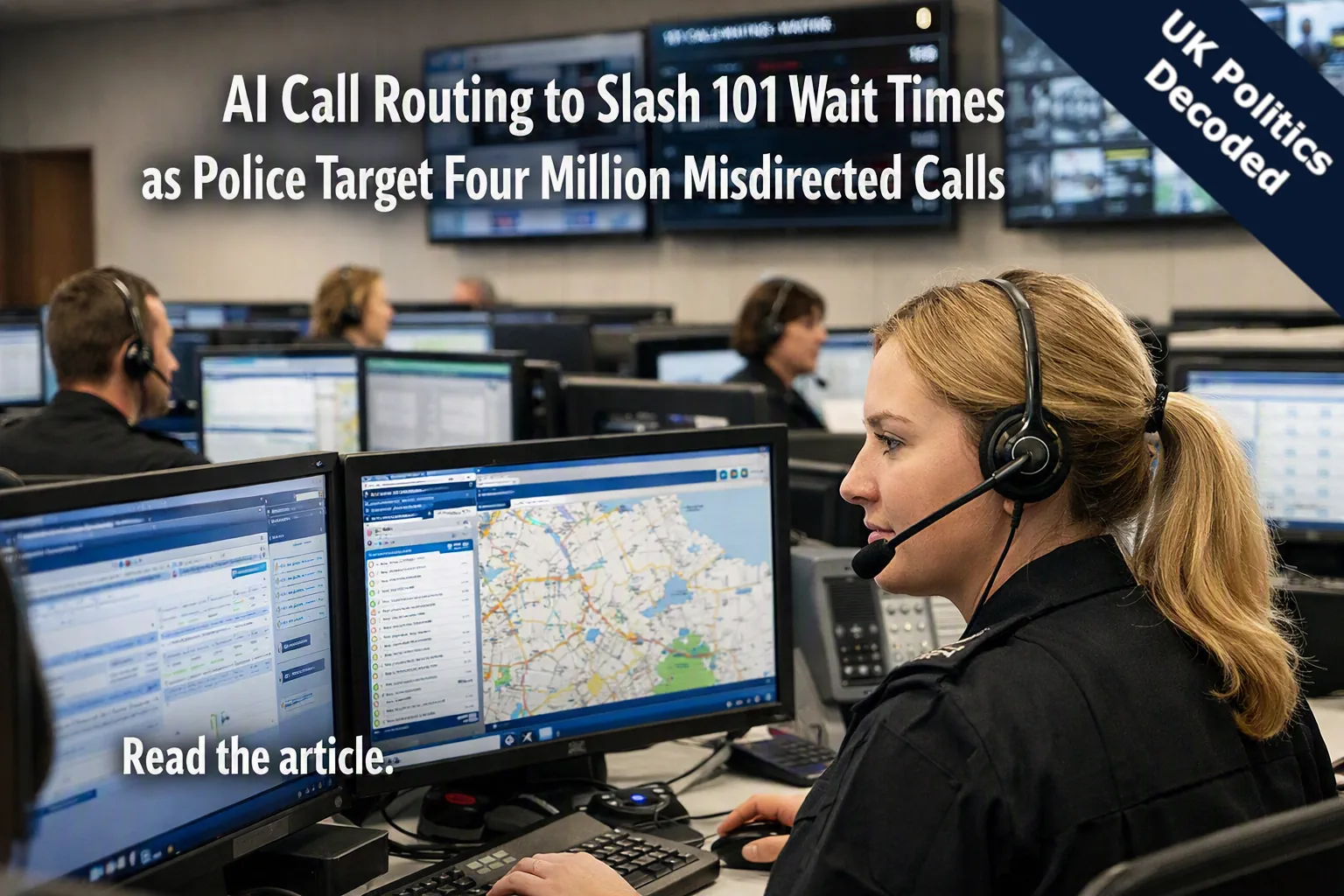
The AI does not replace call handlers. It sits in front of the queue. When someone dials 101, the system analyses their stated reason for calling and tries to match it against a set of categories. If the reason falls outside policing such as fly tipping that belongs to the council, say, or a damage only road traffic incident, the system routes the caller to the right agency before they ever join a police queue.
The process is not automatic in any alarming sense. Callers are told precisely how the system has understood their reason for calling, and they must confirm or reject that interpretation before anything happens. Rejecting it or giving a reason the system cannot confidently categorise, sends the call straight to a police handler without further steps. Callers can also ask to speak to a handler at any point regardless of what the system has determined.
Where a stated reason falls into a broader category, one that could plausibly involve policing, the system asks additional screening questions before deciding. Testing across the 15 pilot forces included specific checks on performance across different accents and phrasing. A routing system that consistently misheard regional dialects or informal speech would create real access barriers, and the Home Office confirmed this was a deliberate focus during development and testing.
Against a £1.4 million development investment, the government projects annual savings of up to £8.5 million. That gap looks compelling, but the figure is a projection rather than a guarantee. It depends on the system performing consistently once deployed across 43 forces, each with different telephone infrastructure and call volumes. The rollout will not be uniform, forces can implement the system around whatever phone menu setup they already have, which means the caller experience will vary by area. A fixed national deployment timetable has not been published. The 999 emergency line is unaffected throughout.
The 101 routing system is one element of a broader investment the government has described as a record £16.5 million commitment to modernising police contact. The wider package includes AI capable of transcribing 999 and 101 calls in real time, and software to link crime reports across forces and identify patterns in demand, though neither element has a confirmed deployment date.
The system was developed jointly by the Home Office and the National Police Chiefs Council, with Vodafone Business trading as VodafoneThree is acting as the technical delivery partner. A/Deputy Chief Constable Stuart Hooper, the NPCC lead for Contact Operations, described the result as "a major step forward in modernising how the public interacts with policing," and said forces had long struggled with the volume of contact that does not require a police response.
Crime and Policing Minister Sarah Jones was direct about where the problem lay. "Police call handlers are wasting hours fielding calls meant for other organisations," she said. "Every minute spent on these calls is time taken away from helping people who genuinely need their support." Nick Gliddon, Business Director at VodafoneThree, said the system would "help police teams focus their time and resources where they are needed most."
Neighbourhood Watch chief executive John Hayward-Cripps, whose network has long heard from members frustrated by 101 delays, called it "a practical step towards a faster, smarter and more responsive 101 service." Al Murray, interim director at PoliceAI, was more pointed, "Every minute spent dealing with a misdirected call is a minute that could be spent helping a victim or responding to a crime."
It is worth being clear about what the system does not touch. Call routing is an administrative layer, it operates before any policing decisions are made. Nothing in the announcement changes how crime is investigated, how officers respond once a call is accepted, or how victims are supported. The government has also not set out any independent scrutiny or performance monitoring arrangements for the system once it operates nationally.
For people who call 101 about something that belongs with a council or NHS 111, the practical change is straightforward, a faster automated route to the right place, without queuing for a police handler who cannot help. For handlers, it should mean fewer calls that cannot be resolved and more time for the ones that can.
Whether the £8.5 million saving materialises depends on how consistently the AI performs at scale. The 15 pilot forces provide some evidence, but deployment across the full range of forces with their different call patterns, phone systems, and local demand pressures will be the real test. The government has said the broader policing modernisation programme, including the transcription and crime pattern tools, will be developed further in due course.
The 101 routing system is, on the current evidence, the part of that programme that is ready. Everything else is still to come.
Key Takeaways
- AI call routing for 101 will redirect non police calls before they enter a queue, targeting an estimated four million misdirected calls a year
- The £1.4 million system is projected to save policing up to £8.5 million annually though that figure depends on consistent performance across all 43 forces
- Callers are told how the system has understood their call and must confirm before any redirection, in any doubt, the call goes straight to a handler
- Tested in 15 forces with specific attention to accent and phrasing recognition before wider deployment
- The 999 emergency line is unaffected, rollout timelines and caller experience will vary between forces
Sources & Further Reading
- AI to slash 101 wait times and free vital police time - Home Office / GOV.UK (18 August 2026) Archived copy (OGL): archived page
- National Police Chiefs Council - npcc.police.uk Archived internally for verification (19 August 2026)
- PoliceAI - police.uk Archived internally for verification (19 August 2026)