AI Use: AI tools were used to support source discovery and to structure the article for clarity. All research, verification, drafting, and final editorial decisions are fully human led. Learn about our AI policy.
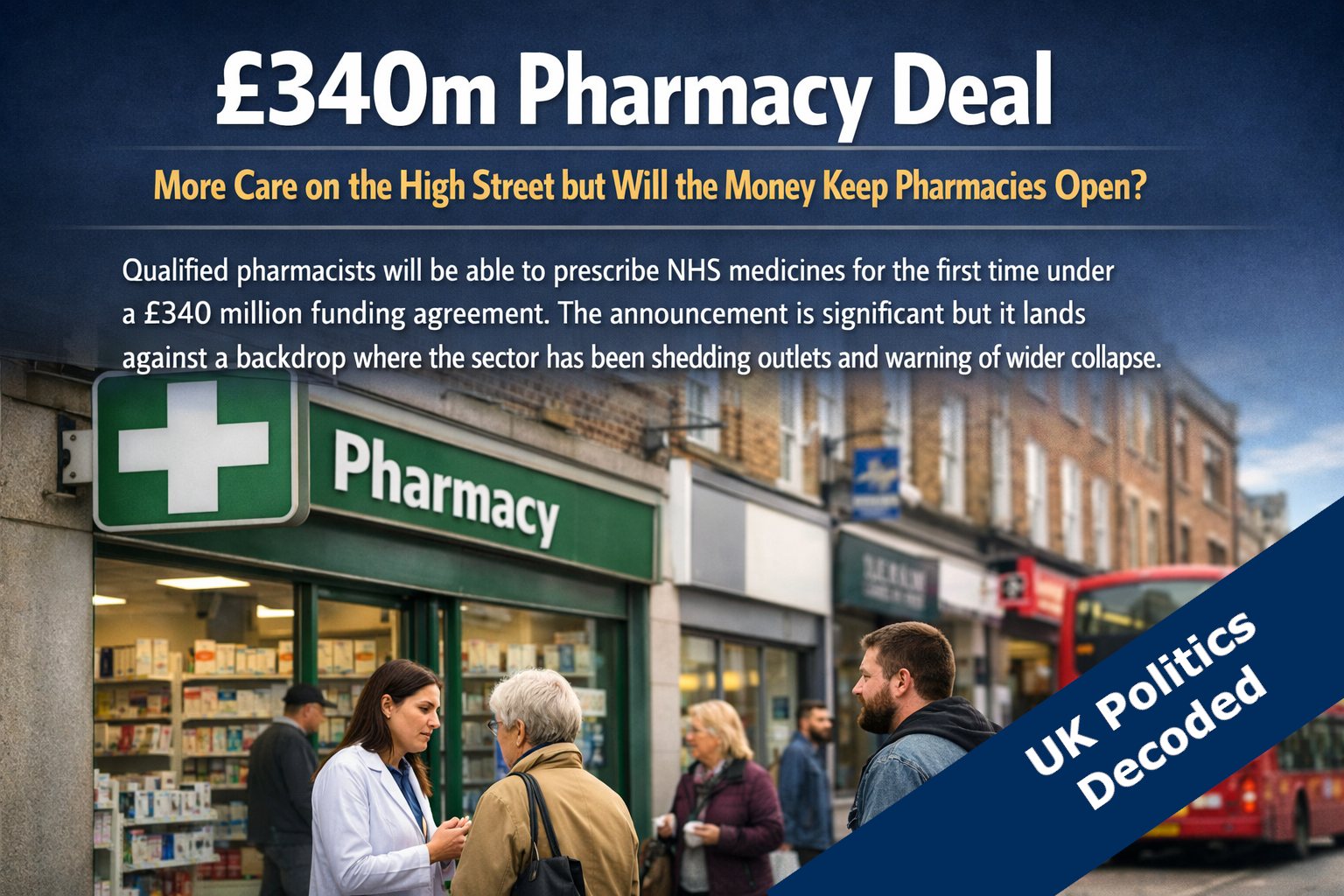
For most people, the pharmacy on their high street is still where you go for a prescription, a flu jab, or advice about a sore throat. But behind the counter, the economics have been brutal for years. Dispensing fees frozen, costs rising, staff stretched thin. The new £340 million government deal which will for the first time allow qualified pharmacists to independently prescribe NHS medicines is the most significant shift in community pharmacy's role in a generation. The question is whether it has come in time.
On 29 May 2026, the Department of Health and Social Care confirmed a new contractual framework for community pharmacies in England, agreed with Community Pharmacy England. The centrepiece is the rollout of independent prescribing, due to begin from autumn 2026.
Under the current Pharmacy First service, pharmacists can already assess and treat patients for seven common conditions, ear infections, sinusitis, sore throat, urinary tract infections, shingles, impetigo, and infected insect bites, using patient group directions, which are essentially pre-authorised standing orders for specific medicines. What they cannot do is independently assess a wider range of conditions and write their own prescriptions. That changes under this deal.
Pharmacists who hold an independent prescribing qualification, a post registration qualification recognised by the General Pharmaceutical Council will be able to assess patients and prescribe medicines across a broader range of health conditions as a nationally commissioned NHS service. The government says this will reduce referrals back to GPs and, in some cases, avoid patients needing to attend urgent treatment centres or A&E.
Key Points: What Is Changing
- £340 million in funding agreed with Community Pharmacy England for 2026 to 2027, described as record investment.
- Pharmacists with an independent prescribing qualification will be able to prescribe NHS medicines for a range of conditions, a first for England.
- The rollout begins autumn 2026, building on the existing Pharmacy First service.
- Aims to reduce GP referrals, cut A&E attendance for common conditions, and bring more care into neighbourhood settings.
- The deal covers England only. Pharmacy funding in Wales, Scotland, and Northern Ireland is devolved.
The Scale of Pharmacy First So Far
The Pharmacy First service launched in February 2024, and the usage figures are striking. Between March 2025 and February 2026, there were 3.3 million consultations, a 43% increase on the previous twelve months. NHS England data shows 86% of patients who used the service reported a positive experience.
That growth matters because it demonstrates patients are willing to use pharmacies for clinical care, not just dispensing. The independent prescribing expansion is designed to extend that logic to a wider range of conditions where a qualified pharmacist could, in principle, assess and treat without a GP in the loop at all.
Dr Amanda Doyle, NHS England's National Director for Primary Care and Community Services, said the deal would "make it easier for patients to get advice, treatment and medicines through their local pharmacy" while helping to reduce pressure on other NHS services.
Chief Pharmaceutical Officer David Webb called it "a huge step towards a more effective use of our highly trained workforce." Community pharmacists complete a five year master's degree and are regulated healthcare professionals. The argument from the sector has long been that their prescribing potential has been under-used.
A Sector That Was Running Out of Road
The deal matters not just for patients but for the survival of pharmacies as businesses. The funding context, when you look at it honestly, has been severe.
In August 2025, the National Pharmacy Association warned that 63% of independent pharmacies could close within a year without further financial support. The NPA which represents around 6,000 independent community pharmacies cited a combination of factors, a NHS funding settlement that had failed to keep pace with inflation, rising employment costs following the National Living Wage increase, and business rates pressure on high street premises. At the time, the association described the situation as an "existential crisis" for independent pharmacy.
The closures were already happening before that warning. Pharmacy numbers in England had been falling for several years, with data from NHS England showing a net reduction in the number of NHS contracted pharmacies. The losses were not evenly distributed. Rural areas and deprived urban communities, places where people are least able to travel to an alternative were seeing disproportionate closures. These are also, frequently, the areas where patients have least access to GP appointments and are most likely to benefit from pharmacy based care.
The Financial Squeeze on Independent Pharmacies
- The NPA reported in August 2025 that 63% of independent pharmacies said they could close within a year without further support.
- Dispensing fees had not kept pace with inflation, leaving many pharmacies subsidising NHS work from retail margins.
- Increases to the National Living Wage significantly raised staffing costs for businesses with thin margins.
- Business rates relief for high street premises remained a pressure point for smaller operators.
- The closures already occurring were hitting rural and deprived urban areas hardest.
How the New Deal Addresses the Viability Problem
The government has described the £340 million package as "record investment" and the first step in a programme of reform for the sector. Janet Morrison, Chief Executive of Community Pharmacy England, welcomed the agreement while noting it "opens the door to pharmacist prescribing" rather than fully resolving the funding gap. Malcolm Harrison, Chief Executive of the Company Chemists' Association, said the announcement "recognises the longstanding and significant economic challenges facing the sector" while calling independent prescribing "a generational opportunity."
What the deal does, structurally, is change what community pharmacies can be paid to do. At present, NHS income for a dispensing pharmacy is heavily weighted toward dispensing fees, payments for each prescription item dispensed. These fees have historically been inadequate to cover costs in many cases, with many pharmacies dependent on over the counter retail sales to remain viable. The expansion of commissioned clinical services, Pharmacy First, blood pressure checks, contraception, antidepressant support, and now independent prescribing creates new income streams tied to clinical activity rather than dispensing volume.
In theory, a pharmacy in a deprived area with high NHS footfall could, under the new model, generate more clinical services income. That rebalancing is what the sector's representative bodies have been pushing for, a model where community pharmacies are paid for what they do clinically, not just what they dispense.
What Independent Prescribing Will Look Like in Practice
Not every pharmacist is an independent prescriber. The qualification is a post registration course that takes around a year and covers clinical assessment, diagnosis, and therapeutics. As of 2026, a growing but still minority proportion of registered pharmacists in England hold it. NHS England will need to set out what conditions will fall within the scope of the nationally commissioned service, how consultations will be recorded and shared with GP records systems, and how quality assurance will work.
The model being described is one where patients with conditions that currently bounce back and forth between pharmacy and GP, repeat skin conditions, recurrent UTIs, some respiratory issues, could be managed end to end at pharmacy level. That is a meaningful shift in how primary care works. It is also a shift that requires the NHS to invest in the digital infrastructure connecting pharmacies to GP records, something the government's 10 Year Health Plan has committed to under the neighbourhood health service framework.
The Neighbourhood Health Strategy
The pharmacy deal sits inside a broader strategic direction. The government's 10 Year Health Plan centres on shifting care away from hospitals and into community settings, GPs, pharmacies, community nurses, social prescribers, and other local services working as integrated neighbourhood teams. Community pharmacies, the plan envisages, will be digitally connected nodes in those teams, not standalone dispensing outlets.
If that model works, pharmacy becomes more financially sustainable because it is doing more, and more clinically complex, NHS funded work. If it stalls because the digital connections are not built quickly enough, or because independent prescribing uptake is slow, or because the 2026-2027 funding does not follow through into subsequent years pharmacies remain financially fragile despite the announcement.
The sector's representatives have been careful to welcome the deal without overstating it. Morrison's language was pointed, the agreement "opens the door" and is "a first step." Harrison noted the deal "recognises" economic challenges but stopped short of claiming it resolves them. That is the honest position. £340 million across England's roughly 11,000 NHS contracted pharmacies works out to around £30,000 per pharmacy on average, meaningful, but not transformative in isolation.
Key Takeaways
- A £340 million NHS pharmacy deal for 2026 to 2027 includes the first nationally commissioned independent prescribing service in England, launching from autumn 2026.
- Pharmacists with the independent prescribing qualification will be able to assess patients and prescribe medicines directly, reducing the need for GP referrals for a wider range of conditions.
- Pharmacy First consultations grew 43% year on year to 3.3 million between March 2025 and February 2026, showing strong patient uptake of pharmacy based care.
- The announcement comes after the NPA warned in 2025 that 63% of independent pharmacies could close without further support, driven by funding shortfalls and rising costs.
- The sector's representative bodies have cautiously welcomed the deal as a meaningful first step, while stopping short of claiming it fully resolves the financial pressures facing community pharmacy.
- The longer term viability of pharmacy depends on whether the clinical services model and the digital infrastructure underpinning it is funded and built out in subsequent years.