AI Use: AI tools were used to support source discovery and to structure the article for clarity. All research, verification, drafting, and final editorial decisions are fully human led. Learn about our AI policy.
When Woking Borough Council declared itself effectively bankrupt in June 2023, its debts stood at more than £2 billion. That figure was nearly 100 times the council's annual budget. Thurrock Council built up £1.5 billion in debt through a series of failed investments. Both situations required central government intervention, and the bill for bailing out Woking alone has so far reached £500 million. On 28 May 2026, the Ministry of Housing, Communities and Local Government announced it intends to make sure neither happens again.
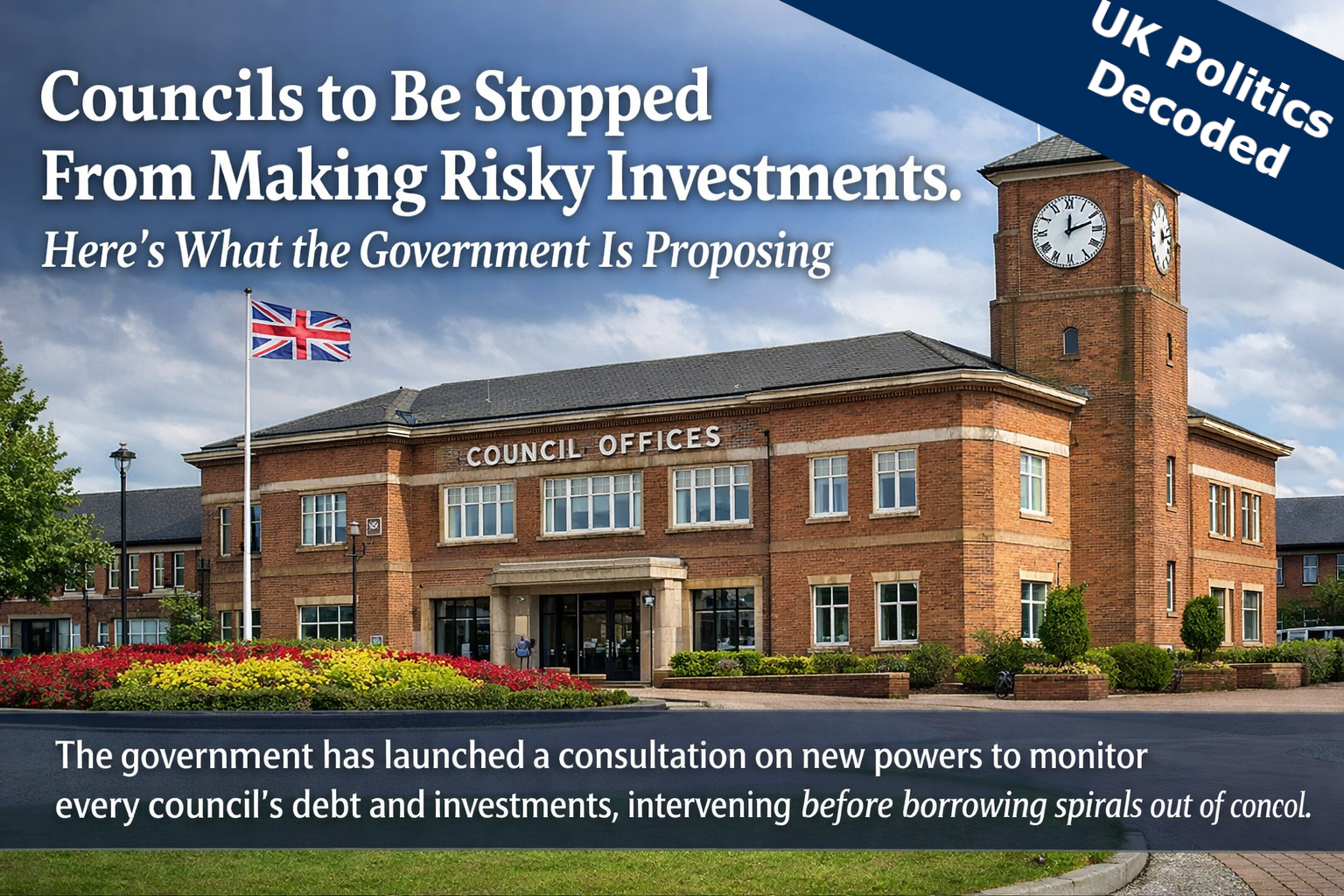
The government has launched a consultation on switching on dormant powers under the Local Government Act 2003, as amended by the Levelling Up and Regeneration Act 2023. These powers, which would require new regulations to become operational, would let ministers track every council's investment portfolio, debt levels, and revenue streams in real time, setting risk thresholds that trigger oversight and, where necessary, formal intervention.
What the Government Is Proposing
- New monitoring regime: Government to track every council's investments, debt, and revenue to identify financial risk early.
- Risk thresholds: Regulations will define the metrics that bring a local authority into scope for intervention.
- Existing legal powers: The powers exist under the Local Government Act 2003 (section 12), amended by the Levelling Up and Regeneration Act 2023. Regulations are needed to activate them.
- Consultation period: Runs from 28 May to 6 August 2026.
- Combined Authorities: The consultation also considers how these powers could apply to Combined Authority debt.
What Went Wrong in Woking and Thurrock
The scale of the Woking collapse is hard to overstate. Between 2016 and 2019, the council pursued an overambitious regeneration programme, borrowing extensively to invest in commercial property and development schemes. When those investments failed to generate the projected returns, the debt became unserviceable. The council eventually declared a Section 114 notice, the closest equivalent in local government to insolvency and central government had to step in.
Thurrock's situation was different in structure but similar in consequence. The council borrowed heavily to invest in solar energy projects and other commercial ventures. When those investments collapsed, around £1.5 billion was lost. Both councils have since curbed their borrowing, but the financial damage is lasting. Woking's debt is set to be transferred to the newly forming West Surrey Council as part of the wider local government reorganisation.
Local Government Minister Alison McGovern said the government "can't afford to wait until a council is on the brink of collapse to act." The consultation's stated goal is to create an early warning system, identifying risk before it tips into crisis rather than managing the fallout after the fact.
How the Powers Would Work
The proposal is built around capital risk metrics defined financial thresholds that, if crossed, would bring a council into scope for government scrutiny and potential intervention. The consultation is asking for views on what those thresholds should be, how they should be calculated, and what oversight steps would follow once a council enters scope.
Crucially, the powers are not yet in force. The legal basis exists, but regulations are required to specify the actual risk thresholds and the operational framework for how intervention would work. The consultation is the process by which those details are being designed. The government is also inviting views on what other measures might complement the metrics system.
The Legal Framework
- Primary legislation: Section 12 of the Local Government Act 2003 gives ministers powers over local authority borrowing and investments.
- Recent amendment: The Levelling Up and Regeneration Act 2023 strengthened and broadened those powers.
- What is missing: Secondary regulations specifying the risk thresholds and the operational framework. The consultation informs these.
- When they come into force: Only after the consultation concludes and regulations are laid before Parliament.
What the Sector Is Saying
Woking's current deputy leader, Dale Roberts, welcomed the consultation publicly. He acknowledged the risks "associated with the scale of borrowing taken on by the previous administration" and said stronger oversight was "essential to preventing similar situations happening again." The council committed to providing a full response before the August deadline.
The announcement is also framed within the government's wider local government finance agenda. The Ministry of Housing, Communities and Local Government has separately made £78 billion available through the Fair Funding Review, a multi year settlement described as the first in a decade, aimed at getting councils back on a stable financial footing. The new monitoring powers sit alongside that funding, rather than replacing it: the theory being that better oversight and more sustainable funding together reduce the conditions under which excessive borrowing tends to occur.
What This Means for Councils
For most councils, which manage their finances prudently, these powers would have no practical effect. The proposals are explicitly targeted at identifying outliers authorities whose borrowing or investment positions look disproportionate relative to their size and revenue base not at imposing blanket restrictions on all council investment activity.
Whether the metrics prove fit for purpose will depend heavily on what the regulations eventually specify. A system that flags genuine risk early is valuable. One that triggers intervention too readily, or too late, solves a different problem. That calibration is precisely what the consultation is seeking to get right, and it is why the government has allowed more than two months for responses.
Key Takeaways
- The government wants to activate existing but dormant powers to monitor council debt, investments, and revenue in real time.
- A public consultation on the capital risk metrics framework runs from 28 May to 6 August 2026.
- The powers require secondary regulations to come into force they will not be operational until after the consultation concludes.
- Woking and Thurrock are the clearest examples of what unchecked municipal borrowing can cost taxpayers: over £3.5 billion in combined debt, and at least £500 million in government bailout funding for Woking alone.
- Woking's deputy leader has welcomed the proposals; the council will submit a formal response to the consultation.
- The proposals sit alongside the Fair Funding Review's £78 billion settlement, part of a broader effort to put local government finances on a more stable footing.
Sources & Further Reading
- GOV.UK - Councils to be prevented from making risky investments (28 May 2026) Archived copy: UK Politics Decoded archive
- BBC News - Government plans to cut risky council borrowing welcomed by Woking (1 June 2026) Archived Privately for Evidence Verification
- GOV.UK - Capital risk metrics implementation and mitigation measures (consultation) Archived copy: UK Politics Decoded archive