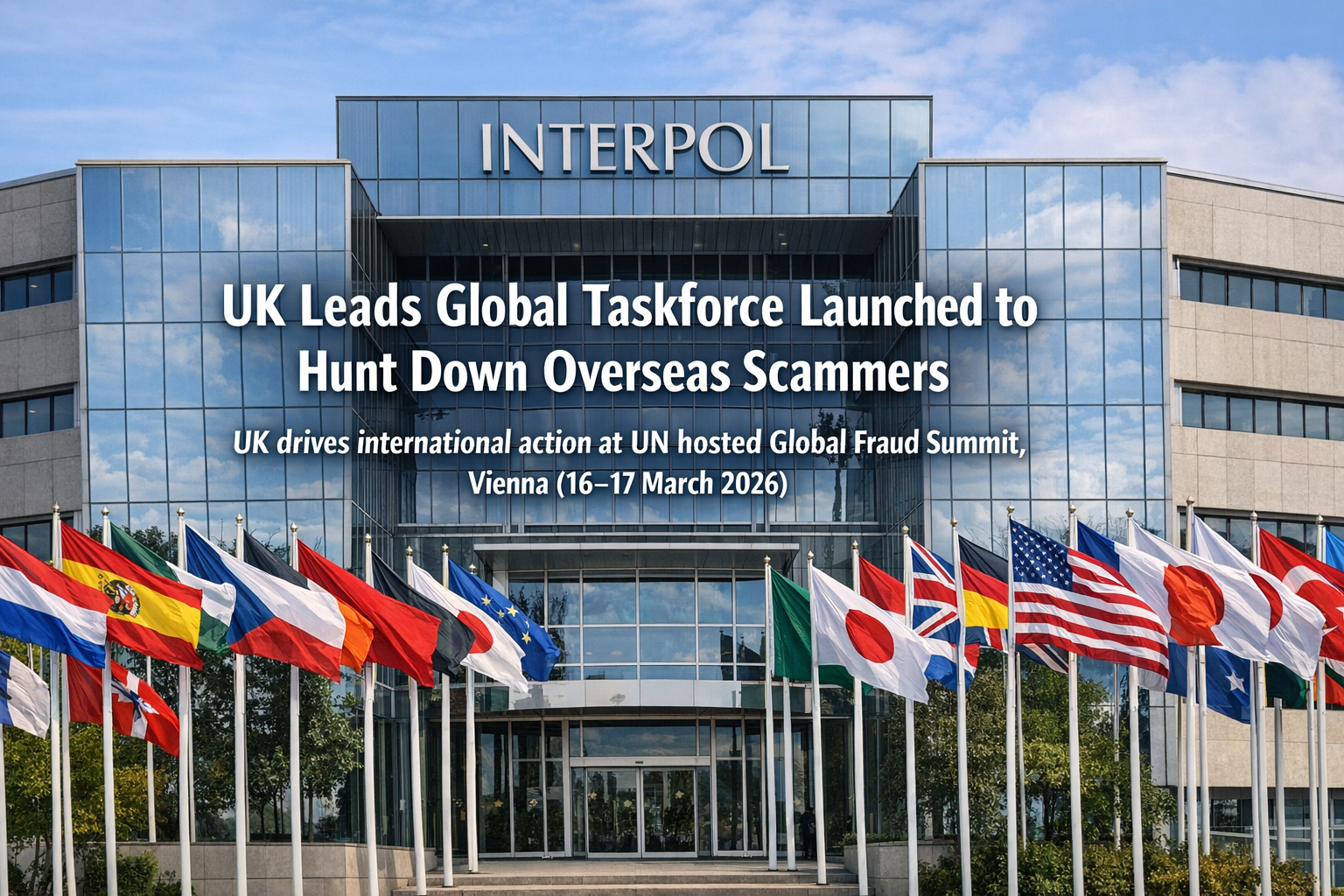
A new INTERPOL Global Taskforce, codenamed Operation Shadow Storm, has been launched to target overseas scam networks responsible for the majority of fraud affecting UK victims. The initiative was unveiled at the Global Fraud Summit in Vienna, convened by the UK and hosted by the United Nations and INTERPOL on 16 and 17 March 2026. The taskforce will coordinate intelligence across 196 countries to identify, disrupt and dismantle scam compounds, with an initial focus on South East Asia.
Key Points at a Glance
- The UK led a gathering of 40 ministers, 100+ countries, and 300 industry leaders at the Global Fraud Summit in Vienna
- INTERPOL announced Operation Shadow Storm, a new global unit to pool intelligence and coordinate disruption of scam networks
- A global public-private partnership was signed between governments and major tech firms including Meta, Google, Amazon, Match Group, and VMO2 Media
- New UK figures show over two thirds of scams targeting British people originate overseas
- The UK's Fraud Strategy 2026-2029, backed by £250 million, underpins the domestic side of this international effort
What Happened
The Global Fraud Summit brought together ministers, law enforcement agencies, international organisations, and private sector leaders from across the world. The UK convened the event, which was hosted by the United Nations Office on Drugs and Crime (UNODC) and INTERPOL in Vienna.
At the summit, INTERPOL announced the creation of Operation Shadow Storm, a dedicated global taskforce designed to pool intelligence across borders, trace scam operations through bank accounts, crypto wallets, phone numbers and social media profiles, and coordinate rapid disruption including freezing assets and shutting down communication channels. The taskforce will also support joint raids against scam compounds, with an initial operational focus on South East Asia, where large scale fraud operations have been documented.
Alongside the INTERPOL announcement, a global public-private partnership was signed between governments and major technology firms. Signatories include Meta, Google, Amazon, Match Group, and VMO2 Media. The partnership commits these companies to sharing intelligence with law enforcement and acting earlier on emerging threats before scams reach the public at scale.
Why It Matters
Fraud is now a transnational, industrial scale crime
The government describes fraud as the UK's most common crime. It is increasingly run from large scale scam compounds abroad, which exploit online platforms, encrypted messaging, and cross border payment systems to target victims in the UK and elsewhere. New government figures presented at the summit show that over two thirds of scams affecting British people originate from outside the UK.
Domestic enforcement alone cannot reach the perpetrators
With most scam networks operating outside UK jurisdiction, the government argues that only coordinated international action can meaningfully disrupt them. UK police and intelligence agencies cannot arrest or prosecute individuals operating from compounds in South East Asia, West Africa, or parts of India without cooperation from those countries and international bodies.
The scale of the problem
Impact on individuals
- 1 in 14 adults in the UK have been victims of fraud
- 1 in 4 businesses have been targeted
- Scams increasingly use social media, messaging apps, and online marketplaces
The international dimension
- Criminal groups operate from scam compounds in South East Asia, West Africa and parts of India
- Fraudsters exploit crypto based payment channels to move money rapidly across borders
- Over two thirds of scams targeting UK victims originate overseas
What Operation Shadow Storm Will Do
Operation Shadow Storm is structured around four core functions. First, it will pool intelligence from law enforcement agencies across INTERPOL's 196 member countries, creating a shared picture of active scam networks that no single country could build alone. Second, it will trace the infrastructure that scam operations depend on, including bank accounts, cryptocurrency wallets, phone numbers, and social media profiles used to contact and defraud victims.
Third, it will coordinate rapid disruption actions, including freezing financial assets and shutting down communication channels used by scammers. Fourth, it will support joint law enforcement raids against physical scam compounds, where large numbers of people are often employed or coerced into running fraud operations.
The initial operational focus is South East Asia, a region where large scale scam compounds have been extensively documented by journalists and human rights organisations in recent years.
The Public-Private Partnership
A significant element of the Vienna summit was the signing of a formal global public-private partnership between governments and major technology companies. The companies involved, Meta, Google, Amazon, Match Group, and VMO2 Media, have committed to sharing intelligence with law enforcement agencies and acting earlier when emerging fraud threats are identified on their platforms.
The rationale is straightforward, most scams reach victims through digital channels controlled by private companies. Social media platforms, search engines, online marketplaces, and messaging services are the primary routes through which fraudsters contact potential victims. Without cooperation from these companies, law enforcement agencies cannot access the data needed to identify and disrupt scam operations at scale.
The UK's Broader Anti Fraud Strategy
The Vienna summit builds on a series of steps the UK government has taken to address fraud both domestically and internationally.
Bilaterally, the UK has signed intelligence sharing agreements with Nigeria and Vietnam, and has participated in recent joint operations that dismantled scam centres in Nigeria and India. These operations demonstrated that coordinated international action can produce results, and the government has cited them as evidence that the approach being scaled up through Operation Shadow Storm is viable.
Domestically, the government has launched the Fraud Strategy 2026-2029, backed by £250 million. A central element of this strategy is a new online crime centre that links government departments, police forces, intelligence agencies, banks, and technology firms. The centre is designed to integrate international data streams into domestic enforcement, so that intelligence gathered through Operation Shadow Storm and bilateral partnerships can be acted upon within the UK.
Key Quotes
Lord Hanson, Minister for Fraud: "Fraud is now a global crime run by organised networks operating across borders and targeting victims at industrial scale… Through a new taskforce that will disrupt and dismantle fraud networks worldwide… we are protecting the British public from our country's most common crime."
Nick Sharp, National Crime Agency: "The Global Fraud Taskforce is an exciting and important step forward… As these criminals continue to grow in sophistication and across borders, it is important law enforcement and industry works together to protect the public."
John Brandolino, UNODC Acting Executive Director: "We are facing a very different kind of fraud… sophisticated, organised, and perpetrated across borders with breath taking speed."
What Happens Next
INTERPOL will begin coordinated intelligence operations under Operation Shadow Storm, prioritising high volume scam compounds. Governments and technology firms will begin implementing the new intelligence sharing partnership agreed at Vienna. The UK's new online crime centre will integrate international data streams into domestic enforcement operations.
Further bilateral agreements are expected as the UK expands its overseas disruption model beyond the existing partnerships with Nigeria and Vietnam. The government has indicated that the Vienna summit is intended as the beginning of an ongoing international process rather than a one off event.
Conclusion
The initiative signals a shift in the UK's anti fraud posture from reactive victim support to proactive, international disruption. Rather than focusing primarily on helping people who have already been defrauded, the strategy aims to target the infrastructure that makes fraud possible before scams reach the public.
The success of Operation Shadow Storm will depend on several factors, cooperation from countries hosting scam compounds, the willingness of technology firms to share actionable intelligence, the speed at which INTERPOL can coordinate cross border enforcement, and the ability to disrupt financial flows that move rapidly through global banking and cryptocurrency systems. Its effectiveness will become clearer only as early operations unfold.
Sources & Further Reading
- Gov.UK — Global taskforce launched to hunt down overseas scammers Archived copy (OGL): archived page
- Gov.UK — Fraud Strategy 2026-2029 (PDF) Archived copy (OGL): archived page
AI Use: AI tools were used to support source discovery and to structure the article for clarity. All research, verification, drafting, and final editorial decisions are fully human led.