AI Use: AI tools were used to support source discovery and to structure the article for clarity. All research, verification, drafting, and final editorial decisions are fully human led. Learn about our AI policy.
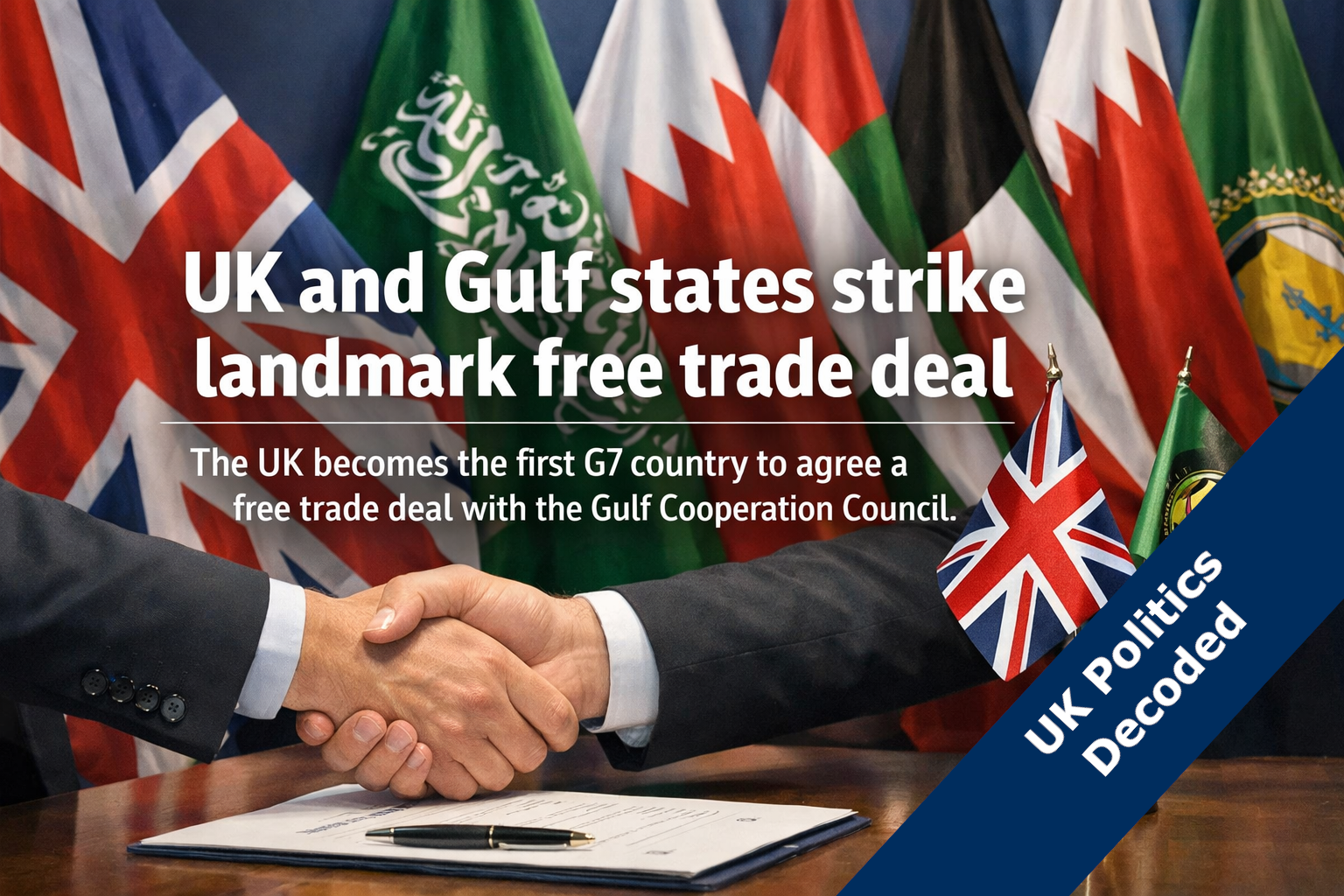
The UK has agreed a free trade deal with the Gulf Cooperation Council (GCC), making it the first G7 nation to reach such an agreement with the six country bloc. The deal was announced on 20 May 2026 and covers Bahrain, Kuwait, Oman, Qatar, Saudi Arabia, and the United Arab Emirates, a region with which the UK already trades roughly £53 billion a year.
The government says the deal will remove an estimated £580 million in annual duties on existing UK goods exports to the GCC once fully implemented, with £360 million of that removed on the day the agreement comes into force. Separate government modelling projects a long run boost to UK GDP of £3.7 billion a year, though that figure comes with significant caveats explained below.
Key Points at a Glance
- First G7 deal with GCC: The UK is the first major economy in the G7 to agree a free trade agreement with the six Gulf states.
- Tariff reductions: An estimated £580 million in annual duties on UK goods exports will be eliminated once fully in force, £360 million from day one.
- GDP projection: Government modelling estimates a long run increase of £3.7 billion a year to UK GDP, compared to a baseline of no deal by 2040.
- Wage impact: The same modelling projects a £1.9 billion annual increase in real wages, equivalent to around £60 per worker per year on average.
- Services access: UK services exporters gain guaranteed market access, the GCC imports around 80% of its food, opening opportunities for UK agri food exporters.
What the deal actually covers
The agreement removes tariffs across a wide range of UK goods heading to Gulf markets. Food and drink features prominently cereals, cheddar cheese, chocolate, butter, and biscuits are among the categories expected to become tariff free once the deal is in force. The GCC imports more than 80% of its food, so British agri food exporters stand to gain new competitive footing.
The UK automotive industry and retailers, the government cited Holland & Barrett as one example, are also expected to benefit, with tariff reductions, stronger intellectual property protections, and simplified customs processes all included.
Services and professional access
Services make up around 80% of the UK economy and roughly half of UK exports to the GCC. The deal locks in guaranteed market access for services exporters and makes it easier for UK professionals, lawyers, engineers, consultants to travel to Gulf countries and stay longer. Visa processes are to become clearer and increasingly digital.
One provision highlighted by the government as a first for any GCC trade agreement, UK companies will be able to store and process data outside the Gulf region. Previously, firms often faced pressure to build costly local data centres. That requirement is lifted under the deal.
Customs and logistics
The deal includes what the government describes as the most ambitious customs commitments the GCC has ever agreed to. Standard shipments would clear customs within 48 hours, perishable goods within six hours, once all requirements are met. For food and pharmaceutical exporters, that speed of clearance matters commercially.
What changes on day one vs. in the long run
- Day one: An estimated £360 million in annual duties removed immediately when the agreement enters into force.
- Fully implemented: Total annual duty removal rises to an estimated £580 million, covering a broader range of tariff lines phased in over time.
- Staged tariff removal: Some tariff lines are subject to gradual reduction rather than immediate elimination, the full schedule has not yet been published in detail.
- Data rules: UK firms will be able to store and process Gulf market data outside the region, removing the requirement to build local data infrastructure.
Understanding the economic figures
The headline numbers, £3.7 billion added to GDP, £1.9 billion in real wages come from preliminary government modelling published alongside the announcement. They deserve to be read carefully.
What the modelling actually says
The Department for Business and Trade's technical note is explicit that these are not forecasts. They represent the estimated difference between having the deal in place and not having it, compared to projected 2040 baseline figures. They are long run estimates, not something that happens overnight, or even in the first few years after the deal comes into force.
How to read the GDP and wages figures
- Not a forecast: The £3.7 billion GDP figure is a modelled comparison against a 2040 baseline where no deal exists, it is not a prediction of how much richer the UK will be next year.
- Long run and permanent: The modelling suggests a permanent annual gain once the effects work through the economy over time not a one off boost.
- Wages per worker: The £1.9 billion wage impact, applied to the current UK workforce, equates to around £60 per worker per year on average in the long run.
- Trade increase: DBT models a 19.8% increase in total bilateral trade, roughly £15.5 billion more a year by 2040 compared to no deal.
- Caveats apply: The modelling does not account for the conflict in the Middle East, recent US tariff announcements, or other geopolitical developments.
Combined effect with the India deal
The UK agreed a separate free trade deal with India in May 2025. When the two agreements are modelled together, the combined GDP impact rises to around £8.5 billion a year in the long run, 0.2% of projected 2040 GDP. The GCC deal alone accounts for roughly £3.7 billion of that figure, the India deal for around £4.8 billion.
Where this sits in the government's wider trade agenda
Ministers have framed this as the fifth major trade agreement since the current government took office following deals with India, the United States, the European Union, and South Korea. The GCC deal is presented as evidence of the UK's ability to negotiate preferential trade arrangements now it operates outside EU frameworks.
Total two way investment between the UK and the Gulf states stood at £18 billion in 2024, according to the government's announcement. That includes critical infrastructure, Heathrow Airport is cited as an example of Gulf investment already embedded in the UK economy. The deal includes provisions designed to ensure future investment disputes are resolved fairly and transparently.
What is confirmed
- Duty removals: £580 million in annual tariff savings on UK goods exports once fully implemented.
- Services access: Guaranteed market access for UK services firms across all six GCC states.
- Data rules: UK companies can store and process Gulf data outside the region for the first time.
- Customs speed: 48 hour standard clearance, 6 hour clearance for perishables, once requirements are met.
Conclusion: A significant agreement with real benefits still to be realised
The UK-GCC free trade agreement is a substantive deal with tangible commitments on tariffs, services access, customs, and data. For British exporters particularly in food and drink, professional services, and advanced manufacturing, it opens doors that were not open before.
The economic projections are large numbers that require context. A £3.7 billion annual GDP gain and £60 more per worker per year sound significant, and the modelling behind them follows standard international methodology but these are long run estimates measured against a 2040 baseline, not near term windfalls. The government has been clear that a fuller impact assessment will follow.
What happens next depends on ratification, implementation, and how quickly UK businesses begin using the preferential terms on offer. The deal is signed, the benefits are not yet automatic.
Key Takeaways
- The UK is the first G7 country to agree a free trade deal with the six nation Gulf Cooperation Council.
- The deal removes an estimated £580 million in annual duties on UK goods exports to the Gulf once fully implemented.
- Government modelling projects a long run GDP gain of £3.7 billion a year and a £1.9 billion real wage increase compared to a 2040 baseline with no deal.
- Key new provisions include guaranteed services market access, data storage freedoms, and faster customs clearance for UK exporters.
- The deal must still be formally ratified before any provisions take effect, the full tariff schedule has not yet been published in detail.
Sources & Further Reading
-
GOV.UK - UK and Gulf strike historic multi billion pound trade deal (20 May 2026)
Archived copy (OGL): archived page -
GOV.UK - Technical note: preliminary economic impacts of the UK-GCC Free Trade Agreement (20 May 2026)
Archived copy (OGL): archived page - ONS - UK total trade: all countries, seasonally adjusted (Q4 2025)