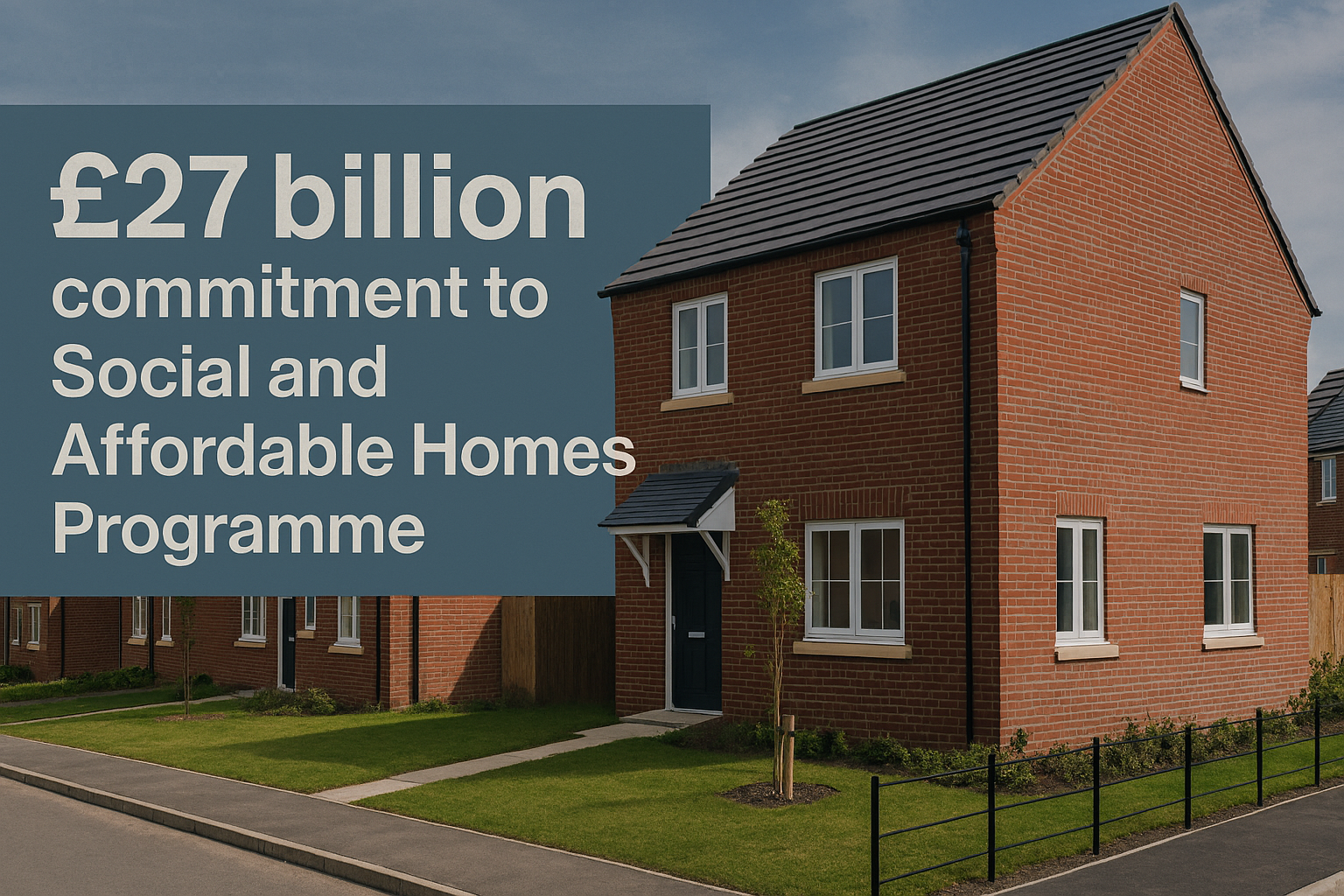
Homes England has opened bidding for the Social and Affordable Homes Programme (SAHP) 2026–2036, a decade long funding scheme designed to increase the supply of social rent, affordable rent and shared ownership homes across England. The programme forms part of the government's wider £39 billion investment in social and affordable housing, with at least £27 billion delivered through Homes England.
Ministers frame SAHP as delivering the "biggest increase in social and affordable housing in a generation" while establishing new requirements that at least 60% of funded homes must be for social rent, signalling a policy shift towards the most affordable tenure.
🎯 Programme Overview
- £27 billion funding over decade long programme through Homes England
- 60% social rent minimum requirement for all funded developments
- Two bidding routes: Continuous Market Engagement and Strategic Partnership Framework
- Mixed tenure focus: Social rent, affordable rent, and shared ownership
- Long term certainty: Ten year funding cycle replacing previous five year programmes
🏗️ What the Programme Aims to Achieve
The government and Homes England frame SAHP as a major expansion of affordable housing delivery addressing persistent supply shortages and affordability challenges across England.
Core Policy Objectives
The programme is intended to deliver comprehensive housing outcomes:
- Increase social rent supply: Prioritising lowest cost tenure through 60% minimum requirement
- Support mixed tenure developments: Integrating different housing types in single developments
- Maintain high quality standards: Design, safety and sustainability requirements
- Align with local needs: Coordinating new housing with local strategies and demand
- Provide long term certainty: Multi year planning horizons for providers
Government Housing Strategy Integration
SAHP connects with broader government housing commitments:
📈 Wider Housing Targets
- 1.5 million homes: Total new homes target during this Parliament
- £39 billion investment: Overall social and affordable housing commitment
- Planning reform coordination: Aligning funding with streamlined approval processes
- Regional balance: Supporting development across different economic areas
- Tenure diversity: Ensuring range of housing options for different household needs
📋 Two Bidding Routes Available
Homes England has established two distinct pathways for organisations to access SAHP funding, designed to accommodate different provider scales and delivery approaches.
1. Continuous Market Engagement (CME)
CME provides flexible access for scheme by scheme bidding:
- Rolling access: Continuous application opportunities throughout programme duration
- Scheme specific bidding: Individual project applications rather than bulk allocations
- Local responsiveness: Flexibility to respond to changing housing needs and opportunities
- Ongoing certainty: Clear grant availability throughout programme period
- Smaller provider access: Suitable for organisations with limited development pipelines
2. Strategic Partnership Framework
Strategic partnerships target large scale, high pace delivery:
💰 Partnership Benefits
- Long term funding certainty: Multi year allocation commitments
- Scale requirements: Pace and scale delivery expectations
- Strategic planning: Multi year development programmes
- Ambitious delivery: Higher volume housing completion targets
📊 Selection Criteria
- Delivery track record: Proven capacity for large scale development
- Financial capability: Resources to manage significant funding allocations
- Pipeline readiness: Substantial development opportunities identified
- Value for money: Cost effective delivery models and processes
Updated Bidding Guidance
Homes England has published comprehensive guidance addressing:
- Programme requirements: Detailed expectations and assessment criteria
- Application processes: Step by step guidance for both bidding routes
- Quality standards: Design, sustainability, and safety specifications
- Value for money frameworks: Cost effectiveness assessment methodology
- Delivery milestones: Timeline expectations and progress monitoring
🏘️ Key Changes from Previous Programmes
SAHP introduces significant modifications compared with the Affordable Homes Programme (AHP) 2021–2026, reflecting lessons learned and evolving policy priorities.
Programme Structure Changes
The new programme addresses previous structural limitations:
| Programme Element | AHP 2021–2026 | SAHP 2026–2036 |
|---|---|---|
| Duration | 5 year cycle | 10 year cycle |
| Social Rent Priority | No minimum requirement | At least 60% social rent |
| Mixed Tenure Focus | Limited emphasis | Explicit requirement |
| Bidding Routes | Single process | CME and Strategic Partnerships |
Policy Emphasis Shifts
The programme reflects changing government priorities:
- Stronger social rent focus: 60% minimum represents significant increase from previous programmes
- Greater sustainability emphasis: Updated environmental and climate resilience standards
- Enhanced quality expectations: Clearer design and safety specifications
- Improved value for money frameworks: More sophisticated cost effectiveness assessments
- Flexible delivery models: Accommodating different provider capabilities and local contexts
🌍 Structural Challenges Shaping Housing Delivery
SAHP is being launched amid multiple structural pressures that affect both housing supply and household ability to afford new homes, creating complex delivery challenges that extend beyond traditional housing policy.
Labour Market and Affordability Pressures
Declining job vacancies and employment uncertainty affect housing demand:
Employment Impact on Housing Affordability
- Stricter mortgage assessments: Lenders perceive higher employment risk in tight labour market
- Reduced deposit capacity: Slower wage growth or reduced hours limit savings ability
- Higher living cost pressures: Rising bills reduce disposable income for housing
- Developer market adjustments: Focus on higher margin homes if fewer buyers qualify
- Longer term financial uncertainty: Households reluctant to commit to major debt
Grid Capacity and Infrastructure Constraints
Delivering hundreds of thousands of new homes requires major electricity grid upgrades:
- Heat pump infrastructure: Electrification of heating requiring significant capacity increases
- EV charging preparation: Anticipating widespread electric vehicle adoption
- Renewable energy integration: Grid modernisation for distributed generation
- Connection timescales: Infrastructure upgrades affecting development timing
- Cost implications: System wide upgrades funded through consumer bills and investment frameworks
Even without the transition to low carbon heating, new housing developments require significant grid reinforcement, and these costs can influence:
- Connection timescales for new developments
- Local infrastructure charges passed through planning obligations
- Household energy bills, as system wide upgrades are funded through a mix of consumer bills and investment frameworks
The scale of development anticipated under SAHP means grid capacity will remain a central issue for local planning authorities, distribution network operators and developers.
Climate Risk and Land Use Planning
New homes continue to be built in areas with known flood risk, including locations where flooding is currently being reported. This reflects long standing pressures on land availability, particularly in regions with high housing demand.
🌊 Flood Risk Considerations
- Ongoing flood events: New homes being built in areas experiencing current flooding
- Planning authority dilemmas: Balancing housing need with environmental risk
- Higher development costs: Flood resilient design and drainage systems
- Insurance implications: Higher premiums or coverage limitations for residents
🗺️ Land Availability Pressures
- Regional variation: Different climate risks across England
- Long term sustainability: Climate change increasing event frequency
- Mitigation requirements: Additional costs for climate resilient construction
- Strategic planning: Integrating flood risk with housing need assessments
These factors shape where new homes can be delivered and the cost of making them safe and sustainable.
📍 Regional Housing Market Variations
Housing pressures vary significantly across England, meaning SAHP impact will differ substantially between regions and local areas.
South East and South West Pressures
High demand regions face acute affordability challenges:
- House price to earnings ratios: Severe affordability gaps relative to local wages
- Limited social rent availability: Long waiting lists and high demand for affordable tenures
- Infrastructure constraints: Grid capacity and transport links limiting development
- Land availability: High competition for suitable development sites
- Economic migration: Workers moving to access employment affecting local demand
North and Midlands Challenges
Some regions in the North and Midlands face slower population growth or economic transition, affecting the viability of large scale developments
Different regional dynamics affect housing delivery viability:
🏭 Economic Transition Regions
- Slower population growth: Affecting demand for large scale developments
- Economic restructuring: Industrial change influencing employment and housing needs
- Infrastructure legacy: Older grid and transport systems requiring upgrade
- Development viability: Lower sales values affecting scheme economics
- Regeneration opportunities: Brownfield sites available for mixed tenure development
These regional differences shape both the opportunities and the constraints for delivering new social and affordable homes
Infrastructure and Risk Mapping
Regional differences in infrastructure readiness and flood risk shape delivery opportunities:
- Grid capacity variations: Some areas better prepared for electrification than others
- Flood risk concentration: River valleys and coastal areas facing particular challenges
- Transport connectivity: Access to employment centres affecting housing demand
- Planning policy differences: Local authority approaches to balancing housing and environment
- Economic base diversity: Employment resilience affecting long term housing viability
Conclusion: Ambition Within Constraints
The Social and Affordable Homes Programme represents the most significant commitment to social housing delivery in over a decade, providing £27 billion over ten years with clear priorities for social rent and mixed tenure development. The programme addresses genuine need and offers providers long term funding certainty essential for strategic planning.
The 60% social rent requirement signals a meaningful policy shift towards the most affordable tenure, recognising that market housing costs have moved beyond reach for increasing numbers of households. The flexible bidding routes accommodate different provider scales and capabilities, while strategic partnerships enable ambitious delivery programmes.
However, housing delivery operates within structural constraints that extend beyond traditional housing policy. Grid capacity limitations, flood risk pressures, labour market uncertainty, and regional economic variations all affect where, when, and how new homes can be built. These challenges require coordinated government action across multiple departments and policy areas.
The programme's ten year duration provides opportunity for sustained delivery but also creates political sustainability risks. Electoral cycles, Spending Review pressures, and changing policy priorities could affect long term funding commitment. Success requires maintaining focus through inevitable political changes and economic fluctuations.
Most critically, SAHP success cannot be measured solely in homes delivered but must consider housing affordability, regional balance, climate resilience, and contribution to broader social and economic objectives. The programme provides essential resources, but delivery depends on workforce capacity, infrastructure readiness, planning system efficiency, and markets that enable people to afford new homes.
The scale of ambition is clear and necessary. Whether SAHP delivers transformational change depends on sustained political commitment, coordinated policy implementation, and recognition that housing challenges require comprehensive responses addressing supply, affordability, infrastructure, and employment together.
🎯 Key Takeaways
- £27 billion decade long programme requires 60% social rent delivery through two flexible bidding routes
- Success depends on grid capacity, flood risk management, workforce availability, and regional economic conditions
- Labour market uncertainty affects household affordability and mortgage accessibility for new homes
- Regional variations in infrastructure readiness and economic conditions will create uneven delivery opportunities
- Programme provides funding certainty but delivery requires coordinated action across multiple policy areas
📚 Sources & Further Reading
- Gov.UK - Homes England opens bidding for ten-year social and affordable homes programme Archived copy (OGL): archived page
- Gov.UK - Social and Affordable Homes Programme (SAHP) 2026 to 2036 Archived copy (OGL): archived page
- ONS - Jobs and vacancies in the UK: February 2026 Archived copy (OGL): archived page
- National Grid - Future Energy Scenarios Archived internally for verification (01 March 2026)
- Gov.UK - Flood map for planning Archived copy (OGL): archived page
- ONS - Ratio of house price to residence-based earnings Archived copy (OGL): archived page
- Centre for Cities - Cities Outlook 2026 Archived internally for verification (01 March 2026)