AI Use: AI tools were used to support source discovery and to structure the article for clarity. All research, verification, drafting, and final editorial decisions are fully human led. Learn about our AI policy.
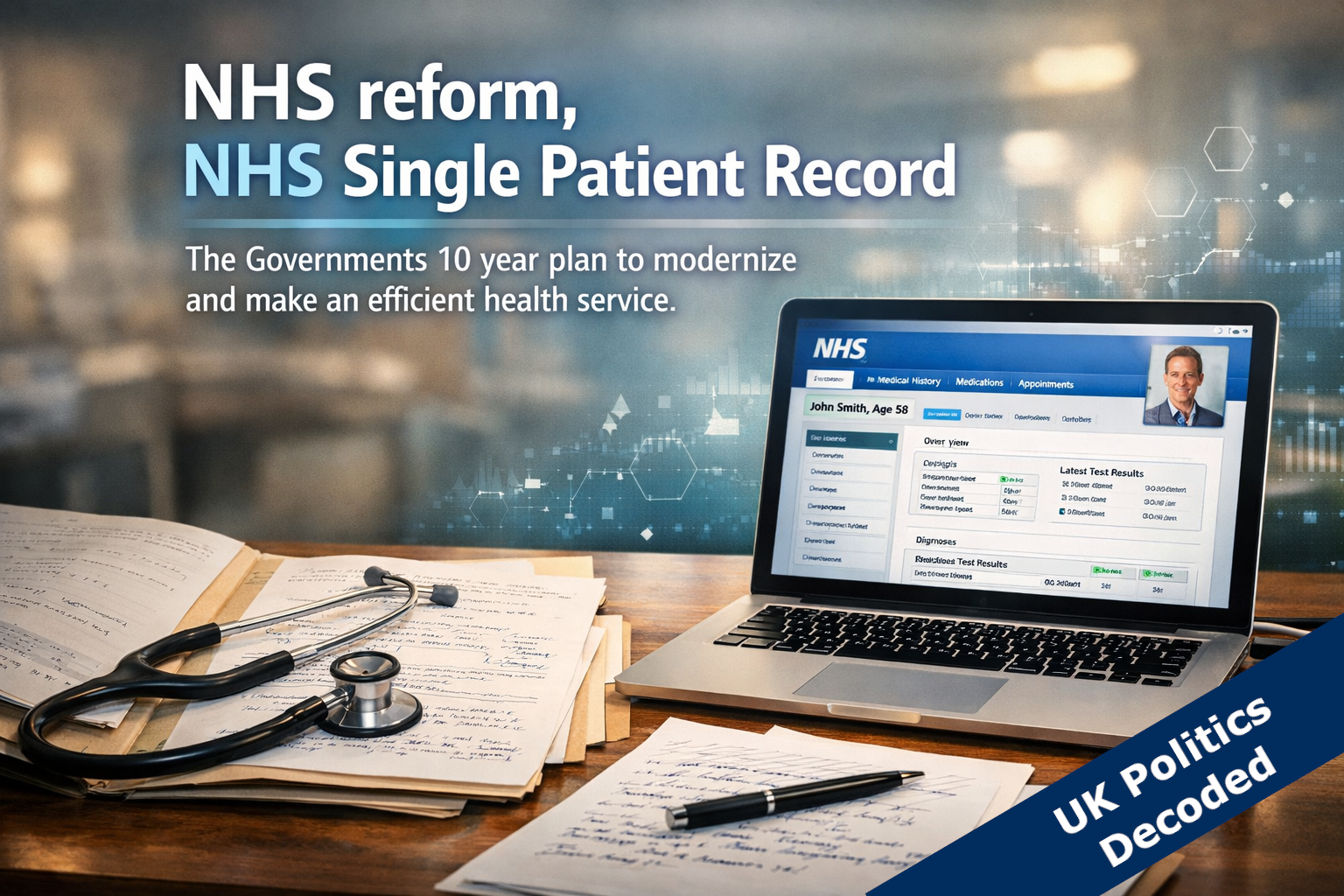
The government has introduced legislation that will oblige all NHS providers, hospitals, GPs, and community services to share patient data into a single, unified record accessible by any authorised clinician in England. The NHS Modernisation Bill, introduced on 14 May 2026, is part of the government's 10 Year Health Plan and is designed to reduce duplicate testing, speed up diagnosis, and cut the administrative friction that costs the NHS time and money every day.
For patients, the most immediate change is straightforward: you will not have to repeat your medical history every time you see a different doctor or specialist. For the NHS, the goal is sharper, fewer costly mistakes, faster clinical decisions, and the kind of joined up care that has been promised in successive reforms for more than a decade.
Key Points at a Glance
- What it is: A legal requirement for all NHS providers to share data into one secure record, accessible in real time by authorised health and care professionals across England.
- When it starts: Clinicians in maternity and frailty care could gain access as early as 2027, with a wider rollout to follow.
- Why it matters: Fragmented records have long caused patients to repeat their story, led to duplicated tests, and left clinicians working without the full picture, contributing to avoidable errors and inefficiency.
- The other change: The Bill also formally abolishes NHS England, transferring its functions into the Department of Health and Social Care to cut bureaucracy and restore democratic accountability.
- Data safeguards: The Bill includes built in protections including tiered access levels, audit trails, and patient choice over how data is used beyond direct care.
What the Single Patient Record Actually Does
Currently, health information in England is held across dozens of different systems. Your GP holds one record, your hospital trust another, community services a third. When you move between them, going from your GP to a specialist, or being admitted to a different hospital than usual, clinicians often cannot see what their colleagues have already done, tested, or prescribed. The Single Patient Record changes that by creating one authoritative account of a patient's health and care history, shared across the system in real time.
The Problem It Is Designed to Fix
The NHS has been operating with fragmented records for decades, and the consequences are measurable:
- Repeated consultations: Patients attending a first midwife appointment are currently required to recall their entire medical history from memory, a system that is unreliable and creates gaps in clinical information throughout a pregnancy.
- Duplicated tests: Without access to existing results, clinicians often repeat blood tests, scans, and investigations that have already been carried out elsewhere, wasting NHS resources and patient time.
- Avoidable errors: Incomplete information at the point of care creates real clinical risk. A doctor unaware of a patient's allergies, existing diagnoses, or current medications is working with one hand tied behind their back.
- Poor patient experience: Having to explain the same history to multiple professionals, often when already unwell, is one of the most consistent complaints patients make about the NHS.
- Disconnected community care: People managing long term conditions often interact with multiple services simultaneously. Without a shared record, coordinating that care depends on manual communication between teams that frequently breaks down.
What Changes Under the New Legislation
The NHS Modernisation Bill places a legal duty on NHS providers to participate in the Single Patient Record,
How the Single Patient Record Works
- Mandatory data sharing: All NHS providers will be legally required to contribute data to the Single Patient Record, ending the voluntary and inconsistent approach that has characterised previous data sharing initiatives.
- Real time access: Authorised health and care staff will be able to view a patient's complete record in real time, regardless of where the patient is being treated or where the original data was created.
- Early specialities: Maternity and frailty care are identified as the first areas to benefit, with clinicians in those fields expected to gain access in 2027, the areas where incomplete records have historically caused the most harm.
- Community services included: The record is intended to join up community health services alongside acute and primary care, supporting better management of long term conditions closer to home.
Data Protection: What the Safeguards Look Like
Any system that concentrates health data across a national platform raises legitimate questions about security, access, and patient rights. The government has confirmed that the Bill includes a set of built in protections, though the detail of how those protections will work in practice will be subject to parliamentary scrutiny.
Patient Rights and Access Controls
The government has set out the following protections as part of the Bill's design:
Data Safeguards Built Into the Bill
- Tiered access: Different levels of access will be granted to reflect different clinical roles and needs, so not every NHS employee will be able to view every aspect of a patient's record.
- Audit trails: Every access to a patient's record will be logged, giving patients and regulators the ability to see who has viewed their information and when.
- Patient choice: Patients will have a degree of control over how their data is used beyond direct clinical care, including for research and service planning purposes, with clear rules on what requires consent.
- Security standards: The Bill requires that the system be designed to be robust to data breaches, with healthcare professionals and the public consulted throughout the design process.
- Parliamentary oversight: Because the Single Patient Record is being established through primary legislation rather than administrative direction, its creation is subject to full parliamentary scrutiny, a point that patient advocacy groups have explicitly welcomed.
What Patient Groups Have Said
Jacob Lant, Chief Executive of National Voices, described the record as a potential "game changer for patient safety and experience" but was clear that its value depends entirely on implementation. He called for transparent rules on who can access data and why, and meaningful mechanisms for patients to exercise their rights. The Academy of Medical Royal Colleges also welcomed the Bill, while flagging that the rollout must not deepen health inequalities by disadvantaging those who are less able to engage with digital systems.
Abolishing NHS England: The Structural Change Alongside the Record
The NHS Modernisation Bill does two distinct things. Alongside the Single Patient Record, it formally transfers NHS England's functions into the Department of Health and Social Care and out to the wider NHS system, effectively abolishing the world's largest arm's length body. The government argues this will reduce duplication, resolve the confusion caused by having "two centres" of NHS decision making, and restore direct democratic accountability for how the health service is run.
The Case for Abolishing NHS England
- Clearer accountability: Local leaders and NHS staff have complained for years that responsibility for NHS decisions was split between DHSC and NHS England, creating confusion about who was ultimately in charge.
- Reduced duplication: Merging functions into a single structure is expected to cut administrative overhead and free up resources that can be redirected to frontline services.
- Local empowerment: Integrated Care Boards and NHS Foundation Trusts are expected to gain greater decision making authority, with less being referred upward through a central quango.
- Patient safety reform: Alongside the structural change, the Bill streamlines the patient safety landscape and embeds patient voices more formally in national and local decision making.
Policy Context: Where This Fits in the 10 Year Health Plan
The Single Patient Record is one of several technology and efficiency measures the government has signalled as central to its 10 Year Health Plan for the NHS. The plan is framed around reducing diagnosis and treatment times, cutting avoidable costs, and shifting care closer to home. The Single Patient Record is the data infrastructure underpinning much of that ambition, without it, joined up community care and faster clinical decision making remain aspirations rather than realities.
The Wider NHS Reform Picture
The Modernisation Bill sits within a broader set of NHS changes the government is pursuing simultaneously:
Key NHS Reform Measures in 2026
- NHS Modernisation Bill: Introduced 14 May 2026, it legislates for the Single Patient Record and the abolition of NHS England, with the Bill formally titled the Health Bill.
- 10 Year Health Plan: The broader strategic framework within which the Single Patient Record sits, with a focus on prevention, technology, and moving care out of hospitals into community settings.
- NHS data strategy: The Single Patient Record builds on previous NHS data strategies but is notable for being placed on a statutory footing for the first time, requiring mandatory participation rather than relying on voluntary adoption.
- Integrated Care Boards: ICBs are expected to play a greater role in local health planning as NHS England's functions are devolved, with the Bill giving them strengthened powers.
- AI in the NHS: The government has separately invested in AI diagnostic tools, and the Single Patient Record is designed to be the data foundation on which future AI clinical applications can operate effectively.
Why Data Sharing Has Taken So Long
The aspiration for joined up NHS records is not new. NHS wide electronic patient records have been attempted, partially built, and abandoned before most notably with the National Programme for IT, which was cancelled in 2011 after spending an estimated £10 billion. What is different this time, the government argues, is that the underlying technology is more mature, the NHS already has a significant digital infrastructure to build on, and crucially the commitment is being legislated for rather than left to voluntary adoption. Whether that assessment proves correct will become clear as the Bill progresses through Parliament and the implementation begins.
If the Bill passes and is implemented as announced, the Single Patient Record will represent the most significant change to how NHS information is managed in the health service's history. For the majority of patients, the practical difference will be felt in clinical encounters: fewer requests to repeat your history, fewer duplicate tests, and in theory, fewer situations where a clinician has to make a decision without the information they need.
For NHS staff, particularly those working across care boundaries, it addresses a daily frustration that has long been recognised as a driver of inefficiency and clinical risk. Dr Alec Price-Forbes, National Chief Clinical Information Officer at NHS England, described the current situation patient information held in silos, patients repeating their story, duplication of effort as something that "the Single Patient Record will revolutionise."
The government is clear that it views this as a structural efficiency gain as much as a quality improvement. Fewer duplicated tests, faster diagnoses, and better coordinated care all translate into reduced costs. Placed in the context of an NHS facing significant financial pressure, the commercial case for the investment is as important as the clinical one.
Key Takeaways
- The NHS Modernisation Bill, introduced on 14 May 2026, will for the first time legally require all NHS providers in England to share data into a single, unified patient record.
- Clinicians in maternity and frailty services are expected to gain access as early as 2027, with a wider rollout to follow across the NHS.
- The record is a central plank of the government's 10 Year Health Plan, designed to cut diagnosis times, reduce duplicate testing, and enable better coordinated care.
- Built in safeguards include tiered access levels, full audit trails, and patient choice over how data is used beyond direct clinical care.
- The Bill also abolishes NHS England, transferring its functions into DHSC and to local NHS leaders in a move intended to cut bureaucracy and restore democratic accountability for the health service.
Sources & Further Reading
- GOV.UK – Better patient care as NHS set to introduce Single Patient Record (15 May 2026, Department of Health and Social Care, NHS England and Karin Smyth MP) Archived copy (OGL): archived page
- Commons Library Parliament – The 10 Year Health Plan for England Archived copy (OGL): Web arcive, archived page