AI Use: AI tools were used to support source discovery and to structure the article for clarity. All research, verification, drafting, and final editorial decisions are fully human led. Learn about our AI policy.
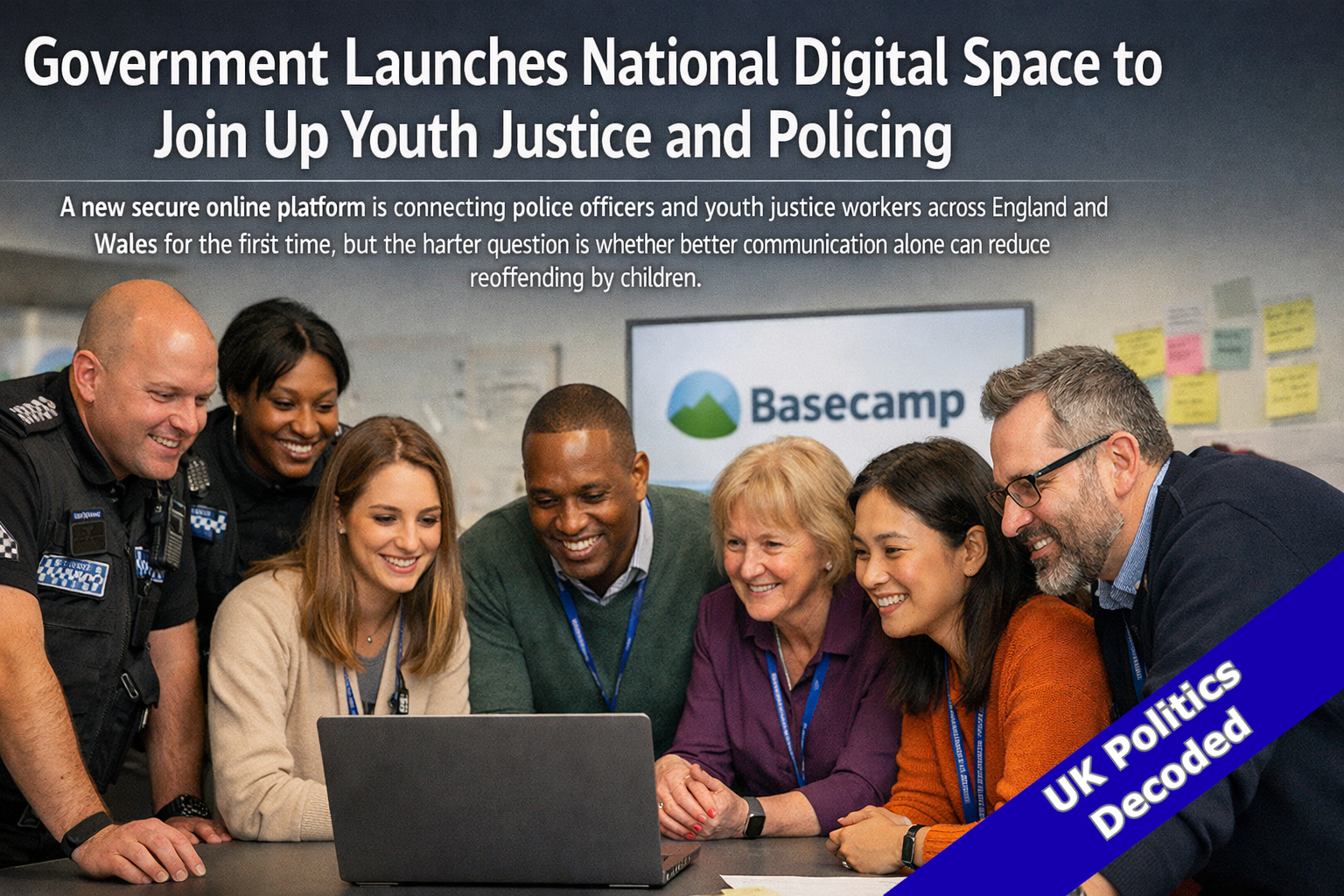
A new national digital platform designed to connect youth justice workers and police officers across England and Wales has officially launched, with the government arguing that faster sharing of evidence and best practice is essential to reducing offending and reoffending by children. The platform, called Basecamp Diversion and Youth Justice Policing, went live on 8 May 2026 and was created by the Youth Justice Board (YJB) in partnership with the National Police Chiefs' Council (NPCC), with development support from the Youth Endowment Fund and the Centre for Justice Innovation.
The announcement frames the initiative as a response to a long standing structural problem in the youth justice system: police and youth justice services have historically operated in separate silos, limiting how quickly frontline workers can share information about what works, respond to emerging patterns of youth offending, or coordinate on diversion programmes that keep children out of the formal justice system. Basecamp is intended to change that by providing a single, secure, permission based space where professionals from both sectors can communicate in real time.
Key Points at a Glance
- What launched: Basecamp Diversion and Youth Justice Policing, a secure national online collaboration platform for youth justice services and police.
- Who is behind it: Created by the Youth Justice Board (YJB) and the National Police Chiefs' Council (NPCC), with support from the Youth Endowment Fund and the Centre for Justice Innovation.
- What it does: Allows professionals to share evidence, ask questions, exchange resources, and coordinate on diversion and youth justice policing approaches in real time.
- Who can access it: Access is closed and permission based, managed centrally by the YJB. Professionals must email the YJB to request an invitation.
- What it does not do: No personal or case specific information about individual children is shared on the platform.
What Is Basecamp and What Does It Actually Offer?
Basecamp is not a public forum or a government website. It is a closed, professional collaboration space similar in principle to tools used in other sectors to share internal knowledge but built specifically for youth justice practitioners and police. Access is tightly controlled, colleagues must submit a request to the YJB and demonstrate they hold a legitimate operational role before receiving an invitation to join.
What Professionals Can Do on the Platform
Once inside, the platform is designed to support day to day professional practice in a number of ways:
- Post questions and discussion topics: Frontline workers can raise practical queries or flag emerging issues for comment from colleagues across different areas of England and Wales.
- Share local resources: Youth justice services can upload templates, tools, and examples of practice from their own area so that other services can adapt and use them.
- Access national guidance: The platform will host current YJB and NPCC guidance, training materials, and thematic outputs in one place rather than scattered across different websites.
- Network across areas: Officers and youth justice workers from different regions can connect directly, supporting coordination on issues that cross local authority or police force boundaries.
- Contribute to live threads: Users can engage with ongoing conversations rather than waiting for the next conference or training event to discuss sector wide challenges.
What the Platform Will Not Include
The YJB has been explicit about the boundaries governing what can and cannot be shared within the platform:
Platform Safeguards and Governance
- No case specific information: Details about individual children, victims, or ongoing cases must not be shared on the platform under any circumstances.
- Moderated content: All content is subject to moderation to ensure appropriate professional use, with the YJB responsible for oversight.
- Membership monitoring: Membership lists are actively monitored to ensure only authorised professionals retain access.
- Data protection compliance: Participants must adhere to national and local data protection policies when sharing any information on the platform.
Why Has This Been Created Now?
The launch reflects a broader recognition within government and the youth justice sector that the relationship between policing and youth justice services though often strong at a local level has lacked a consistent national infrastructure for sharing learning. Youth justice in England and Wales sits across multiple agencies: local authority youth offending teams, police forces, courts, the probation service, and the voluntary sector. Each operates under different governance structures, making coordinated practice difficult to sustain at scale.
The Case for Joined Up Working
The arguments made by the YJB and NPCC for the platform centre on several practical gaps the sector has consistently identified:
Problems Basecamp Is Intended to Address
- Slow evidence dissemination: Promising diversion approaches developed in one area can take years to reach practitioners elsewhere without a mechanism for rapid sharing.
- Inconsistent guidance visibility: National guidance documents and resources are not always accessible or well known to frontline staff, particularly in police forces with high turnover.
- Limited cross sector networking: Youth justice workers and police often have limited structured contact outside formal multiagency meetings, which can be infrequent and procedurally focused.
- Emerging issues go uncoordinated: When new patterns of youth offending or county lines activity emerge in one area, there is currently no fast track mechanism to alert colleagues nationally and share responses.
- Duplication of effort: Services frequently develop resources and tools that already exist in other areas, wasting capacity that could be directed at direct work with children.
What the Sector Leaders Said
Stephanie Roberts-Bibby, Chief Executive of the Youth Justice Board, said the platform built on what the YJB had already been doing to share evidence of what works, describing collaboration as central to the organisation's model:
"We know that the strongest outcomes for children come from systems that work together at the YJB we refer to this as 'the power of the partnership'. This collaboration space builds on what we have already been doing to share the evidence of what works and takes it one step further; creating a dedicated place where professionals across youth justice can connect, challenge and learn from one another in real time."
Chief Constable Catherine Roper, the NPCC lead for Children and Young Persons, said she regarded all children who came into contact with the criminal justice system as victims, including those suspected of committing offences:
"I believe all children should have the opportunity to fulfil their potential, without their lives being blighted by crime. Any child who is touched by criminality is a victim, even if they are suspected of committing an offence themselves, and through partnership working and collective continued improvement, we can ensure we are doing everything we can to keep our young people safe."
Who Is Backing the Platform and What Does That Mean?
The involvement of the Youth Endowment Fund (YEF) and the Centre for Justice Innovation (CJI) alongside the YJB and NPCC gives the platform a level of cross sector credibility that purely government sponsored initiatives do not always achieve. Both organisations are well regarded within the youth justice and violence reduction sectors for their focus on evidence based approaches.
The Organisations Involved
Platform Founders
- Youth Justice Board (YJB): The executive non-departmental public body sponsored by the Ministry of Justice, responsible for overseeing the youth justice system in England and Wales. The YJB manages access to the platform and is responsible for its governance.
- National Police Chiefs' Council (NPCC): The body that brings together UK police leaders to set direction and drive progress across policing. The NPCC's involvement ensures the platform aligns with national policing priorities for children and young people.
Development Partners
- Youth Endowment Fund (YEF): An independent charity and what works centre focused on preventing children from becoming involved in violence. The YEF's role is to ensure the platform highlights evidence informed practice and innovation from the field.
- Centre for Justice Innovation (CJI): An independent organisation that develops and promotes reforms to the criminal justice system. The CJI's involvement helps shape ongoing development and ensures the platform draws on practitioner led learning.
Conclusion: A Tool That Connects, With Outcomes Still to Be Proven
Basecamp Diversion and Youth Justice Policing is a modest but practically meaningful development in how the youth justice sector organises itself. A secure national space where police and youth justice professionals can share evidence, ask questions, and coordinate without waiting for formal meetings or training events fills a genuine gap.
The platform does not, in itself, deliver better outcomes for children. Its value depends entirely on whether practitioners actually use it, whether the evidence shared translates into changed practice on the ground, and whether the organisations involved sustain their commitment to moderating and developing the space over time. The YJB's track record on knowledge sharing is reasonable, and the involvement of the YEF and CJI gives the initiative a stronger evidence base than many comparable government backed communication tools.
For anyone working in youth justice, policing, or violence reduction, the practical first step is straightforward, if you have a legitimate operational role and want access, email the YJB at the address listed in the sources below. The broader test, whether a platform like this can measurably accelerate diversion and reduce the number of children drawn into the formal justice system, will take considerably longer to answer.
Key Takeaways
- Basecamp Diversion and Youth Justice Policing launched on 8 May 2026 as a closed, secure national platform for youth justice services and police to share evidence and best practice.
- It was created by the Youth Justice Board and the National Police Chiefs' Council, with the Youth Endowment Fund and Centre for Justice Innovation providing development support.
- The platform allows professionals to post questions, share resources, access guidance, and network across areas, but prohibits sharing any personal or case specific information about individual children.
- Access is permission based and managed by the YJB; professionals can request access by emailing basecamp@yjb.gov.uk.
- The platform addresses a recognised structural gap in the youth justice system, but its impact on outcomes for children will depend on sustained engagement from practitioners and organisations across the sector.