AI Use: AI tools were used to support source discovery and to structure the article for clarity. All research, verification, drafting, and final editorial decisions are fully human led. Learn about our AI policy.
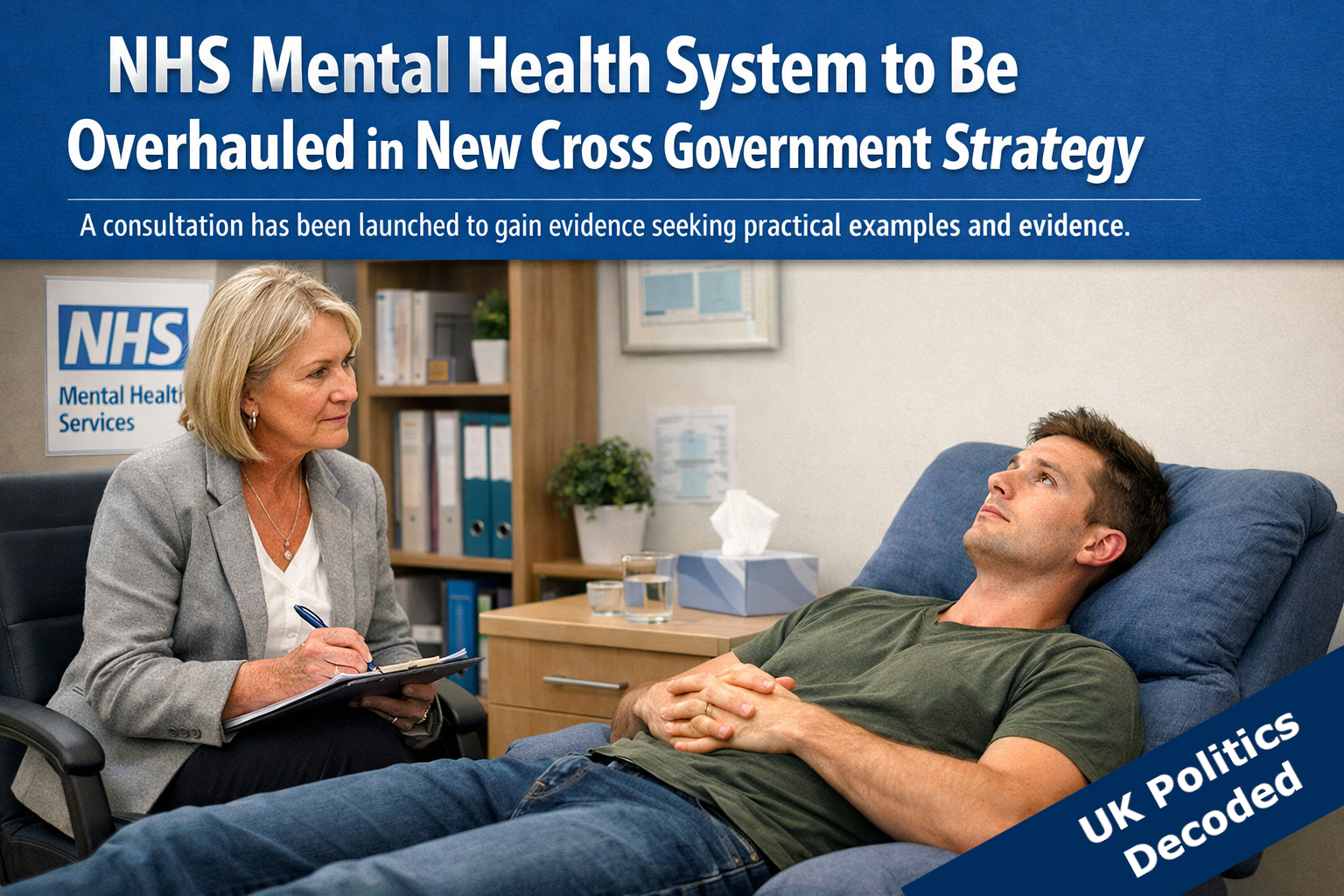
The government announced on 15 May 2026 that it is developing a new cross government mental health strategy for England, inviting frontline workers, clinicians, and mental health experts to help shape it through a formal call for evidence. The strategy, described by ministers as a once in a generation reform, is a commitment under the government's 10 Year Health Plan and is intended to fundamentally change how mental health services are designed and delivered.
Around 1 in 5 people in England are currently affected by a common mental health condition. Demand for services has risen sharply in recent years, particularly among children and young people, who routinely face long waits for care. Despite NHS mental health spending reaching a forecast record of £16.1 billion in 2026, the government acknowledges the existing system remains reactive, fragmented, and uneven, with the support available depending heavily on where you live.
Key Points at a Glance
- What it is: A formal call for evidence to inform a new cross government mental health strategy for England, seeking practical examples and implementation evidence from across sectors.
- Who can respond: Mainly service providers and those with direct experience of service provision, across health, education, workplaces, local government, and community settings.
- Deadline: The call for evidence closes at 11:59pm on 10 July 2026.
- The goal: A shift from crisis led, reactive care towards earlier intervention, prevention, and a joined up, whole system approach.
- Who leads it: Baroness Merron, Minister for Mental Health, announced the strategy during Mental Health Awareness Week.
What the Strategy Is Trying to Fix
The government is explicit about the problem. Funding has increased and the NHS has hit its target to hire 8,500 extra mental health workers three years ahead of schedule, yet services remain inconsistent. People too often reach breaking point before getting help. Postcode determines provision. And the system is primarily built to respond to crises rather than prevent them.
The new strategy is designed to address this by setting a new direction for how the mental health system works. It will look beyond clinical settings and ask how schools, workplaces, the voluntary sector, and local government can play an active role in supporting mental health, moving away from a model focused on diagnosis towards one that asks what support people need to live well.
Children and Young People
Children and young people are a central focus. According to campaigners, 75% of mental health problems are established by age 24, and as many as 1 in 5 young people currently face poor mental health. The strategy includes the accelerated rollout of Mental Health Support Teams in schools and colleges, alongside the expansion of Early Support Hubs and Young Futures Hubs in communities. An additional £473 million has been committed over four years for mental health emergency departments, community based centres, and related capital projects.
Autism, ADHD, and Independent Review
The strategy will also respond to forthcoming recommendations from an independent review into mental health, ADHD, and autism, chaired by Professor Peter Fonagy, a clinical psychologist and psychoanalyst. The review is examining the drivers of rising demand and how public services can meet that demand more equitably. Autistic people and those with ADHD face a significantly elevated risk of developing a mental health condition, and the strategy will reflect their needs. A separate cross government autism strategy is also being developed, with consideration being given to extending it to cover ADHD.
What the Call for Evidence Covers
The call for evidence is seeking practical examples and implementation evidence from a wide range of settings. The Department of Health and Social Care is particularly interested in what has worked, drawn from across the UK and internationally, in the following areas:
- Mental health and wider health services: Examples of effective early intervention and crisis care models.
- Local government: Community based approaches that have reduced demand on clinical services.
- Education and training settings: Schemes that have improved mental health outcomes for children and young people.
- Workplaces: Employer led support that has helped people stay in or return to work.
- Community settings: Voluntary sector and grassroots initiatives with a demonstrable impact.
Respondents are expected to be primarily service providers and those with direct experience of service provision. The online response portal opened on 15 May 2026 and closes at 11:59pm on 10 July 2026.
What Sector Leaders Have Said
The announcement has been broadly welcomed by mental health organisations, though with consistent calls for delivery to match ambition. Mark Winstanley, Chief Executive of Rethink Mental Illness UK, said the strategy creates "the opportunity to change" longstanding failures but warned that long waits, unsafe inpatient settings, and fragmented services remain "a daily reality for many." He called for improvements to be rapid and measurable.
Mark Rowland, Chief Executive of the Mental Health Foundation, described it as "a big moment" and welcomed the government's shift towards a cross government prevention focus, while emphasising the need to address the social and economic conditions that shape mental health. Both the Head On coalition and Future Minds campaign, together representing over 20 leading mental health organisations, also welcomed the announcement but stressed that the strategy must reach beyond the health system to succeed.
Key Takeaways
- The government launched a call for evidence on 15 May 2026 to inform a new cross government mental health strategy for England, described as a once in a generation reform.
- NHS mental health spending is forecast to reach a record £16.1 billion in 2026, alongside a target beating recruitment of 8,500 extra mental health workers.
- The strategy aims to shift focus from reactive crisis care to earlier intervention and prevention, spanning health, education, workplaces, and communities.
- Children and young people are a priority, with £473 million committed over four years and accelerated rollout of Mental Health Support Teams in schools.
- The call for evidence closes at 11:59pm on 10 July 2026 and is primarily aimed at service providers and those with direct experience of provision.
Sources & Further Reading
- GOV.UK – Government to transform mental health care with new strategy (15 May 2026, Department of Health and Social Care and Baroness Merron) Archived copy (OGL): archived page
- GOV.UK – Informing the mental health strategy for England: call for evidence (15 May 2026, Department of Health and Social Care) Archived copy (OGL): archived page