AI Use: AI tools were used to support source discovery and to structure the article for clarity. All research, verification, drafting, and final editorial decisions are fully human led. Learn about our AI policy.
Wind and solar are now the cheapest ways to generate electricity in the UK. The problem is that the wind does not always blow and the sun does not always shine. When generation falls short, the grid falls back on gas, which costs more and exposes consumers to the kind of international price swings that drove the 2022 energy crisis. The government's answer, announced on 20 August 2026, is to invest in the technology that would make that fallback unnecessary.
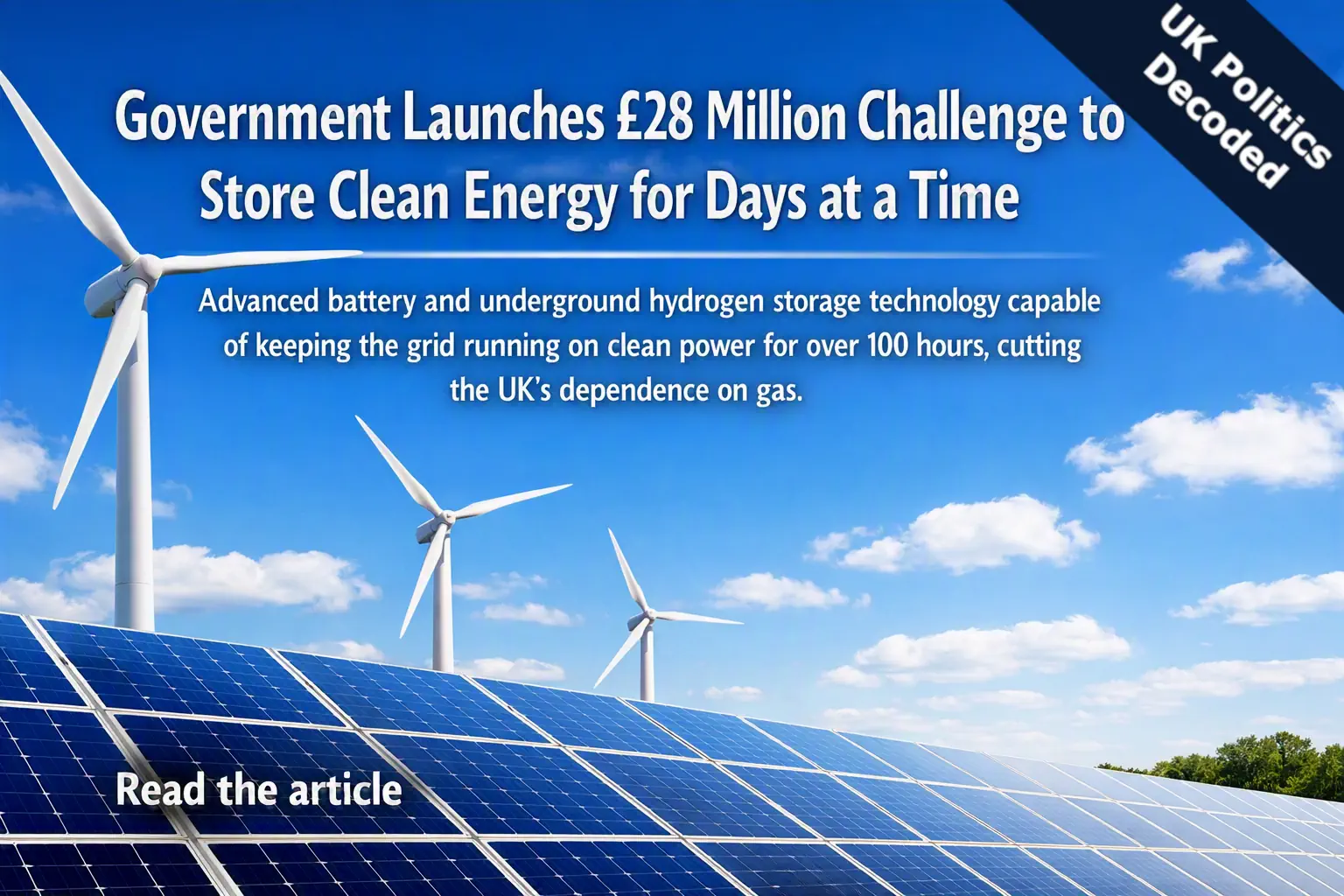
The Ultra Long Duration Energy Storage (Ultra LDES) Challenge will offer £28 million in grants, administered through UK Research and Innovation (UKRI), to develop systems capable of storing clean electricity for 100 hours or more. That is enough, the government says, to power homes and businesses for at least four continuous days from stored energy alone.
At a Glance
- £28 million in grants from UKRI to develop energy storage technology capable of supplying clean electricity for 100 hours or more
- Two focus areas: next generation electrochemical battery technologies and underground hydrogen storage systems
- Additional £3 million competition launched alongside for electrochemical ultra long duration energy storage project development studies
- Part of £102 million in Clean Energy Challenges, sitting within a wider £500 million R&D Missions Accelerator Programme running to 2030
- Underground hydrogen storage could reduce total energy system costs by between £14 billion and £50 billion between 2035 and 2050
What the Challenge Will Fund
The Challenge has two distinct tracks. The first focuses on electrochemical technologies, essentially advanced battery systems that have not yet been commercialised at scale. These are chemistries capable, in principle, of storing energy cheaply enough to discharge it back into the grid for four days or more, but they remain at an early stage of development. The government sees an opportunity to give UK innovators an early foothold in what will become a significant global market.
The second track covers underground hydrogen storage. This involves compressing hydrogen produced from surplus renewable electricity and storing it in geological formations or purpose built underground facilities, then releasing it when the grid needs it. UKRI's assessment, drawing on a report commissioned from the UK Energy Research Centre, estimates this approach could reduce total energy system costs by between £14 billion and £50 billion between 2035 and 2050. That is a wide range reflecting genuine uncertainty about deployment costs, but the potential scale is substantial.
Alongside the main Challenge, UKRI has opened a separate £3 million competition specifically for project development studies focused on electrochemical ultra long duration storage. That funding is designed to bring promising battery technologies closer to the point where they could compete for a place on the national grid.
Where This Fits in the Wider Policy Picture
The Ultra LDES Challenge completes the rollout of what the government is calling the Clean Energy Challenges, a package totalling £102 million that also includes the £74 million Consumer led Flexibility Challenge, announced initially in August 2025. Both sit within the R&D Missions Accelerator Programme (R&D MAP), a cross government initiative targeting at least £500 million of public investment in research and development by 2030. Alongside that public funding, R&D MAP projects are expected to attract a further £1.5 billion in private investment over the same period.
The energy storage announcement also arrives as Ofgem consults on plans to support 16 long duration electricity storage projects, including what would be the first new pumped storage hydropower schemes built in the UK in more than 40 years. Pumped hydro, which works by moving water uphill to store energy and releasing it downhill to generate power, is the most established form of long duration storage but requires significant geography and capital. The new Challenge is aimed at technologies that could work at scale without those constraints.
Energy Minister Michael Shanks said homegrown clean energy was the route to more affordable bills and that storing it for when it is needed most is critical. "By backing new cutting edge battery technology and hydrogen storage with this £28 million grant, we will store more clean power, reduce reliance on expensive gas generation and deliver a more secure energy system."
Science Minister Chris McDonald framed it in terms of national benefit. "When we unlock the potential of science and innovation, it can improve all of our lives. If we can meet the challenge of storing energy from renewables, we will improve our energy security, bring down energy bills in the long term, and leave all of us better off."
Clare Jackson, chief executive of Hydrogen UK, said ultra long duration storage is critical for a low carbon energy system and that the Challenge is "an important step towards developing the technologies and infrastructure the UK will need at scale."
The Underlying Problem It Is Trying to Solve
The logic behind the investment is straightforward. Renewable generation is intermittent by nature. The grid already manages short gaps using a combination of battery storage, interconnectors, and dispatchable generation, but longer stretches of low wind or overcast weather are harder to cover. Gas plants fill that role today, but gas is internationally traded and its price can shift sharply on geopolitical events beyond the UK's control, as 2022 demonstrated. Long duration storage would make it possible to bank surplus renewable electricity during periods of high generation and draw it down later, reducing how often and how much gas is needed as a backup. The government argues this would both lower average bills and protect consumers from future price spikes.
How to Apply for the £3 Million Project Development Studies Competition
UK registered businesses of any size can apply for a share of the separate £3 million competition for electrochemical ultra long duration energy storage project development studies. The competition, administered through Innovate UK's Innovation Funding Service, is open until 30 September 2026 at 11am.
Individual grants run from £350,000 to £700,000, with projects expected to start by 1 January 2027 and complete by 30 September 2027. Businesses can apply alone or as part of a collaborative team. Academic institutions, charities, research and technology organisations, and public sector bodies can join as partners, but only a UK registered business can lead an application. No single organisation can claim more than 70% of total project costs in a collaborative bid.
Applicants must choose between two streams. Stream 1 targets technologies approaching commercial scale, aiming for a grid connected demonstration of at least 100 MWh by 2030 at a total ownership cost below $40 per kilowatt hour. Stream 2 is for earlier stage technologies with the potential to eventually compete on cost with gas fired generation, requiring a smaller pilot demonstration of at least 100 kWh by 2030 and a target cost below $15 per kilowatt hour by the early 2030s.
The application itself covers four sections: project details, scored questions covering technology description, demonstration pathway, cost competitiveness, commercialisation plans, and manufacturing and supply chain strategy, then finances and project impact. A first draft of the project development study must be completed by 31 May 2027, in time to inform applications to the planned Phase 2 competition. Successful applicants will be notified by 2 November 2026.
This is Phase 1 of a two phase process. A separate Phase 2 competition, planned for mid 2027 and backed by at least £10 million, will fund the construction of full scale demonstrators. Taking part in Phase 1 is not a condition of eligibility for Phase 2, but Innovate UK is encouraging businesses to use the project development study to work through practical delivery barriers before committing to demonstration scale.
Applications are submitted through the Innovation Funding Service at apply-for-innovation-funding.service.gov.uk. Organisations needing accessibility support or guidance can contact Innovate UK at support@iuk.ukri.org or call 0300 321 4357, Monday to Friday from 9am to 12pm and 2pm to 5pm.
Key Takeaways
- The Ultra LDES Challenge offers £28 million through UKRI for technology capable of storing and supplying clean electricity for 100 hours or more
- Two technology tracks, next generation electrochemical batteries (not yet at commercial scale) and underground hydrogen storage systems
- A separate £3 million competition has opened for electrochemical ultra long duration storage project development studies
- The Challenge completes the £102 million Clean Energy Challenges package and sits within the wider £500 million R&D Missions Accelerator Programme
- Underground hydrogen storage could reduce energy system costs by £14-50 billion between 2035 and 2050, according to UKRI analysis
- Ofgem is separately consulting on 16 long duration storage projects, including the first new UK pumped hydro schemes in over 40 years
Sources & Further Reading
- New challenge launched to store clean energy for longer and protect households from price spikes - GOV.UK (20 August 2026) Archived copy (OGL): archived page
- UK Research and Innovation - Research and Development Missions Accelerator Programme - ukri.org
- Innovate UK - Ultra Long Duration Energy Storage Project Development Studies competition - Innovation Funding Service
- Innovate UK - Ultra Long Duration Energy Storage Project Development Studies: Competition Overview and How to Apply - Innovation Funding Service
- Ofgem - Long Duration Electricity Storage consultation - ofgem.gov.uk