AI Use & Transparency: AI tools were used to support source discovery and to structure the article for clarity. All research, verification, drafting, and final editorial decisions are fully human led. Learn about our AI policy.
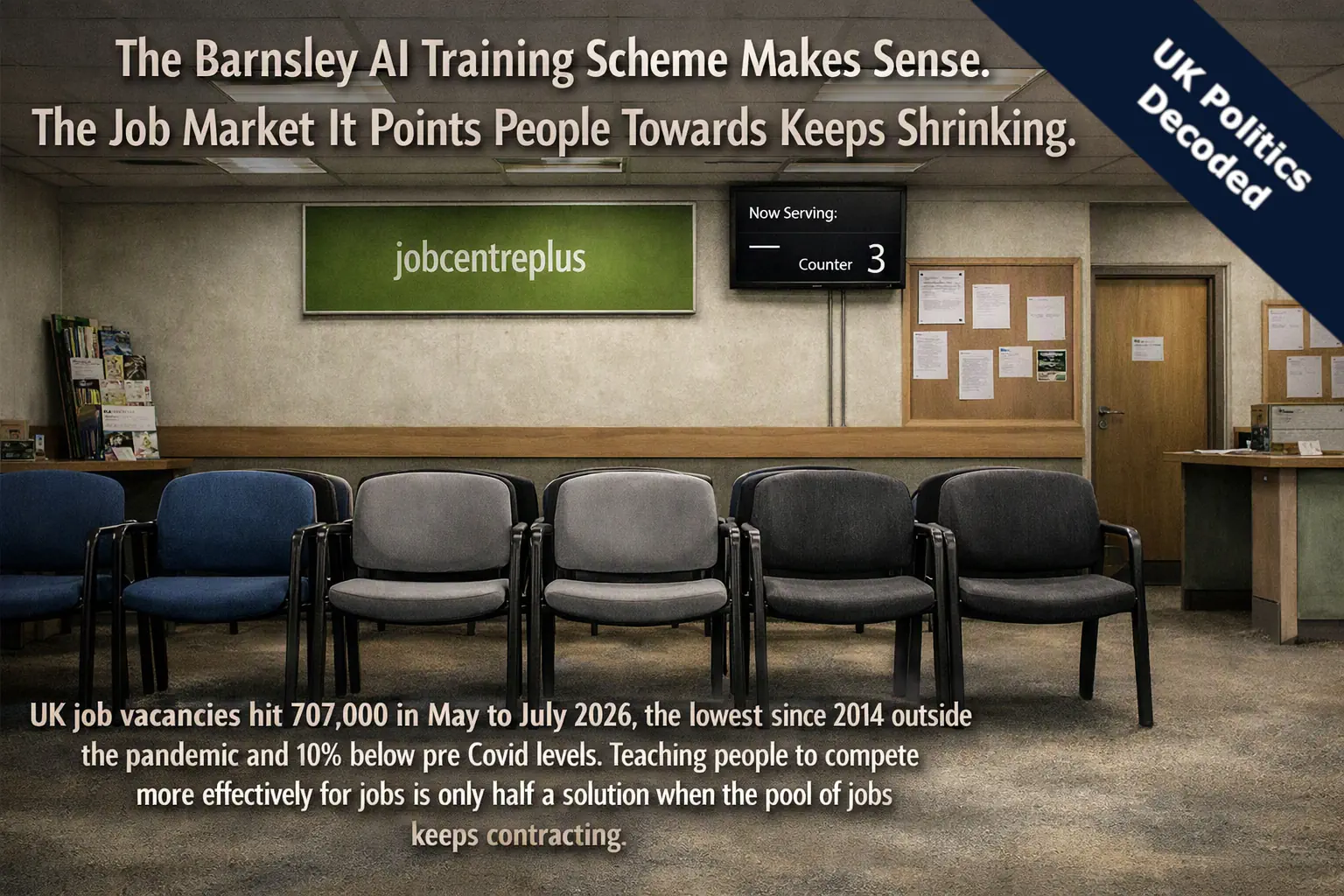
Two new AI training schemes were announced for Barnsley today. The AI Career Launchpad, a £400,000 plus partnership with Barnsley College, will give local residents a faster route into AI adjacent jobs through six months of training linked to a Level 4 apprenticeship, with paid placements alongside. A separate Getting Job Ready with AI pilot, launching through Jobcentre Plus in September, will help jobseekers use AI tools to improve CVs, identify suitable roles, and prepare for interviews. Both are practically designed and grounded in what employers are increasingly expecting from applicants.
But the ONS published its latest vacancy figures this same week. In the three months to July 2026, there were an estimated 707,000 job vacancies across the UK, the lowest figure recorded outside the pandemic since September to November 2014. Vacancies now sit 81,000, or about 10 percent, below where they stood before Covid. Vacancies fell across eleven of eighteen industry sectors over the past year and are down 2.7 percent on the year. The job pool isn't static. It has been contracting for years.
This trend has run continuously across Conservative governments and under Labour. That persistence matters. It tells you the pattern isn't electoral, it's structural. The Bank of England's agents' summary, published in July 2026, found employment intentions broadly flat, shaped by weak and uncertain demand, elevated labour costs, and firms across sectors increasingly prioritising efficiency and automation over headcount expansion. Job cuts are being achieved mainly through natural attrition rather than redundancies. Some targeted hiring is happening in professional and digital services. But the headline is a labour market holding its breath.
The Barnsley schemes are supply side interventions. They make individual job applicants more competitive. In a market with plentiful vacancies, that is exactly the right kind of support, and the individuals who go through the programme will benefit in real and measurable ways. But when the pool of available roles is contracting, the arithmetic shifts. Training more people to apply more effectively for fewer jobs doesn't change the number of positions on offer. It shifts who gets them. That is a meaningful outcome for the person who wins the role. It does nothing about the underlying shortage.
The ONS's own vacancy survey feedback identifies smaller businesses as a primary source of the decline, citing increases in labour and operating costs as reasons for pulling back on recruitment. The employer National Insurance increase, which came into force in April 2025 and raised the rate from 13.8 percent to 15 percent while cutting the per employee threshold to £5,000, added a direct cost to every new hire at the smaller end of the market. The British Chambers of Commerce reported in its Q2 2026 quarterly survey that investment intentions had fallen to their lowest level since the pandemic, with fewer than one in five firms planning to increase spending. "Most firms," the BCC noted, "are now experiencing policy as downside risk rather than opportunity with the rise in employer NICs a prominent example, still being felt almost two years on."
Energy costs compound the picture. Commercial and industrial energy bills have remained elevated since the 2022 spike, and the wholesale pricing mechanism continues to expose UK businesses to gas price volatility at moments they cannot predict or plan for. When operating costs are high and the return on investment from hiring is uncertain, business owners don't expand headcount. They wait. That collective caution, multiplied across thousands of small and medium firms, shows up in the data as a gradually narrowing vacancy pool that bears most heavily on those at the margins of the labour market, younger workers, returners, and those competing without recent experience.
The UK-India Free Trade Agreement came into effect in July 2026. A deal with the Gulf Cooperation Council was concluded in May. Several further negotiations are underway. These are real gains, and the long term economic case for them is solid. But the mechanism by which trade agreements eventually become job vacancies works on a years long horizon. They build the conditions in which businesses might later invest and hire. They are not an answer for the person going through Jobcentre Plus this September, and there is no shortcut from a signed FTA to a vacancy notice on a high street window.
I find myself thinking that the Barnsley scheme is solving the easier half of the problem. Teaching someone to use AI to prepare for an interview is fundable, measurable, and fits neatly into a morning's announcement. The harder question is why are there 81,000 fewer vacancies than before the pandemic, and what would actually reverse that doesn't compress into a press release. It would require sustained attention to business costs, energy pricing, planning reform, and the kind of demand side conditions that make it worth a firm's while to take on a new member of staff rather than manage on its current headcount.
None of this is an argument against Barnsley or against upskilling people to use AI. The individuals who go through these programmes will, all else equal, be better placed. The question is what the market looks like when they emerge. Right now it has fewer vacancies than it did six years ago, and the trajectory is still pointing downward. Supply side investment in skills is necessary. It is not sufficient on its own, and today's announcement doesn't suggest anyone is yet grappling seriously with the part of the problem that is.
Sources & Further Reading
- GOV.UK - Barnsley residents to get practical AI training to help them find work and build future careers Archived copy (OGL): archived page
- Office for National Statistics - Vacancies and Jobs in the UK: August 2026 Archived copy (OGL): archived page
- BBC News - Job vacancies at five-year low as smaller firms scale back recruitment
- Bank of England - Agents' Summary of Business Conditions: July 2026
- British Chambers of Commerce - Business Investment Plans Hit Post Pandemic Low (Q2 2026)