AI Use & Transparency: AI tools were used to support source discovery and to structure the article for clarity. All research, verification, drafting, and final editorial decisions are fully human led. Learn about our AI policy.
UKPoliticsDecoded is an IMPRESS regulated public interest publisher. Read our editorial standards.
Andy Burnham's statement to the House of Commons yesterday, a Prime Minister's statement with seriousness of intent. Not the performative kind, with pledges carefully scoped to a parliamentary cycle. Burnham stood up and talked about 40 years of wrong turns. Deindustrialisation, centralisation, austerity, Brexit. He was not just announcing policy. He was diagnosing a structural failure that took decades to build. That is a different kind of statement.
The programme is genuinely ambitious. Number 10 North, a new centre of government operating outside Westminster, driving regional growth with the full authority of Downing Street. Devolution deals for every part of England that wants one, including a specific offer to Cornwall. A push to reindustrialise Britain by backing local industrial strategies, anchoring skills pipelines to regional economies, and drawing business, academia, and government behind a shared plan, Stronger public control over water and energy, Cross party work on social care, Bus services returning to public hands in Liverpool this weekend, with more to follow. These are not easy wins for a Prime Minister looking for quick political credit. They are reforms that, if they work at all, will take 10 to 20 years to show results.
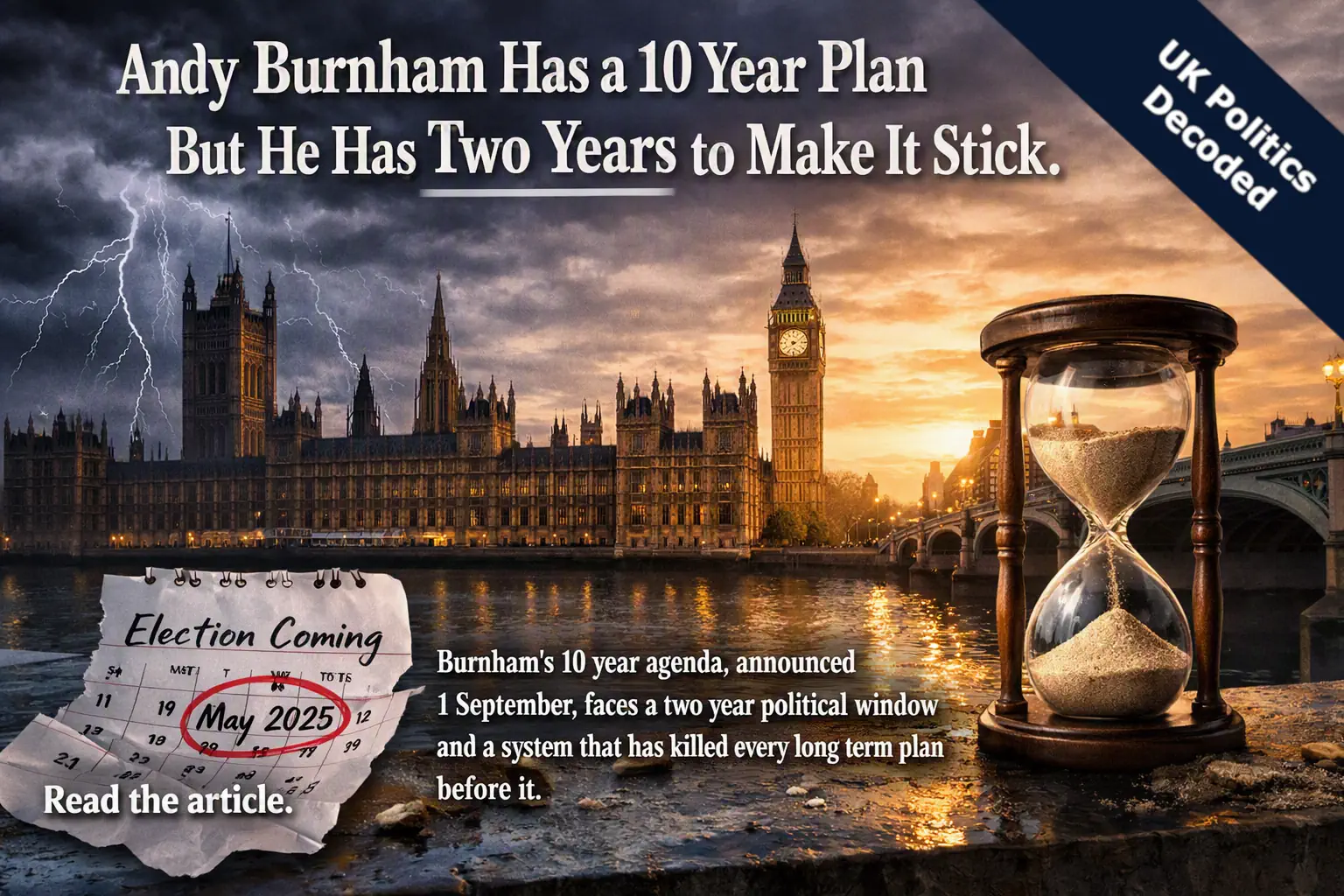
The problem is that Burnham has, at most, two years before the political weather shifts.
Britain's record on this is not encouraging. Cameron launched an industrial strategy. May relaunched it. Johnson replaced it with Levelling Up. Starmer reframed it as Growth. Each administration arrived with its own vocabulary and its own priorities and within a couple of years, the previous version had been cleared away. Civil service capacity followed. Regional funding bodies were renamed or dissolved. NHS reform was reset. What looked like permanent infrastructure turned out to be political furniture, moved around by whoever was redecorating. The UK has not sustained a consistent national economic strategy for more than one parliamentary cycle in living memory.
Burnham knows this, I suspect. The creation of Number 10 North as a physical institution not a ministerial task force or a policy review, but a functioning arm of government with its own buildings, its own staff, and its own mandate, is a different kind of signal. Physical institutions are harder to abolish than strategies. Devolution deals, once signed and legally embedded, carry a real political cost to unpick. If industrial clusters start attracting private capital and businesses anchor themselves to a region, future governments inherit a constituency that does not want the support pulled. That is not a guarantee. But it is more durable than a white paper.
What Burnham cannot manufacture is visible change before the next election, energy bills will not fall dramatically, NHS waiting lists will not collapse, Wages will not stabilise within this term. The reforms he is launching are foundational they shift the conditions for change without delivering the change itself. For voters whose experience of the cost of living is determined by what they pay at the end of this month, foundational is a hard sell. Burnham's calculation is that starting is better than not starting, and that voters who understand the depth of the problem will give him credit for at least diagnosing it honestly. That is an optimistic read of the electorate, but it may be the only read available to him.
There is also a harder question sitting beneath all of this. A future Conservative or Reform UK government would approach this agenda very differently. Reform UK's published platform is particularly incompatible with Burnham's direction, it opposes net zero commitments, renewable subsidies, regional devolution, and most of the regulatory infrastructure Burnham wants to use as a lever for reindustrialisation. If the reforms are not embedded quickly enough in legislation, in institutions, in actual economic activity on the ground they become reversible. That has happened before. It is not difficult to imagine it happening again.
What is genuinely interesting about yesterday's statement is not the ambition, which is real. It is the implicit acknowledgement of how broken the system itself is. Burnham said Britain took a series of wrong turns from the 1980s. He did not say who would stop the next government from taking a different set of wrong turns in the opposite direction. That is the unanswered question, and it may be the most important one. He is trying to build something durable inside a system that does not reward durability. Whether he can manage it is a different question from whether he has a plan. He clearly has a plan. The plan now has two years to become something harder to undo.
Sources & Further Reading
-
GOV.UK - PM statement to the House of Commons: 1 September 2026
Archived copy (OGL): archived page