AI Use: AI tools were used to support source discovery and to structure the article for clarity. All research, verification, drafting, and final editorial decisions are fully human led. Learn about our AI policy.
UKPoliticsDecoded is an IMPRESS regulated public interest publisher. Read our editorial standards.
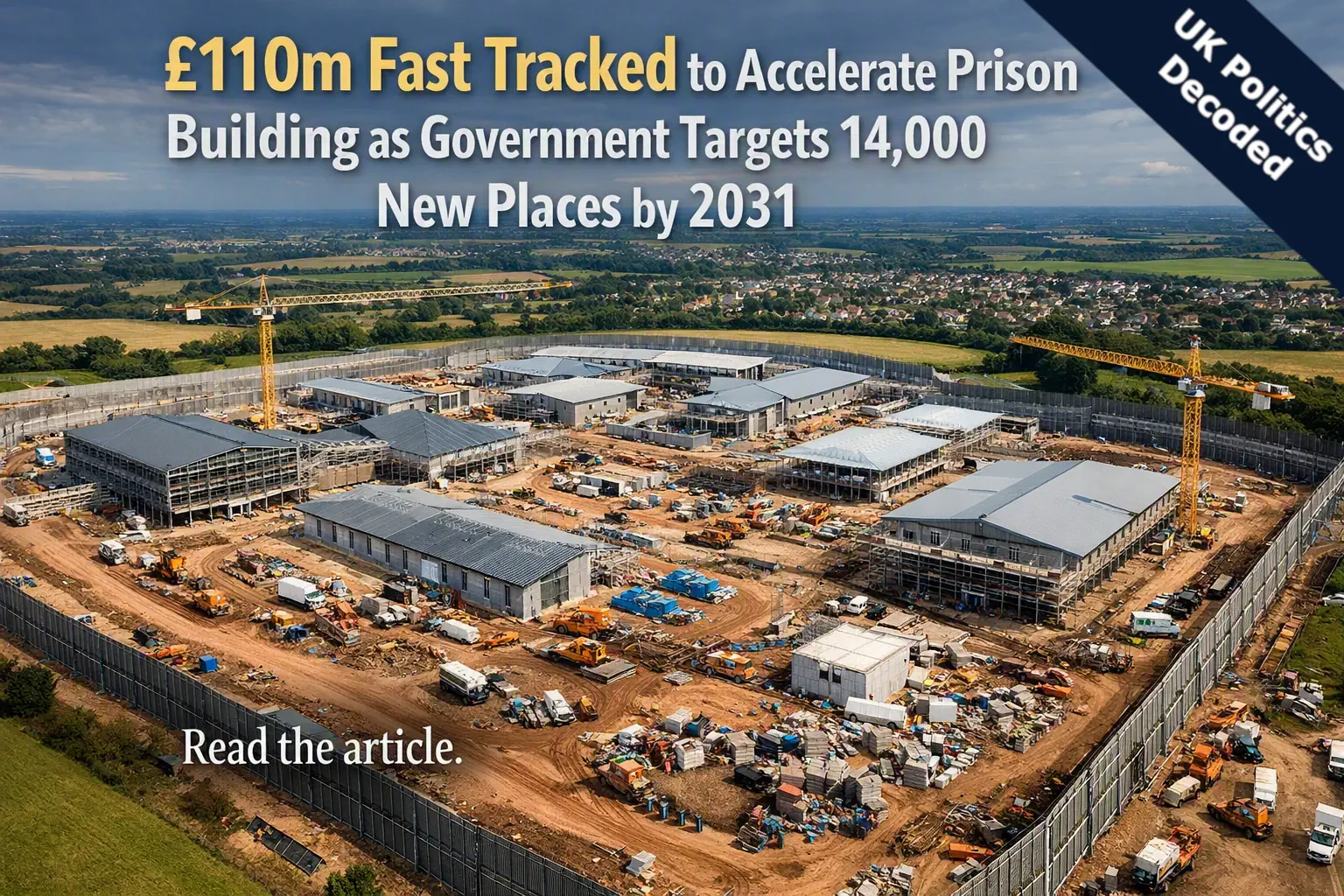
£110m has been fast tracked to accelerate prison construction in England and Wales, with the government signing a contract for the first phase of a new 1,700 place prison in Lancashire and setting plans in motion to turn unused space inside existing jails into cells.
Lord Chancellor Alex Norris made the announcement on 1 September 2026, setting out the investment as part of the government's programme to add 14,000 extra prison spaces by 2031. The money has been reprioritised from within existing budgets rather than representing new Treasury spending. Norris also addressed Parliament on the same day, outlining changes to upcoming sentencing reforms and confirming additional funding for victim support services.
At a Glance
- The government has fast tracked £110m from existing budgets to accelerate prison building, including converting unused offices, laundry rooms, and storage areas within existing prisons into cells.
- A contract has been signed to begin the first phase of work on a new 1,700 place prison in Lancashire, described by ministers as the latest step in the largest prison building programme since the Victorian era.
- The investment forms part of plans to deliver 14,000 extra prison places by 2031, with ministers claiming more than 3,200 places have been added since the government took office.
- An additional £18.9 million has been directed to specialist victim support services, on top of a record £550 million already committed over the next three years.
- The Lord Chancellor confirmed to Parliament that upcoming sentencing reforms will be adjusted to prevent more dangerous offenders from qualifying for early release, among other changes.
How the £110m Will Be Spent, Cell Conversions, New Land, and a New Build
The £110m is not new money. The Ministry of Justice has confirmed it has been fast tracked from existing budgets, meaning the purpose is to get construction moving faster than previously scheduled rather than to expand the overall capital envelope. A portion of the funding will also go toward purchasing new land, which the government says is needed to build a credible long term pipeline for entirely new prisons beyond those already in planning or under construction.
Much of the immediate spend is directed at turning unused space inside existing prisons into functional cells. The announcement specifically cites offices, laundry rooms, and storage areas as the types of space being converted. It is a faster route to adding capacity than new builds which take years to plan, approve, and construct and has been used by governments before when the prison population has climbed toward operational limits.
Ministers describe the programme as the largest prison building effort since the Victorian era. That framing covers the scale of planned expansion rather than the pace, but the government has been clear it wants to demonstrate urgency. Norris said the government had already delivered more than 3,200 prison places in roughly two years in office, and that it is now spending more than three times what was spent on prison building over the previous seven years. Both figures come directly from the Ministry of Justice announcement.
New 1,700 Place Lancashire Prison Contract Signed and the 14,000 Place Target Explained
The most concrete new commitment in the announcement is the signed contract to begin the first phase of work on a new 1,700 place prison in Lancashire. No specific location within Lancashire was named, but ministers framed it as the programme's latest ground level delivery rather than a future aspiration. The first phase contract is a standard staging point for large construction projects of this kind, covering early design, enabling works, and site preparation before the main build begins.
Prison building programme: key commitments
- £110m fast tracked from existing Ministry of Justice budgets to accelerate prison building, announced 1 September 2026.
- First phase contract signed for a new 1,700 place prison in Lancashire, the latest new jail in the current building programme.
- Investment in new land acquisition to establish a longer term pipeline of prison sites beyond current planning stages.
- Target of 14,000 extra prison places delivered by 2031, with ministers claiming more than 3,200 places already added since taking office.
The 14,000 place target by 2031 is the overall framework into which this investment fits. Getting there requires sustained construction output over five years, which means the land acquisition element of the announcement is as significant as the immediate build activity. Without a credible pipeline of sites cleared for development, the programme risks stalling in later years even if near term targets are met.
Sentencing Tightened at the Same Time as Prison Places Expand, Will Demand Outpace Supply?
The prison building investment arrived alongside a separate set of sentencing policy announcements that point in the opposite direction for capacity. Norris told Parliament that upcoming sentencing reforms would be adjusted to block more dangerous offenders from qualifying for early release changes that, if significant in volume, will put upward pressure on the prison population at the same time as the building programme is adding space.
Capacity being added
- £110m fast tracked to convert unused prison space and begin new build works, targeting immediate capacity gains within the existing estate.
- First phase contract signed for 1,700 place Lancashire prison, contributing to the 14,000 place target for 2031.
- New land purchases underway to secure sites for future prisons and prevent gaps in the building pipeline after current projects complete.
- Ministers claim more than 3,200 places added since taking office, with spending on new prisons described as three times higher than the previous seven years combined.
Demand pressures ahead
- Sentencing reforms will be adjusted to block more dangerous offenders from early release, increasing the number of people held for longer periods.
- Plans to remove foreign national offenders more quickly are presented partly as a capacity management measure, potentially freeing space in the near term.
- The government will move to end Imprisonment for Public Protection sentences in a way it says balances fairness and public safety, which could eventually reduce long term prisoner numbers.
- The combined effect of sentencing changes on prison population projections was not set out in the announcement.
The plans to end Imprisonment for Public Protection sentences, a sentence type created in 2005 and abolished in 2012 but still held by thousands of prisoners serving beyond their original tariff represent a longer term reform with uncertain population effects depending on how the balancing of fairness and safety is applied in practice.
£18.9m Extra for Victim Support Services On Top of £550m Already Committed
The announcement also confirmed an additional £18.9 million for specialist victim support services. Like the prison building investment, the money has been reprioritised from within existing budgets. It is framed by the Ministry of Justice as targeted funding to provide the specialist emotional and practical support that helps victims move on with their lives.
The £18.9 million sits alongside a record £550 million the government has already committed to victim support over the next three years. Ministers described the additional allocation as supplementing services under particular pressure, though no breakdown by service type or region was provided in the announcement.
Can the Government Deliver 14,000 Prison Places by 2031?
The 1 September announcement represents the clearest signal yet from the government that it views the prison estate as a structural problem requiring sustained capital investment. The combination of cell conversions, new builds, land acquisition, and a long term numeric target reflects a programme designed to be harder to unpick than a one off funding injection.
Whether the 14,000 place target by 2031 is achievable will depend on factors the Ministry of Justice does not fully control, planning timelines, contractor capacity, and how quickly demand shifts in response to sentencing changes. The Lancashire contract is a visible step, but five years is a tight window for a target of this scale, and the history of public prison building programmes suggests delivery timelines tend to stretch.
Norris used the announcement to argue the government had already demonstrated credibility by delivering more than 3,200 places in two years. The question for the remainder of the programme is whether the pace can be maintained as the easier conversions are completed and the harder new build projects dominate the pipeline.
Key Takeaways
- The government has fast tracked £110m from existing Ministry of Justice budgets to speed up prison construction, primarily through converting unused space in existing prisons into cells.
- A first phase contract has been signed for a new 1,700 place prison in Lancashire, the latest new build in a programme targeting 14,000 extra prison places by 2031.
- Ministers claim more than 3,200 prison places have been delivered since taking office and say current spending on new prisons is more than three times what was spent in the previous seven years.
- Sentencing reforms will be adjusted to block more dangerous offenders from early release, remove foreign national offenders more quickly, and move toward ending Imprisonment for Public Protection sentences.
- An extra £18.9 million has been directed to specialist victim support services, in addition to a £550 million commitment already in place for the next three years.
Sources & Further Reading
- GOV.UK - Funding accelerated to turbocharge prison building across country (Ministry of Justice and Alex Norris MP, 1 September 2026) Archived copy (OGL): archived page
- Ministry of Justice - Prison population statistics Archived copy (OGL): archived page
- Victim and witness information Archived internally for verification (1 September 2026)
- Parliament.uk - Written Ministerial Statements