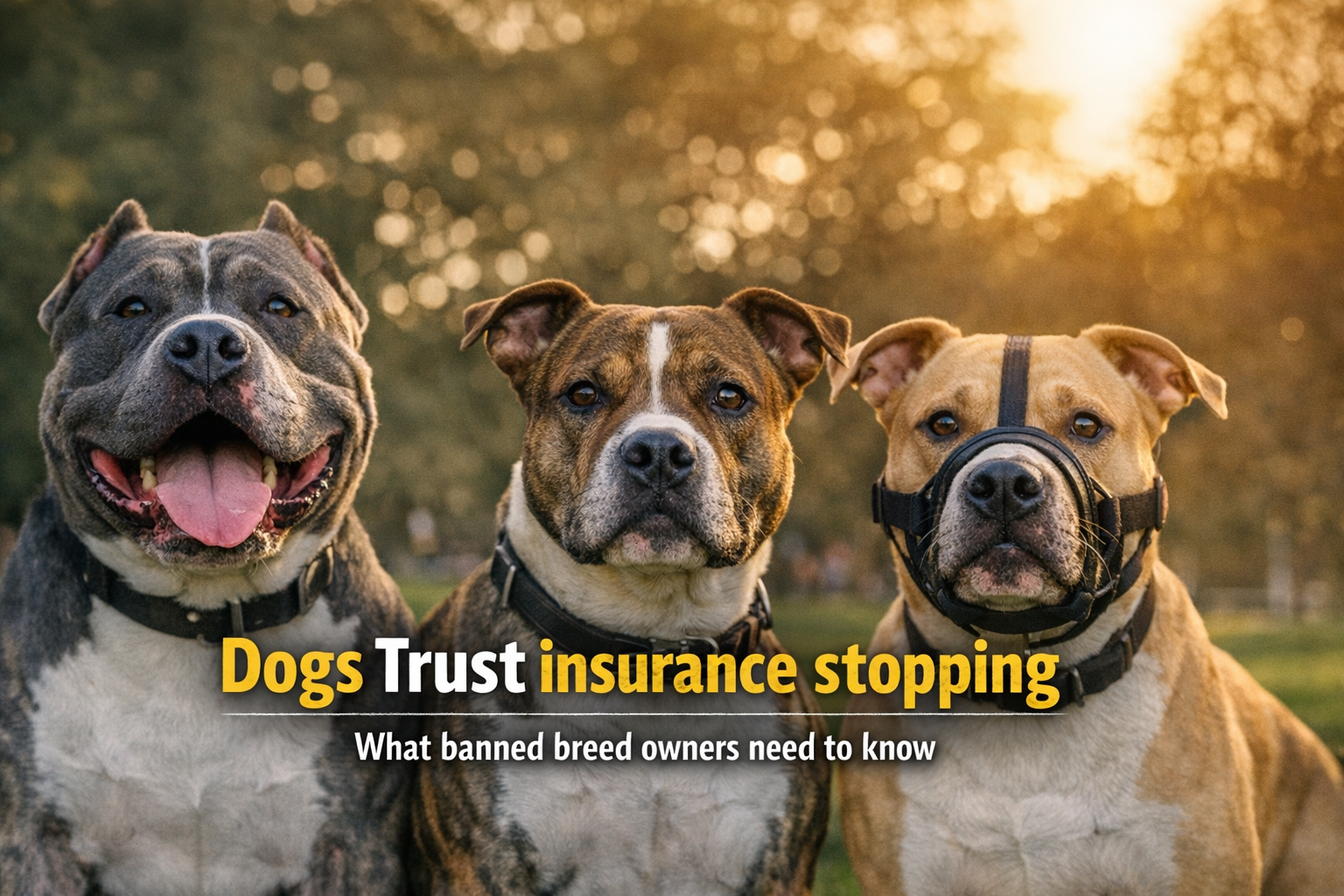
Dog owners across England and Wales have received new emails from Dogs Trust and Defra confirming important changes to third party public liability insurance for banned breeds including XL Bullies. The updates have caused understandable confusion, so here is a clear breakdown of what is happening, what stays the same, and what you actually need to do.
What Is Changing?
Dogs Trust has announced that it will stop issuing new insurance policies and stop renewing existing policies for banned breeds after 30 June 2026. This affects owners whose dogs are registered under a Certificate of Exemption.
But crucially:
- Policies renewed on or before 30 June 2026 will still run for their full 12 month term.
- Policies that already extend beyond 30 June 2026 (for example, into 2027) remain valid until they naturally expire.
No one loses cover overnight.
Do I Still Need Insurance Right Now?
Yes. Insurance remains a legal requirement for your Certificate of Exemption to stay valid. Your policy must:
- Provide cover until at least 1 July 2026
- Be in the same name as the Certificate holder
- Cover death or bodily injury to any person caused by the exempted dog
- Be suitable for a prohibited breed under the Dangerous Dogs Act 1991
If your insurance lapses before 30 June, your Certificate becomes invalid and you must contact your local police Dog Legislation Officer immediately.
What Happens After 30 June 2026?
This is the part causing the most anxiety. Here is the key message from Defra:
Defra is working on a long term insurance solution and will contact owners directly. You do not need to take any action yet.
While Dogs Trust is stepping back from providing cover, the government is preparing an alternative pathway. Owners will receive instructions in June.
If Your Dogs Trust Policy Renews Before 30 June
You must renew it to stay legally compliant. Once renewed, it will run for a full 12 months even if that takes it well past the June deadline.
Example:
- Renewal date: 15 May 2026
- New policy runs until: 15 May 2027
- This is valid and accepted.
If Your Policy Expires After 30 June
Your existing policy remains valid until its natural expiry date. No action is required.
If You Currently Have No Insurance
Your Certificate of Exemption is not valid. Defra advises you to:
- Contact your local police force
- Ask for the Dog Legislation Officer
- They will advise you on next steps
Lack of insurance is treated as non‑compliance under the Dangerous Dogs Act.
Why Is This Happening?
Dogs Trust has been the primary provider of low cost third party liability insurance for exempted dogs. With the surge in registrations and the long term administrative burden, they are stepping back from this role. Defra is now responsible for ensuring a replacement system is in place.
What Owners Should Do Right Now
Here is the simple checklist:
- ✔ Keep your current insurance active. Do not let it lapse before 30 June.
- ✔ Renew before 30 June if your renewal date falls earlier. This keeps your Certificate valid.
- ✔ Wait for Defra's June update. They will contact you directly with the next steps.
- ✔ Continue meeting all other Certificate conditions, including:
- Neutering
- Microchipping
- Keeping your dog muzzled and on a lead in public
- Secure containment at home
Where to Get Official Information
- Defra's updated guidance:
www.gov.uk/guidance/ban-on-xl-bully-dogs - Questions about insurance:
dogsindex@defra.gov.uk
The Wider Picture: What Experts Say Would Actually Improve Public Safety
If any government were serious about reducing dog bites and preventing attacks, the expert consensus is remarkably consistent. Effective prevention focuses on people, behaviour, and education not breed labels.
Evidence led measures include:
- National public education programmes on safe dog handling, child dog interactions, and responsible ownership
- Accessible training and socialisation support, especially for first time owners
- Early intervention behaviour services to help owners address issues before they escalate
- Licensing or competency based schemes that focus on owner responsibility rather than appearance
- Better data collection so policy decisions are based on real world patterns, not assumptions
These are the approaches repeatedly recommended by vets, canine behaviourists, academic researchers, and public health specialists.
Why This Matters Now
The ongoing changes to insurance for exempted dogs highlight a wider issue: policy decisions are still being made around banned breeds, even though breed specific rules have not delivered the safety outcomes the public deserves.
Owners, professionals, and welfare organisations are calling for a shift toward:
- Evidence based prevention
- Education over enforcement
- Behaviour focused risk assessment
- Support for responsible ownership
This is the direction experts say would genuinely reduce dog bites and improve safety for both people and animals.
If previous governemnts where serious about public safety they would have implemented these evidence based measures long ago.
Instead, they have chosen to continue to make policy decisions around banned breeds as it gives the appearance of action when infact they ignore the advice that would actually have an impact on public safety and increase animal welfare.
This is a clear indication that the governments of the past are not serious about public safety and are more interested in political expediency than evidence based policy.