AI Use & Transparency: AI tools were used to support source discovery and to structure the article for clarity. All research, verification, drafting, and final editorial decisions are fully human led. Learn about our AI policy.
UKPoliticsDecoded is an IMPRESS regulated public interest publisher. Read our editorial standards.
The news this morning is that the Prime Minister has moved to block more serious offenders from early release. Manslaughter, Death by drunk or dangerous driving, Causing or allowing the death of a child, Historic child sex offences, The categories are serious enough that announcing their exclusion from a sentencing reform scheme feels, briefly, like something solid. Of course those people shouldn't be let out early.
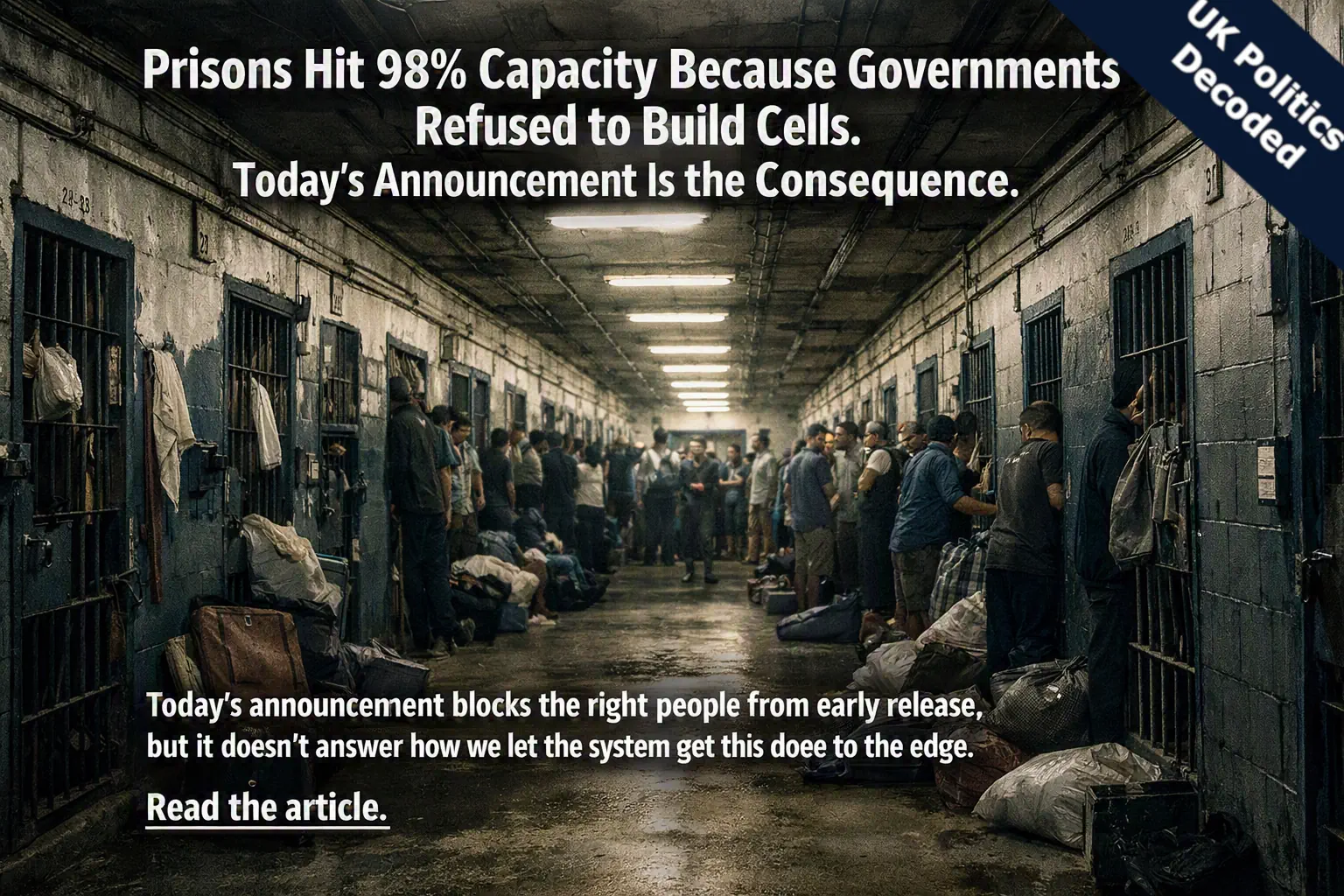
But then you sit with the sentence that appears lower down in the government's announcement. Adult male prisons are now at 98% capacity. When this government took office in the summer of 2024, fewer than 100 spaces remained across the entire English and Welsh prison estate. Not county by county. The whole country. That is the context this announcement exists inside, not as a principled stand on sentencing, but as a managed retreat from the edge of total systemic failure.
The SDS40 scheme introduced in September 2024 to release eligible prisoners at 40% of their sentence rather than the previous 50% was never designed to go soft on crime. It was a consequence. You do not run a justice system at near maximum capacity without consequences eventually arriving, and the form those consequences take is rarely tidy or comfortable. What bothered a lot of people was not just that some offenders were being released early, but that the eligibility criteria weren't always drawing the lines people expected. The government's own guidance acknowledges that someone serving multiple sentences at the same time could be released earlier if even one of those sentences qualified for the scheme. A person with a serious offence on their record, serving concurrent time for something that did fall within the eligible categories, could walk out earlier than most people would have expected. The government excluded sex offences, serious violent offences carrying four years or more, terrorism, and domestic abuse related offences but the edges of that framework were never going to be clean. That is not a minor concern.
And yet it is a concern that should not have been necessary in 2026. The prison estate has been in creeping decline for the better part of a generation. Across the decade before this government took office, only 500 net prison places were added to the estate despite a rising prison population, rising levels of violence inside jails, and capacity warnings being issued year after year. Every government found reasons to defer. The economics were poor, the timelines long, and building prisons is not the kind of announcement that makes headlines in a good way. So the problem accumulated quietly, until it couldn't any longer.
I find myself thinking about what this looked like from a victim's perspective this year. The government's announcement today acknowledges that "hundreds more victims will no longer face the anxiety of seeing their offender coming out sooner than they were expecting." That phrasing carries a lot of weight. There should not have been hundreds of victims in that position in the first place. The fact that they were is not an accident of this government's policy choices, it is the endpoint of a structural failure that long preceded them.
The new measures go beyond simply blocking offence categories. Prison leavers will, as a presumption, be tagged on release. New restriction zones described by the government as a world first will limit the movement of some sexual and violent offenders after release, with victims having a direct say in how those zones are drawn. Some foreign national offenders will be deported immediately after sentencing from early next year, blocked from returning. And Imprisonment for Public Protection sentences, a legal anomaly that has kept some people in custody years beyond their original tariff, will finally be ended during this Parliament. As of 30 June 2026, 2,271 people remain imprisoned under IPP, 856 who have never been released and 1,415 who were recalled after a period of licence. Many have served their minimum term several times over.
The restriction zone proposal in particular sounds like something genuinely useful for survivors of domestic and sexual violence. But the deeper problem is not addressed by any of it. The government has already built more than 3,200 new prison places since taking office, with 14,000 planned by 2031, described as the largest prison building programme since the Victorian era. That fact is more damning than it sounds as a boast. We are measuring ambition against a standard set in the 1840s because nothing at comparable scale has happened since. The population has tripled in that time. The prison estate has not kept pace.
What today amounts to is the right call on a specific and urgent question, should people imprisoned for killing someone benefit from a capacity driven sentencing reform? The answer was always no. But we are having that argument in August 2026 because the argument that mattered, build the cells before the crisis forces your hand, was avoided for years across multiple administrations. The government has pushed the system, in its own words, to the very limits of what is possible without it collapsing. That is a reasonable thing to say. It is also a fairly stark summary of where we have ended up.
Sources & Further Reading
-
GOV.UK - Prime Minister blocks hundreds more criminals from sentencing changes (30 August 2026)
Archived copy (OGL): archived page -
Ministry of Justice - Annual Statement on Prison Capacity 2025
Archived copy (OGL): archived page -
GOV.UK - New change to some offenders' automatic release dates (SDS40 scheme guidance)
Archived copy (OGL): archived page - HMPPS - Annual Report on the IPP Sentence 2025/26 (Written Ministerial Statement, 9 July 2026)
-
Ministry of Justice - Offender Management Statistics Bulletin, England and Wales, Q4 2025
Archived copy (OGL): archived page