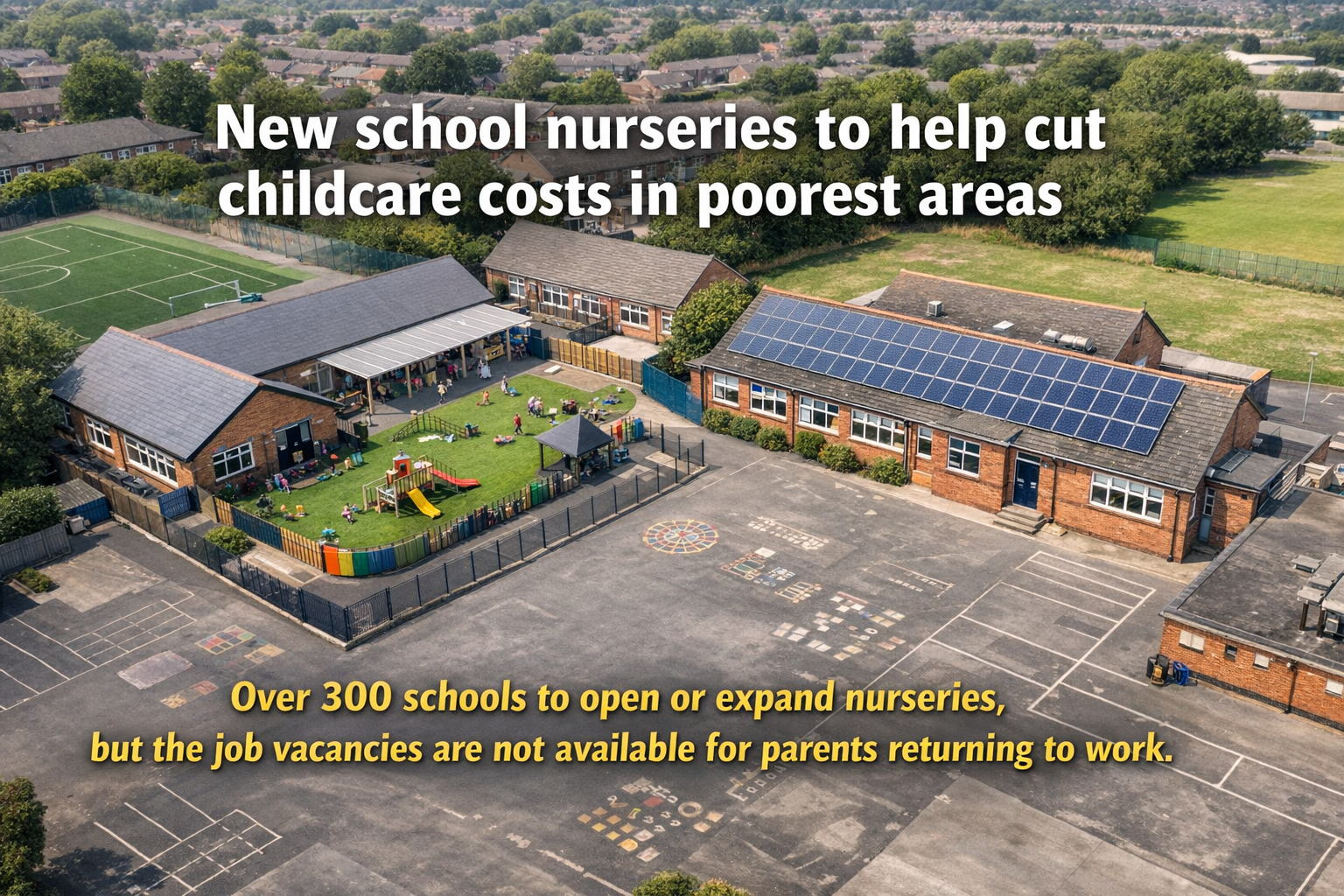
On 22 March 2026, the government announced that a further 331 schools across England will receive a share of £45 million to build or expand nurseries on their sites, with the new places available from September 2026. This is the second phase of an expansion programme that began in 2024–2025 and is aimed specifically at areas where childcare is hardest to access and families face the greatest financial pressure.
Here is a plain English breakdown of what is being announced, why the government says it matters, and what the wider structural picture looks like for families trying to return to work.
What Has Been Announced?
The government is expanding school based nursery provision. A total of 331 schools have been successful in applying for funding, adding over 6,000 new childcare places across England from St Ives in Cornwall to Gateshead in the North East. This is on top of up to 6,000 places already being delivered through the first phase of the programme.
Combined with the government's existing 30 hours of funded childcare for eligible working parents, school based nurseries can significantly reduce what families pay. The government says families could save up to £8,000 a year in childcare costs as a result.
Over one million parents now use the government's funded childcare offer. However, take up is lower in poorer communities, which is why the new funding is being targeted at areas with the greatest unmet need.
Why the Government Says This Matters
School based nurseries are not simply about providing more childcare places the government argues they serve a specific role in communities where commercial providers have not filled the gap. In the most deprived areas, school based nurseries already make up around 35% of all childcare provision, compared with just 16% in the least deprived areas. They sit within trusted, familiar buildings and are accessible to families who might otherwise struggle to find or afford local provision.
The government's case for school based nurseries rests on several practical benefits:
- When combined with the 30 hours funded childcare offer, they can cut childcare costs significantly for working families
- They simplify the school run by allowing families to drop children at one location
- They help parents return to work by removing the barrier of unaffordable or unavailable childcare
- They help prepare children for the transition to primary school, with nearly six in ten parents surveyed (59%) identifying this as a key benefit
- They fill provision gaps in deprived communities where private and voluntary childcare has retreated
The government also points to the development gap, children growing up in the most deprived communities are more than 20 percentage points less likely to reach a good level of development by age five compared with their peers in the least deprived areas. School based nurseries, positioned in those communities, are intended to begin narrowing that gap from the earliest possible age.
How the Programme Is Changing Structure
This second phase does not simply repeat the first. The government is making significant changes to how the programme is run, broadening where nurseries can be located and who decides where new places are needed.
Moving to a Locally Led Model
From May 2026, councils rather than individual schools will be responsible for identifying where new nursery places are needed most. Local authorities are better placed to assess gaps across their areas and target investment where families face the greatest barriers. This shift is designed to ensure that funding reaches the places with the highest need, rather than simply going to schools that apply most quickly.
Best Start Family Hubs
For the first time, Best Start Family Hubs which are being set up in every local area will be able to host school based nurseries. This is a significant change. Instead of childcare existing in isolation, it will sit alongside:
- Family support services
- Health visiting
- Early identification of special educational needs and disabilities (SEND)
The intention is that a family can access multiple forms of support from one place, reducing the number of appointments, referrals, and journeys that parents often those with the least time and fewest resources currently have to navigate.
Early Years Pupil Premium Uplift
Ten local areas will receive an additional £363 per child on top of the Early Years Pupil Premium, which itself already received a 45% uplift in 2025 and a further 15% uplift in 2026. This funding is for early years providers to improve education quality, raise attainment, and support children from more deprived backgrounds. The ten areas are: Brighton and Hove, Durham, Islington, Leeds, Luton, Nottingham, Rochdale, Rotherham, Torbay and Sandwell. A further ten areas will be announced next year.
Wider Cost of Living Measures Referenced
The government has positioned this announcement within a broader package of cost of living support for families. Other measures mentioned alongside the nursery expansion include:
- Free breakfast clubs, which the government says are saving families up to £450 a year
- A cap on branded school uniform costs
- Free school meals extended to all children in families receiving Universal Credit
What Ministers Said
Prime Minister Keir Starmer said:
"As a parent, I know how hard it can be to juggle work and family life, especially in those early days where time is precious and sleep is short. School based nurseries are already driving a seismic shift in how childcare supports families. Now we're going even further to build on what works with over 300 new nurseries cutting childcare costs, simplifying the school run, and helping parents at a time when household budgets are under real pressure."
Education Secretary Bridget Phillipson said:
"Our school based nurseries are already helping fill the gaps in communities where childcare is hardest to find, giving children the strong start they deserve and helping parents access childcare close to home. By expanding these nurseries further and targeting them at the areas that need them most, we are making sure more families can benefit from quality early education while putting practical support in place to help with the cost of living."
Nicola Wileman, Headteacher at Hillsborough Primary in Sheffield, one of the schools receiving funding, said:
"We are absolutely thrilled to have been chosen for this grant it's such a great thing for our school and our whole community. Our area has faced real challenges over recent years, with higher levels of deprivation and a drop in nursery provision since Covid, meaning too many children were starting school without having accessed early childcare. This expansion will help us ensure every local family has access to a quality, trusted nursery, giving children the best possible start in life and helping parents get back into work and back into the community."
The Wider Structural Picture, Will the Economic Case Hold Up?
The childcare expansion is presented primarily as a cost of living measure, but its broader economic justification rests on a clear assumption, that freeing up parental time will lead to more people returning to work, paying more tax, and relying less on state support. That logic is sound in principle. But three significant structural constraints in the current UK economy limit how effective this policy can be in practice.
Falling Job Vacancies
UK job vacancies have been declining steadily since their post pandemic peak. The latest ONS figures, published on 19 March 2026, show an estimated 721,000 vacancies in December 2025 to February 2026 down from the heights seen in 2021 and 2022. Over the same period, the unemployment rate has risen to 5.2%, meaning more people are actively looking for work at the same time as fewer positions are available.
This matters directly for the childcare expansion. The policy's fiscal return higher employment, higher tax receipts, lower welfare spending depends on parents being able to move into work once childcare is available and affordable. But if the jobs are not there, that transition does not happen. Parents may have the time and the childcare, but not the opportunity.
This is not a motivation problem. It is a vacancy supply problem. Expanding childcare access is a necessary condition for parents returning to work. It is not, on its own, a sufficient one.
Post Brexit Trade Gains Are Real but Slow
Since 2024, the UK has signed or ratified a number of free trade agreements, including with Australia, New Zealand, and through accession to CPTPP. The UK also signed a Comprehensive Economic and Trade Agreement with India in July 2025, which is currently going through ratification. These agreements reduce tariffs and regulatory friction, lowering operating costs for businesses and reducing uncertainty for investors.
However, the economic benefits of trade agreements do not arrive immediately. Supply chains typically take 18 to 24 months to adjust. Investment decisions lag behind regulatory change. Job creation follows only after business confidence returns and capacity is rebuilt. The trade related job growth that these agreements may generate is unlikely to materialise at scale before 2027 or 2028 at the earliest.
The childcare expansion is happening now. The job growth it is partly intended to support may not follow for years.
Long Term Deindustrialisation Remains Unaddressed
UK deindustrialisation began in earnest in the 1940s and accelerated sharply through the 1980s. Entire industrial regions lost their economic base over a period of decades, and that loss has never been strategically reversed. The result is persistent regional inequality, a chronic skills gap in many parts of the country, heavy reliance on imported goods, and a limited supply of high quality, well paid jobs outside of London and the South East.
Childcare policy alone cannot compensate for the absence of a long term industrial renewal strategy. In communities where well paid local employment has been absent for a generation, making childcare cheaper does not automatically create the kinds of jobs that would make a meaningful difference to family finances. Without a credible plan to rebuild domestic manufacturing, strengthen regional economies, and create sustainable employment at scale, the fiscal payback from childcare investment will remain partial.
The UK does not have a welfare problem. It has a job vacancy problem and a long term industrial strategy gap.
Childcare expansion is a meaningful and necessary investment in families and early years development. But its economic case the argument that it will pay for itself through higher employment and tax receipts depends on a labour market that is currently moving in the wrong direction.
Taxpayers are funding new childcare places. The expected fiscal return is limited not because the policy is wrong, but because the structural conditions needed to deliver it are not yet in place.
Conclusion
The government's school based nursery expansion is a substantive investment in early years provision, targeted at the communities that need it most. For families in deprived areas who currently face a shortage of affordable, accessible childcare, this announcement represents a real and tangible improvement.
The shift to a locally led model, the integration with Best Start Family Hubs, and the additional Early Years Pupil Premium funding all point to a more joined up approach than previous phases of childcare expansion. These are meaningful changes in delivery, not just headline numbers.
But the policy's broader economic ambitions to increase employment, reduce welfare dependency, and generate a fiscal return will only be realised if the labour market can absorb parents who want to return to work. Right now, vacancies are falling, trade driven growth is years away, and the UK's industrial base remains structurally weak.
The investment in childcare is welcome. The question is whether the economy it is designed to unlock is ready to receive it.