AI Use: AI tools were used to support source discovery and to structure the article for clarity. All research, verification, drafting, and final editorial decisions are fully human led. Learn about our AI policy.
UKPoliticsDecoded is an IMPRESS regulated public interest publisher. Read our editorial standards.
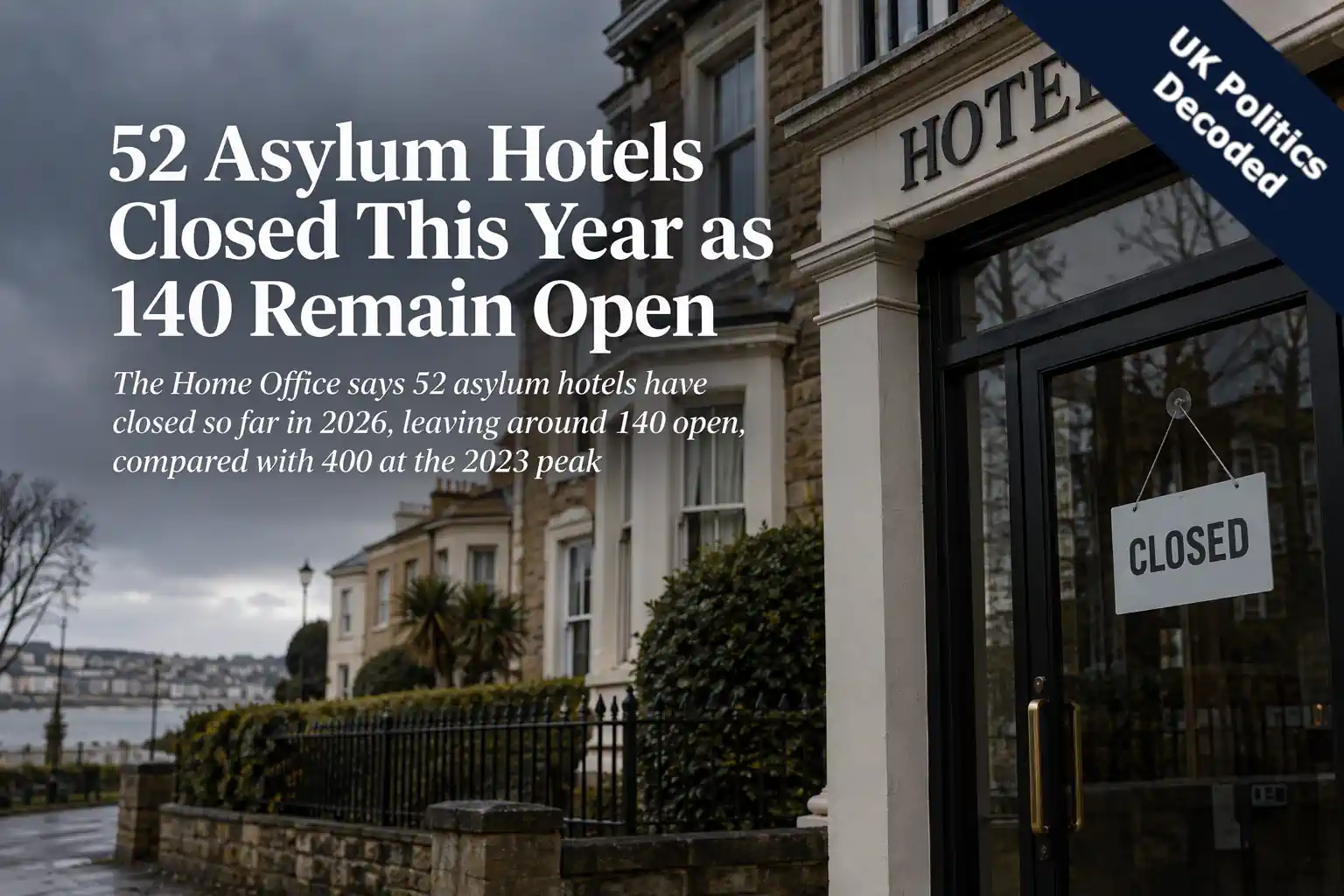
Eight more asylum hotels have been handed back to their communities, the Home Office announced on 19 November 2026, taking the number closed this year to 52. Around 140 remain open.
The government says the closures are possible because fewer people are arriving by small boat, claims are being decided faster, and removals are at their highest level in nearly a decade. Ministers have said they intend to end hotel use entirely.
At a Glance
- The Home Office says eight further asylum hotels have closed since the summer, bringing the total closed in 2026 to 52.
- Around 140 asylum hotels remain open, down from 400 at the 2023 peak and 213 at the 2024 general election.
- The number of people living in asylum hotels has halved in a year to 16,000, which the government says is 71% below the peak of 56,000.
- The latest closures are expected to cut asylum costs by around £16 million, on top of more than £1 billion the government says it has saved since the election.
- Asylum seekers are being moved into more basic accommodation, including former military barracks, while claims are processed.
How Many Asylum Hotels Have Closed, and How Many Are Left?
According to the Home Office, the eight latest closures stretch from Bournemouth to Falkirk. All have been returned to communities since the summer.
The department says that brings the total closed so far this year to 52. Around 140 hotels are still in use. At the 2023 peak there were 400, and by the time of the 2024 general election the figure stood at 213.
The headcount has fallen too. Some 16,000 people are now in asylum hotels, which the Home Office says is half the number a year ago and 71% below the peak of 56,000 under the previous government.
The department puts the saving from this round of closures at around £16 million. It adds that the government has saved more than £1 billion since the election, though the announcement does not break that figure down.
Why Are Asylum Hotels Closing? What the Home Office Says
The Home Office credits what it calls system wide immigration reforms. It points to four changes in particular, a significant drop in small boat arrivals, a fourfold increase in asylum decision making, a 21% reduction in asylum claims, and the highest level of removals in nearly a decade.
Those are the government's own figures, drawn from the announcement. The release does not set out the comparison periods for each one, so readers looking for precise year on year numbers will need the underlying Home Office statistics.
Border Security and Asylum Minister Anna Turley said the government was "restoring fairness and control to an immigration system that had spiralled out of control". She added that more hotels were closing and that ministers "won't stop until they are all shut for good".
The wider asylum population is also shrinking, according to the department. There are 13,800 fewer people in taxpayer funded accommodation than a year ago, a 13% reduction. The Home Office says people whose claims are approved are being moved on from the asylum estate more quickly, while those who are refused are removed where possible.
Where Asylum Seekers Are Being Housed Instead
People waiting for a decision are not being released from support. The Home Office says that while claims are considered, asylum seekers are being moved to what it describes as alternative and more basic forms of accommodation. That includes former military barracks.
The government argues that large sites give it more control than hotels do. It describes them as self contained, with essential services on site and 24/7 CCTV and security.
Asylum hotels
- Around 140 remain open, down from 400 at the 2023 peak.
- About 16,000 people are housed in them, against 56,000 at the peak.
- Eight more have closed since the summer, with 52 closed in 2026.
- The government describes them as expensive and says it wants them all closed.
Large sites, including former barracks
- Described by the Home Office as more basic accommodation.
- Described as self contained, with essential on site services.
- The government says they offer 24/7 CCTV and security.
- The government says they give it greater control than hotels.
The announcement does not say how many people are in barracks or other large sites, or what they cost per person compared with hotels. Those details are not in the source material.
Immigration and Asylum Bill and the Illegal Working Crackdown
The closures came alongside a legislative step. The Home Office says the Immigration and Asylum Bill passed its third reading in Parliament earlier this week. According to the department, the Bill will discourage unfounded, late and repeated asylum claims, strengthen decision making, and bring cases to a conclusion more quickly.
It is not the end of the process. A bill that has cleared third reading in one House still has further parliamentary stages to complete before it can become law, and the announcement does not say when that is expected.
The Home Office also pointed to a separate announcement made the day before. It said asylum seekers caught working illegally could now lose their support payments and accommodation, which it described as removing another pull factor driving illegal migration to the UK.
What to Watch Next on Asylum Hotels
The government's stated aim is to close every asylum hotel, but it has not given a date. With around 140 still open, the pace of closures through the winter will show whether the ambition is on track.
Two things are worth checking against future Home Office statistics, the number of people in asylum accommodation, and the number of hotels still contracted. Both feed directly into the savings the department is claiming.
The figures in this article come from a Home Office press release, which presents the government's own account of its record. Independent verification will depend on the department's published immigration and asylum statistics.
Key Takeaways
- The Home Office says 52 asylum hotels have closed in 2026 and around 140 remain open.
- The government says the number of people in asylum hotels has fallen to 16,000 from a peak of 56,000.
- The department attributes the fall to fewer small boat arrivals, faster decisions, fewer claims and more removals.
- Asylum seekers awaiting decisions are being moved to more basic accommodation, including former military barracks.
- The Immigration and Asylum Bill passed third reading this week, but the announcement does not say when it will become law.
Sources & Further Reading
- GOV.UK: More asylum hotels closed as reforms ease pressure on communities Archived copy (OGL): archived page