AI Use & Transparency: AI tools were used to support source discovery and to structure the article for clarity. All research, verification, drafting, and final editorial decisions are fully human led. Learn about our AI policy.
UKPoliticsDecoded is an IMPRESS regulated public interest publisher. Read our editorial standards.
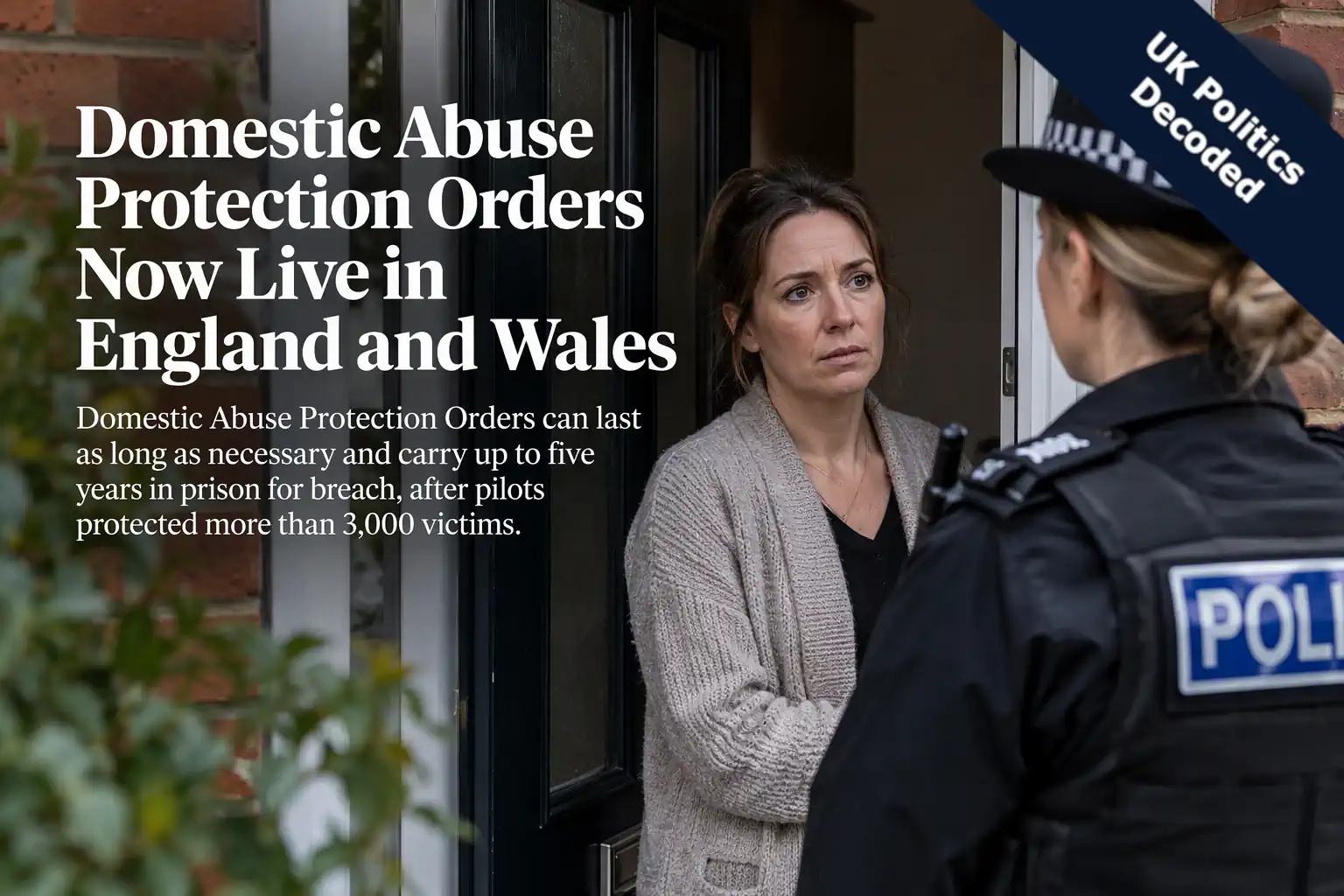
Domestic Abuse Protection Orders and Domestic Abuse Protection Notices go live across England and Wales on 25 November 2026, giving police and courts a single set of tougher tools against perpetrators. The Home Office announced the national rollout on 24 November, describing the powers as the strongest protections for victims yet.
The orders have been tested for two years in Greater Manchester, parts of London, Cleveland, North Wales and by the British Transport Police. According to the government, they protected more than 3,000 victims over that period. Now every police force and court in England and Wales can use them.
At a glance
- Domestic Abuse Protection Orders and Domestic Abuse Protection Notices are rolled out across England and Wales from 25 November 2026.
- Courts can impose any requirement they consider necessary to protect a victim, including forcing an abuser out of a shared home.
- Breaching a Domestic Abuse Protection Order is a criminal offence punishable by up to five years in prison.
- Victims can apply directly to the Family Court for an order without involving the police.
- The pilot areas protected more than 3,000 victims in two years, according to the Home Office.
What Domestic Abuse Protection Orders Can Force Abusers to Do
The headline feature is flexibility. Courts will be able to impose any requirement they think is necessary to protect a victim, rather than choosing from a fixed menu. The government says that could include forcing an abuser out of a home they share with the victim.
The orders also reach online. Perpetrators who use social media to continue campaigns of abuse, intimidation and control may be required to hand over access to their accounts, so that victims are protected both on and offline.
Criminal courts can also attach positive requirements designed to change behaviour. These include drug or alcohol treatment and mental health interventions. Other measures within an order can prohibit contact with the victim, impose curfews and restrict access to certain locations.
The orders cover all forms of domestic abuse, including controlling or coercive behaviour, stalking and economic abuse. Part 3 of the Domestic Abuse Act 2021 sets out the legal framework for both notices and orders, and the same Act repeals the older provisions on domestic violence protection notices and orders.
Up to Five Years in Prison for Breaching an Order
Unlike earlier protections, a Domestic Abuse Protection Order can stay in place for as long as necessary to keep a victim safe. The Home Office ties the duration to the victim's safety rather than to a set period.
Breach is treated as a crime in its own right. Anyone who breaks the terms of an order faces up to five years in prison. People subject to an order must also tell the police if their name or address changes, and failing to do so is a criminal offence.
How the notice and order system works
- Police can issue a Domestic Abuse Protection Notice, which gives immediate emergency protection while a longer term order is considered by the courts.
- A court can then make a Domestic Abuse Protection Order, which can remain in force for as long as necessary to keep the victim safe.
- Anyone subject to an order must notify the police of any change of name or address, and failing to do so is a criminal offence.
- Breaching an order is a criminal offence punishable by up to five years in prison.
Who Can Apply for a Domestic Abuse Protection Order
One of the most practical changes is the route into the system. Victims will be able to apply directly to the Family Court for an order, without going through the police. The government says this gives them a clearer way to seek protection. Local authorities and family members can also ask the court for permission to apply on a victim's behalf.
Police retain their own role through the notice. Because a Domestic Abuse Protection Notice can be issued straight away, officers dealing with an incident do not have to wait for a court hearing before putting some protection in place.
For victims
- They can apply directly to the Family Court without involving the police.
- Local authorities and family members can seek court permission to apply for them.
- Police can issue an immediate notice for emergency protection.
- An order can remain in place for as long as necessary.
For perpetrators
- Courts can force them out of a shared home or impose curfews and location bans.
- They may have to hand over social media account access.
- Criminal courts can require drug, alcohol or mental health treatment.
- Breach carries up to five years in prison.
The government says an estimated 4.7 million people experienced domestic abuse in the last year. It says the orders are meant to protect all victims, including men and boys.
Pilots Protected 3,000 Victims, £1 Billion Funding and Enforcement Concerns
The rollout comes with money attached. Lord Chancellor Alex Norris pointed to what he called an unprecedented £1 billion to support victims and provide safe housing over the next three years. The Home Office adds that nearly half a billion pounds is going to support for victims in safe accommodation, and more than £13 million will establish what it calls pioneering protective order teams.
Those teams are meant to test ways of strengthening the enforcement of protection orders, improving offender management and preventing further harm. Enforcement is where outside voices have focused. Andrea Simon, London Victims' Commissioner, welcomed the rollout as an important step but warned that protective orders are only effective if they are applied consistently, properly monitored and enforced. She also noted that domestic abuse is now formally recorded by courts at sentencing, which she said creates an opportunity to make sure the orders are actively considered.
Katy Barrow-Grint, the National Policing Lead for Domestic Abuse, said the new powers build on the protections available through Domestic Violence Protection Orders. In her words, they allow courts to impose tailored restrictions and positive requirements on perpetrators for longer periods, and should give victims greater confidence to seek support and report abuse.
How DAPOs Fit the Plan to Halve Violence Against Women and Girls
Ministers place the rollout inside their stated mission to halve violence against women and girls in a decade. Home Secretary Shabana Mahmood said the government is rolling out the strongest protections ever available to victims and cracking down on perpetrators.
The announcement comes one year after the government published its Violence against Women and Girls Strategy, which committed it to using the full power of the state against abusers. The Home Office points to other measures under that banner, including domestic abuse specialists in 999 control rooms under Raneem's Law, action on the most dangerous perpetrators, stronger action on stalking and investment in specialist policing.
Whether the orders deliver in practice will depend on how often courts and police use them, and how closely they are monitored once granted. The pilot figure of more than 3,000 victims protected is the government's own measure of early success. A national rollout will be the first real test at scale.
Key Takeaways
- Domestic Abuse Protection Orders and Notices became available across England and Wales from 25 November 2026 after two years of pilots.
- Courts can require abusers to leave shared homes, hand over social media access, attend treatment, observe curfews and stay away from certain places.
- Orders can last as long as necessary, and breaching one is punishable by up to five years in prison.
- Victims can apply directly to the Family Court, while police can issue immediate notices for emergency protection.
- The government is backing the rollout with nearly half a billion pounds for safe accommodation and more than £13 million for protective order teams.