AI Use: AI tools were used to support source discovery and to structure the article for clarity. All research, verification, drafting, and final editorial decisions are fully human led. Learn about our AI policy.
UKPoliticsDecoded is an IMPRESS regulated public interest publisher. Read our editorial standards.
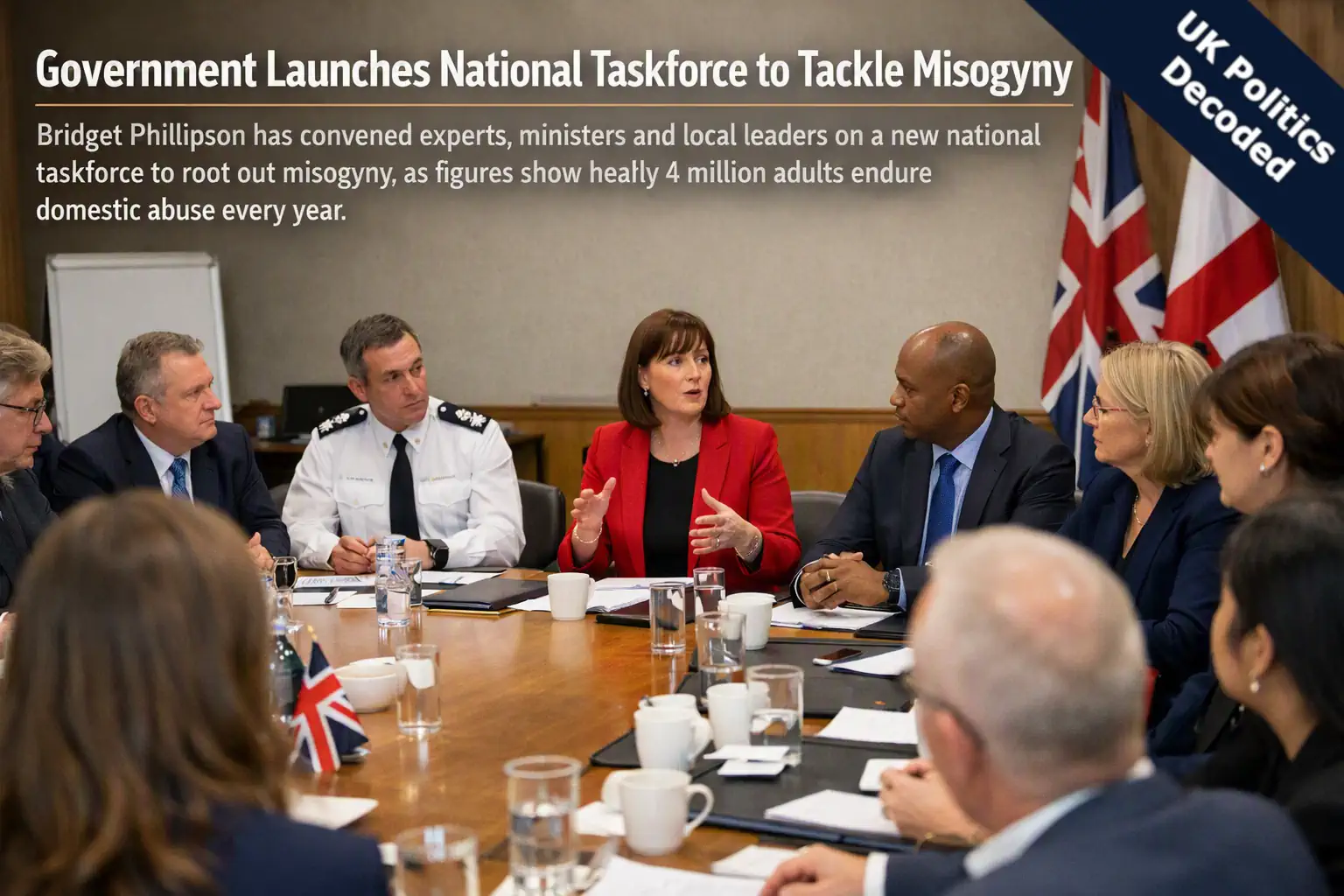
A new national taskforce charged with rooting out misogyny across British society was launched on 20 September, chaired by the Minister for Women and Equalities, Bridget Phillipson. The taskforce brings together government ministers, local leaders and outside experts to examine how harmful attitudes towards women and girls take hold, and what can be done to stop them spreading, from classrooms to workplaces to the internet.
Its first meeting will focus on young people, before turning to workplaces, digital spaces and social cohesion in later sessions. Members will include representatives from women's organisations, academics and local leaders, with the group asked to draw on lived experience so that government policy is shaped by those most affected by misogyny rather than designed in isolation.
At a glance
- Bridget Phillipson, the Minister for Women and Equalities, has launched and will chair a new national taskforce for tackling misogyny.
- The taskforce's first meeting will focus on young people, with later sessions covering workplaces, digital spaces and social cohesion.
- Nearly 1 million adults experience sexual assault, 1.4 million face stalking and nearly 4 million endure domestic abuse in England and Wales each year, according to the government.
- The taskforce sits alongside a wider government mission to halve violence against women and girls within a decade.
- It follows a £16 million schools package and a £10 million fund for young people already showing harmful behaviour, plus a summer campaign at Reading and Leeds festivals.
Why Bridget Phillipson Says Misogyny Needs Its Own Taskforce
The taskforce is designed to complement, rather than duplicate, existing cross government work on violence against women and girls. Where other initiatives focus on policing, prosecutions and support for victims, this group is intended to look further upstream, at the attitudes and behaviours that precede abuse. Officials say it will examine what is already working, in the UK and internationally, to shift harmful social norms before they escalate into harm.
Phillipson has framed the taskforce partly through her own history running a refuge for women fleeing domestic abuse before entering politics. "I've seen first hand the devastating impact on women and girls when harmful attitudes are tolerated and left unchallenged," she said at the launch. "With political leadership and the best experts from across the country, we will shift the dial on the poisonous attitudes that blight women's lives, turn evidence into action, and send misogynistic attitudes back to the dark ages where they belong."
Equimundo, Girlguiding and Everyone's Invited, Who is on the New Misogyny Taskforce
Membership draws on organisations that work directly with women, girls, and increasingly, with men and boys. Gary Barker, chief executive and founder of Equimundo, said the group's research shows misogynistic attitudes are increasing globally but can change when men and boys are engaged as allies. Deniz Uğur, deputy director at the End Violence Against Women Coalition, welcomed the taskforce's focus on root causes but said its impact would depend on "meaningful commitment and engagement by ministers across all government departments."
Soma Sara, chief executive of Everyone's Invited, pointed to the scale of the problem her organisation has documented, noting that more than 53,000 survivors have shared experiences through its online platform, and said the growth of online spaces and artificial intelligence had "turbocharged the scale and speed of harm." Felicity Oswald, chief executive of Girlguiding, said girls report rising sexism both online and in schools, and called for more education on healthy relationships, consent and early warning signs, delivered with girls' own experiences at the centre of the conversation.
Nearly 4 Million Face Domestic Abuse a Year, The Case for Halving VAWG
The government has set out the scale of the problem the taskforce is meant to help address. Nearly 1 million adults experience sexual assault, 1.4 million face stalking, and nearly 4 million endure domestic abuse in England and Wales in a single year, figures cited by the government as the case for tackling attitudes before they escalate into crime. Those numbers sit behind the government's headline commitment to halve violence against women and girls within a decade.
What's already under way alongside the taskforce
- All police forces in England and Wales will have specialist rape and sexual offence teams by December 2027, a year and a half earlier than originally planned.
- A £16 million package is funding lessons on healthy relationships and staff training to help schools challenge misogyny before it escalates.
- A further £10 million fund is paying for intervention programmes aimed at children who are already using harmful behaviour.
- Statutory relationships, sex and health education guidance now directly challenges myths about women spread online through the "manosphere."
How the ENOUGH Campaign Reached Hundreds of Thousands at Reading and Leeds
The taskforce follows a summer of public facing campaigning that gives an early sense of how the government wants to change attitudes in practice. Through a partnership between the Home Office, Festival Republic, Thames Valley Police and West Yorkshire Police, the ENOUGH campaign brought messaging highlighting abusive behaviours that often go unrecognised to Reading and Leeds festivals, reaching hundreds of thousands of festivalgoers over the August bank holiday weekend, following earlier activity at Latitude Festival.
Minister for Safeguarding and Violence Against Women and Girls, Satvir Kaur, said reaching young people directly at festivals helps "drive change in every arena of our society." Festival Republic managing director Melvin Benn said the partnership empowers festivalgoers "to recognise and safely intervene against harmful behaviours," while Thames Valley Police Detective Chief Inspector Laura Corscadden said the force's Consent Conversations initiative, developed with production company Breaking Barriers and campaigner Georgia Harrison MBE, has proved successful at getting young people talking openly about consent. Recent figures show around 1 million adults aged 16 and over experienced sexual victimisation in the year to March 2026.
What the Misogyny Taskforce Will Tackle Next
No new legislation or funding was announced alongside the taskforce's launch. Its purpose, for now, is to convene rather than legislate, giving ministers a standing forum to test ideas against the experience of women's organisations, academics and local leaders before policy is finalised. The government says further announcements on halving violence against women and girls are expected this week, suggesting the taskforce is one strand of a broader push rather than a standalone initiative.
Whether the taskforce shifts attitudes in the way Phillipson describes will not be clear for some time. Its early agenda, starting with young people before moving to workplaces and digital spaces, suggests ministers see prevention in adolescence as the most urgent starting point, even as the wider machinery of policing and prosecution continues to expand alongside it.
Key Takeaways
- A new national taskforce chaired by Bridget Phillipson will focus on preventing misogyny, starting with young people before addressing workplaces and digital spaces.
- Members include Equimundo, the End Violence Against Women Coalition, Everyone's Invited and Girlguiding, alongside ministers and local leaders.
- The government cites nearly 4 million people enduring domestic abuse annually as part of the case for prevention focused work.
- The taskforce sits alongside a £16 million schools programme, a £10 million intervention fund, and faster rollout of specialist police rape and sexual offence teams.
- It follows the ENOUGH campaign's summer activity at Reading, Leeds and Latitude festivals, run with police forces and Festival Republic.
Sources & Further Reading
- GOV.UK - Government launches National Taskforce for Tackling Misogyny Archived copy (OGL): archived page
- GOV.UK - Government, police and music industry unite to tackle VAWG Archived copy (OGL): archived page