AI Use: AI tools were used to support source discovery and to structure the article for clarity. All research, verification, drafting, and final editorial decisions are fully human led. Learn about our AI policy.
UKPoliticsDecoded is an IMPRESS regulated public interest publisher. Read our editorial standards.
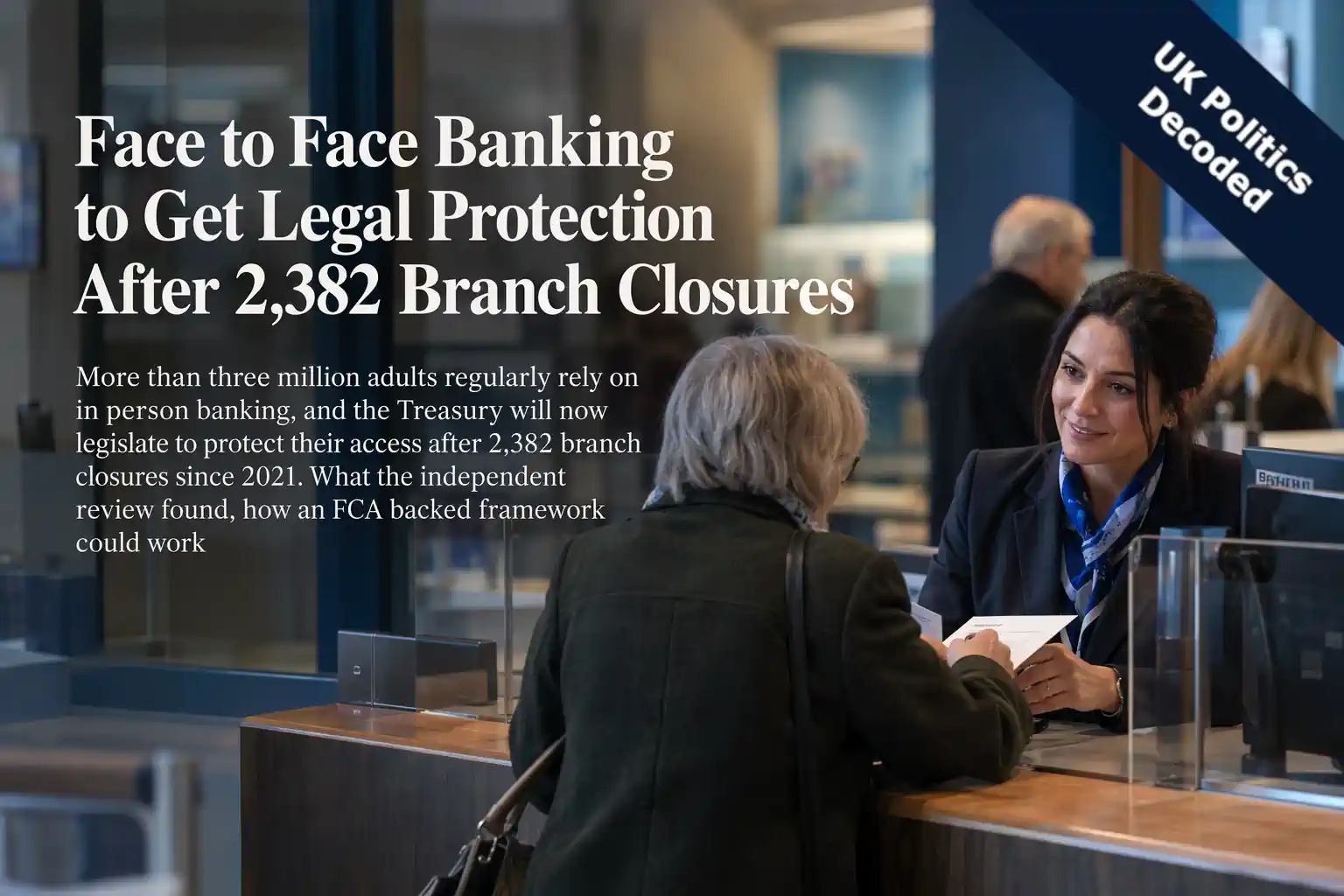
The government has promised to put the right to in person banking on a legal footing. HM Treasury announced on 16 November 2026 that it accepts the central recommendation of an independent review that people who still need to bank face to face should have their access protected by law.
The review, chaired by Richard Lloyd OBE, found that while millions of people happily bank online, a sizeable minority cannot do so and are being harmed as branches disappear. Ministers have not yet published a bill or a timetable for one. What they have set out is a commitment to build a statutory framework with the Financial Conduct Authority, industry and consumer groups.
At a Glance
- HM Treasury has accepted the central recommendation of an independent review and says it will legislate to protect access to face to face banking.
- The review found that more than three million adults in the UK regularly rely on in person banking, rising to more than four million when occasional users are counted.
- Banks and building societies have closed 2,382 branches since January 2021, equivalent to about 45% of the network, according to figures provided to the review.
- The review recommends that designated larger banks must ensure reasonable access to essential in person services, with the Financial Conduct Authority as regulator.
- The review says industry could begin piloting new approaches in 2027, ahead of a regulatory implementation period in 2028, but ministers have not confirmed those dates.
Why Ministers Are Moving to Protect Face to Face Banking
The review was commissioned by HM Treasury to answer a narrow but contentious question, is the decline of in person banking causing consumers real harm? It drew on 18,197 responses to a call for evidence, most of them from individuals, alongside submissions from businesses, charities, consumer groups, regulators and the banking industry.
Its answer was blunt. The report concludes that declining access to in person services has caused widespread, material and recurring harm, and that a significant minority of customers will need those services for the foreseeable future. Richard Lloyd writes in the foreword that "urgent action is necessary to prevent further harm" and that he hopes banks "will act without waiting for legislation".
Economic Secretary to the Treasury Lucy Rigby said millions now bank digitally, "but for people and businesses who rely on face to face services, being able to speak to someone in person really matters. We will act to protect the access they need." She added that the new framework must be "agile and adaptable", because both people's needs and technology are changing rapidly.
The review is careful not to argue against digital banking. Its foreword notes that around 15,000 bank branches have closed since the 1980s and that most banking transactions are now carried out through mobile apps. The report also recognises that the cost of physical banking is ultimately met by bank customers, which is one reason it calls for a proportionate rather than sweeping approach.
How Many Branches Have Closed and Who Still Needs Them
The scale of the contraction is the backdrop to the whole review. According to LINK data supplied to the Treasury, banks and building societies have closed 2,382 branches since January 2021, roughly 45% of the network. Figures from the Financial Conduct Authority show that 79.6% of the UK population lived within three miles of a branch run by one of the larger personal current account providers in 2025, down from 87% in 2022.
The picture is far patchier outside towns and cities. Across the UK, 28.7% of people in rural areas lived within three miles of a branch in 2025, compared with 91.5% of urban residents. By nation, Northern Ireland had the lowest share of its population within three miles at 63.1%, followed by Wales at 69.5% and Scotland at 74.6%.
Branch use has fallen with it. In May 2024, 18% of day to day account holders, or 9.7 million people, had visited a specific branch at least once a month over the previous year, compared with 40% (19.8 million) in 2017. Reliance was highest among digitally excluded adults, heavy users of cash and people aged 75 and over. Industry estimates given to the review put regular branch users at around 5% of customers.
Those who still depend on in person services are not a single group. The gov.uk announcement says face to face banking matters particularly for older people, disabled people, people on low incomes, those facing negative life events and anyone who finds digital services harder to use. In the call for evidence survey, 57.9% of respondents named older people as needing in person access, while 33.7% named disabled or vulnerable consumers. The review also heard that younger customers who could not complete an in person task were more likely to report missed payments, unresolved fraud losses and lost earnings.
Alternatives exist, though they are uneven. A shared banking hub model has grown since the first hubs opened in April 2021 as a pilot, and 250 were open across the UK in September 2026. Cash Access UK, which operates hubs alongside the Post Office, recorded more than 9 million transactions worth £1.58 billion across its network in 2025, and 95% of around 14,000 customers who left feedback said the hub had met their needs. Hubs only serve customers of participating banks, however, and the Treasury has said it remains committed to supporting the industry's roll out of 350 hubs by the end of this Parliament. The Post Office, which is required to maintain at least 11,500 branches and currently operates around 11,800, offers basic banking to customers of signatory banks.
What the Access to Banking Review Found About Customer Harm
The evidence of harm is the heart of the report, though it is open about the limits of the data. It says the real scale of unmet need is hard to measure, partly because friends, family and carers often step in informally and vulnerable people may not tell their bank what they need. Some estimates it cites suggest around 40% of consumers have been unable to access a local in person banking service after infrastructure was cut, and that nearly one in five of those affected could not carry out the banking they needed to do.
Several of the figures come from submissions rather than official surveys, and the report attributes them accordingly. A Post Office submission, for instance, reported that 17% of consumers had incurred charges because payments were missed or delayed, and that 14% had lost wages or earnings because of the extra time spent travelling to a bank. Other evidence cited found that 12% of consumers surveyed felt less confident managing their money, and that 18% felt more stressed or anxious, rising to 24% among disabled people.
The review also found a communication problem. Using Financial Conduct Authority data from the Financial Lives Survey 2024, it reports that consumers found it difficult or impossible to reach the right person to resolve a query in 26% of recent contacts with a current account provider. Some 17% of all UK adults said getting to a bank, building society or credit union was difficult using their normal transport. Among reasons for difficulty, limited opening hours (25%), travel distance (20%) and queues (18%) came top.
Small businesses fare differently. The report says their day to day needs centre mainly on cash, depositing takings, getting change and processing cheques. Respondents described 40 mile round trips and half days lost to banking. The review concedes it had a richer evidence base on consumers than on small businesses.
Existing rules, the review concludes, are not up to the job. The Equality Act 2010 prohibits unlawful discrimination and requires reasonable adjustments, but does not stop a firm closing a branch or dictate which channels it offers. The FCA's Consumer Duty requires firms to avoid foreseeable harm, yet the report says it cannot be used to stop branch closures. FCA guidance already expects at least 12 weeks notice of a closure and an assessment of its impact. Only cash is properly protected, under the access to cash regime created by the Financial Services and Markets Act 2023.
How the New Banking Access Law Could Work
The review proposes building on that cash regime rather than starting from scratch. Its preferred option is a combined access to cash and access to banking services regime, with legislation amending the 2023 Act so that the Treasury publishes a single policy statement, designates the firms covered and gives the FCA power to make rules for them. The report stresses that it is for government and Parliament to decide the final design.
Ministers have confirmed only part of that picture. The government says it will work with the FCA, industry, consumer groups and other stakeholders on the detailed design, including what counts as reasonable access for different types of essential banking service. It says the framework will be "carefully targeted and proportionate" and will support competition and innovation.
How the Review Proposes the Framework Would Operate
- The Treasury sets out its policy on access to banking services and designates the larger banks and building societies that must comply.
- The FCA writes and supervises the rules, including different standards of access for day to day banking and for more complex services.
- Designated firms assess gaps in their areas, consulting local authorities, charities, advice bodies and credit unions, and fill them through branches, shared hubs or other means.
- Anyone who disagrees with the outcome of a local assessment can seek an independent review, as under the current access to cash arrangements.
The report divides essential services into two groups. Day to day banking centres on opening and managing a current account, including payments, transfers, account maintenance and help with online banking. For small businesses, charities and clubs it mainly means cash deposits, withdrawals and change. Complex services cover less frequent but important tasks such as bereavement, Power of Attorney, fraud and scam support, debt management and registering a vulnerability.
One design principle is that the rules should be "solution agnostic". A bank could meet its duty through its own branches, a shared hub or another route, as long as it can show the service meets the standard. The regime itself would be reviewed regularly, and the FCA would have to take account of the needs of local communities.
What Is Still Undecided and When Change Could Arrive
The government's announcement is a commitment of principle, and several important questions remain open. The review's recommendations are not government policy until adopted, and ministers have so far accepted the central recommendation rather than all six.
What Has Been Confirmed
- The government accepts that further action is needed and will legislate to protect access.
- The framework will be developed with the FCA, industry and consumer groups.
- The aim is protection for people, communities and small businesses who need face to face banking.
- Ministers want a framework that can adapt as technology and customer needs change.
What Has Not Yet Been Set Out
- The date a bill will be introduced to Parliament.
- Which banks and building societies will be designated.
- What counts as reasonable access for each type of essential service.
- Whether every one of the review's six recommendations will be adopted.
On timing, the review argues that the legislative, policy and regulatory measures could be in place during this Parliament with prompt action from government, the regulator and industry. It says it is "entirely feasible" for banks to start piloting new approaches in 2027, so that communities see a material difference ahead of a regulatory implementation period in 2028. Those are the review's dates, not a government commitment.
The report also places weight on measures outside the legislation. It recommends that the industry, government and regulator redouble efforts to make digital and telephone banking more accessible, and refers to initiatives such as the Digital Inclusion Action Plan and UK Finance's Inclusive Design Challenge. The aim, it says, is to shrink the number of people who need in person help over time, not to roll back the shift to digital.
Will Your Bank Branch Be Protected? What Happens Next
For customers, nothing changes immediately. Branch closures are still governed by existing FCA expectations, and the access to cash regime remains the only area where reasonable provision is currently enforceable. The FCA is due to evaluate the impact of that regime after the Access to Banking Services Review concludes.
For banks and building societies, the direction of travel is clear even if the detail is not. The review says a voluntary approach would not deliver a level playing field among large providers, and would risk slow progress and continuing confusion over what is available. Richard Lloyd has nevertheless called on banks not to wait for legislation.
The next marker will be the Treasury's work with the FCA and stakeholders on the framework, followed by any bill. Until then, the commitment stands on the announcement of 16 November and the evidence in the review.
Key Takeaways
- The Treasury has committed to legislate to protect face to face banking after accepting the central recommendation of the Access to Banking Services Review.
- The review found that declining in person access has caused material and recurring harm, and that more than three million adults regularly rely on those services.
- The review proposes extending the access to cash regime so that designated banks must ensure reasonable access to essential in person banking, supervised by the FCA.
- Ministers have not yet announced a bill, a timetable or the list of banks that would be covered.
- The review suggests industry pilots in 2027 and regulatory implementation in 2028, but those dates are the review's proposals rather than a government commitment.
Sources & Further Reading
- GOV.UK: Government commits to safeguard face to face banking Archived copy (OGL): archived page
- HM Treasury: Access to Banking Services, Report of the Independent Review (PDF) Archived copy (OGL): archived page