AI Use & Transparency: AI tools were used to support source discovery and to structure the article for clarity. All research, verification, drafting, and final editorial decisions are fully human led. Learn about our AI policy.
UKPoliticsDecoded is an IMPRESS regulated publisher. Read our editorial standards.
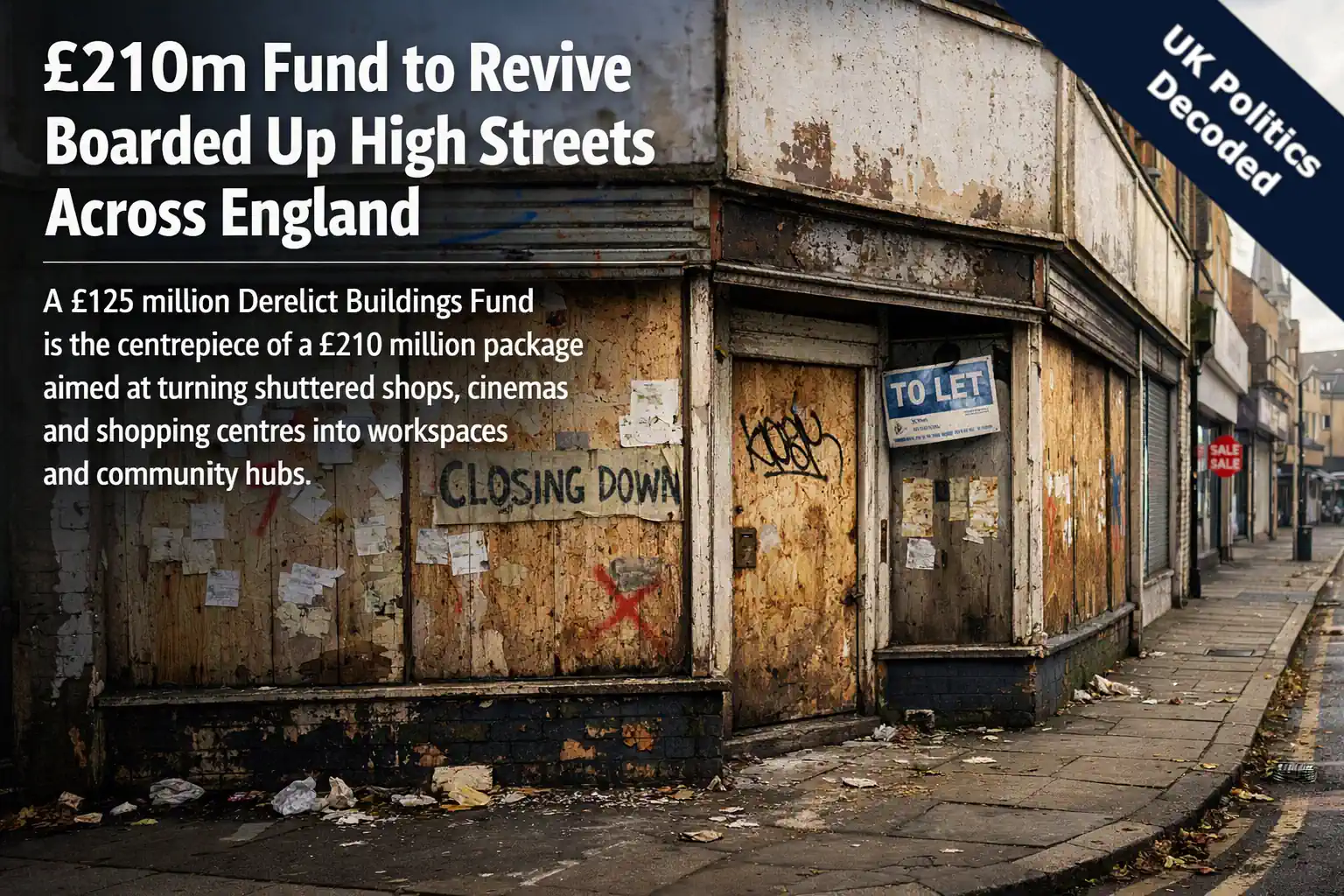
The government has confirmed a £210 million package to transform derelict shops, cinemas and shopping centres into workspaces, cafes and community hubs, the Ministry of Housing, Communities and Local Government announced on 25 September 2026. The centrepiece is a new £125 million Derelict Buildings Fund, which will let local authorities bid for money to convert vacant and boarded up buildings into whatever their area needs, from health centres to civic spaces.
The announcement was made jointly by the Ministry of Housing, Communities and Local Government, First Secretary of State Louise Haigh, Prime Minister Andy Burnham and Deputy Prime Minister Angela Rayner. It builds on the government's existing Pride in Place programme, which has already helped local groups take over a youth centre in Ramsgate and redevelop the former Brunswick Shopping Centre in Scarborough.
At a glance
- A £125 million Derelict Buildings Fund will help councils convert vacant shopping centres, disused cinemas and abandoned buildings into community spaces.
- A further £65 million will help communities rescue pubs, sports clubs and other buildings at risk of closure.
- £20 million will be split equally between High Street Rental Auctions and a new Co-operative Development Programme.
- The £10 million Co-operative Development Programme will help mayors and strategic authorities set up co-operative businesses owned by staff and customers.
- The full £210 million package comes from funding MHCLG has already earmarked for high street support and regeneration.
What the £125 Million Derelict Buildings Fund Actually Pays For
According to the government's announcement, the Derelict Buildings Fund is designed to tackle a specific and visible problem, buildings that have sat empty and decaying for years, dragging down the look and feel of a town centre even where other shops are trading. Local authorities will be able to apply for funding to transform these sites into whatever their community says it needs, whether that's a health centre, a civic space, or shared workspace for local businesses.
The fund sits alongside £65 million earmarked to help communities across England rescue and revamp buildings and businesses at risk of closure, including pubs and sports clubs. The government says this builds on the Pride in Place programme, citing the Ramsgate youth centre takeover and the Brunswick Shopping Centre redevelopment in Scarborough as examples of what community led regeneration can look like when it works.
A further £20 million is being split equally between two smaller schemes. Half goes to High Street Rental Auctions, which let councils force landlords to let out properties that have sat vacant for 12 months or more. The other half funds a new Co-operative Development Programme, worth £10 million, intended to help mayors and strategic authorities set up co-operative businesses owned and run by the staff, customers and communities who use them.
Why Andy Burnham Is Calling This a Test of Devolution
Prime Minister Andy Burnham tied the funding directly to his wider argument that economic growth needs to be visible on the ground, not just in national statistics. "People don't measure growth by looking at a spreadsheet," he said. "They measure it by looking at their local high street. Are shops opening or are the shutters down? Does the place feel like it's moving forward or being left behind?"
Where the £210 million is allocated
- £125 million - Derelict Buildings Fund, for councils to convert vacant buildings into community led uses.
- £65 million - community led rescue and revamp of at risk buildings and businesses, including pubs and sports clubs.
- £10 million - High Street Rental Auctions, targeting properties vacant for 12 months or more.
- £10 million - Co-operative Development Programme, for mayor led and strategic authority led co-operative businesses.
Housing, Communities and Local Government Secretary Angela Rayner said the funding was designed to put decision making power directly into the hands of the people who know their high streets best, rather than routing decisions through Westminster. First Secretary of State Louise Haigh made a similar point, describing the package as evidence of "what devolution means in practice" and part of a broader effort to "rewire" how government works with local areas. The £210 million forms part of a wider Place Regeneration taskforce programme that Haigh is coordinating across departments, ministers and local government, which is due to produce a "roadmap to rebuild Britain."
What This Fund Does and Doesn't Change for Struggling High Streets
The package is explicit about what it is trying to fix, the physical state of town centres, not the wider economics of running a shop or a pub. The Derelict Buildings Fund, the community rescue money and the mayor led co-op scheme are all aimed at bringing empty or failing buildings back into productive, community owned use. High Street Rental Auctions add a legal lever to force reluctant landlords to let vacant units rather than leave them boarded up indefinitely.
What the funding targets
- Derelict, boarded up buildings converted into workspaces, cafes and civic spaces.
- Pubs, sports clubs and other community assets at risk of closure.
- Long term vacant retail units, via forced rental auctions.
- Community and co-operative ownership of local businesses.
What it does not address
- Business rates, rents and running costs affecting existing traders.
- Wider consumer spending and footfall trends nationally.
- Access to finance or credit for expansion or hiring.
- Online competition pressures cited by many high street retailers.
Based on the government's own announcement, the scheme is focused on physical regeneration and community ownership, not on the underlying economic conditions that determine whether businesses expand, hire, or invest. It improves appearance, footfall, and community use but it does not directly change the conditions businesses cite as reasons for not expanding. Whether the fund raises overall economic activity on a high street, rather than simply relocating which building people gather in, will depend on decisions still to be made locally about how sites are used once converted.
Why This £210m Is Just the Opening Move, Not the Full Plan
The £210 million confirmed on 25 September is drawn from funding MHCLG had already earmarked for high street support and regeneration, rather than new money announced for the first time. The government has said it will go further later this year, publishing a full high streets strategy intended to cover town centres across England more broadly.
That forthcoming strategy is likely to be the point at which questions about trading conditions, rather than building conditions, get addressed directly, if they are addressed at all. For now, councils and community groups will be able to start bidding into the Derelict Buildings Fund and the other schemes announced this week, with the government pointing to Ramsgate and Scarborough as templates for the kind of community led projects it wants to see replicated.
That scheme, in particular, marks a shift toward encouraging local ownership models rather than simply attracting outside investment or new tenants. How quickly mayors and strategic authorities take up that offer, and how many derelict buildings actually change hands as a result of the rental auction powers, will be the practical test of whether this funding shifts anything beyond appearances.
Key Takeaways
- The government has confirmed £210 million to regenerate high streets, with £125 million going to a new Derelict Buildings Fund.
- A further £65 million will support community rescue of at risk pubs, sports clubs and other local buildings.
- £20 million is split between High Street Rental Auctions and a new £10 million Co-operative Development Programme.
- The funding targets the physical state of town centres and community ownership, not the trading costs or online competition retailers cite as barriers to growth.
- A full high streets strategy for England is expected later in 2026, which may address wider economic conditions facing town centre businesses.
Sources & Further Reading
- GOV.UK - Boarded up high streets brought back to life with £210m boost Archived copy (OGL): archived page