AI Use: AI tools were used to support source discovery and to structure the article for clarity. All research, verification, drafting, and final editorial decisions are fully human led. Learn about our AI policy.
UKPoliticsDecoded is an IMPRESS regulated public interest publisher. Read our editorial standards.
Children, young people and adults in mental distress will be offered broader support at the earliest opportunity, without first needing a clinical diagnosis, the Government pledged on 9 October 2026. The commitment responds to the Independent Review into prevalence and support for mental health conditions, ADHD and autism, chaired by Professor Peter Fonagy.
The Department of Health and Social Care (DHSC) says the shift will be set out in a forthcoming Mental Health Strategy. It also plans tighter regulation of ADHD and autism assessments, including a review of how private providers advertise them.
At a Glance
- The Fonagy Review found that mental distress has increased substantially among children and young people, while the population level prevalence of ADHD and autism appears broadly stable.
- The Government wants all ADHD and autism diagnostic assessments to become a Care Quality Commission regulated activity, covering NHS, non-NHS and self funded patients.
- NHS England intends to introduce a national tariff for NHS funded autism and ADHD services from April 2027, subject to consultation.
- Mental Health Support Teams are due to reach every school and college in England by 2029.
- The Government says mental health spending is forecast to reach a record £16.1 billion this year.
What the Fonagy Review Found About Rising Mental Distress
The review was chaired by Professor Fonagy, head of the UCL Division of Psychology and Language Sciences, with Professor Sir Simon Wessely and Professor Gillian Baird as vice chairs. It concluded that mental distress has risen substantially among children and young people. It points to several drivers including social media, financial insecurity, uncertainty about the future, poorer sleep, and a weaker sense of connection and belonging.
On ADHD and autism, the picture is more nuanced. Referrals and diagnoses have risen significantly, but the review found that the underlying prevalence of both conditions appears broadly stable. In other words, more people are seeking and receiving a label, without evidence that more people have the condition.
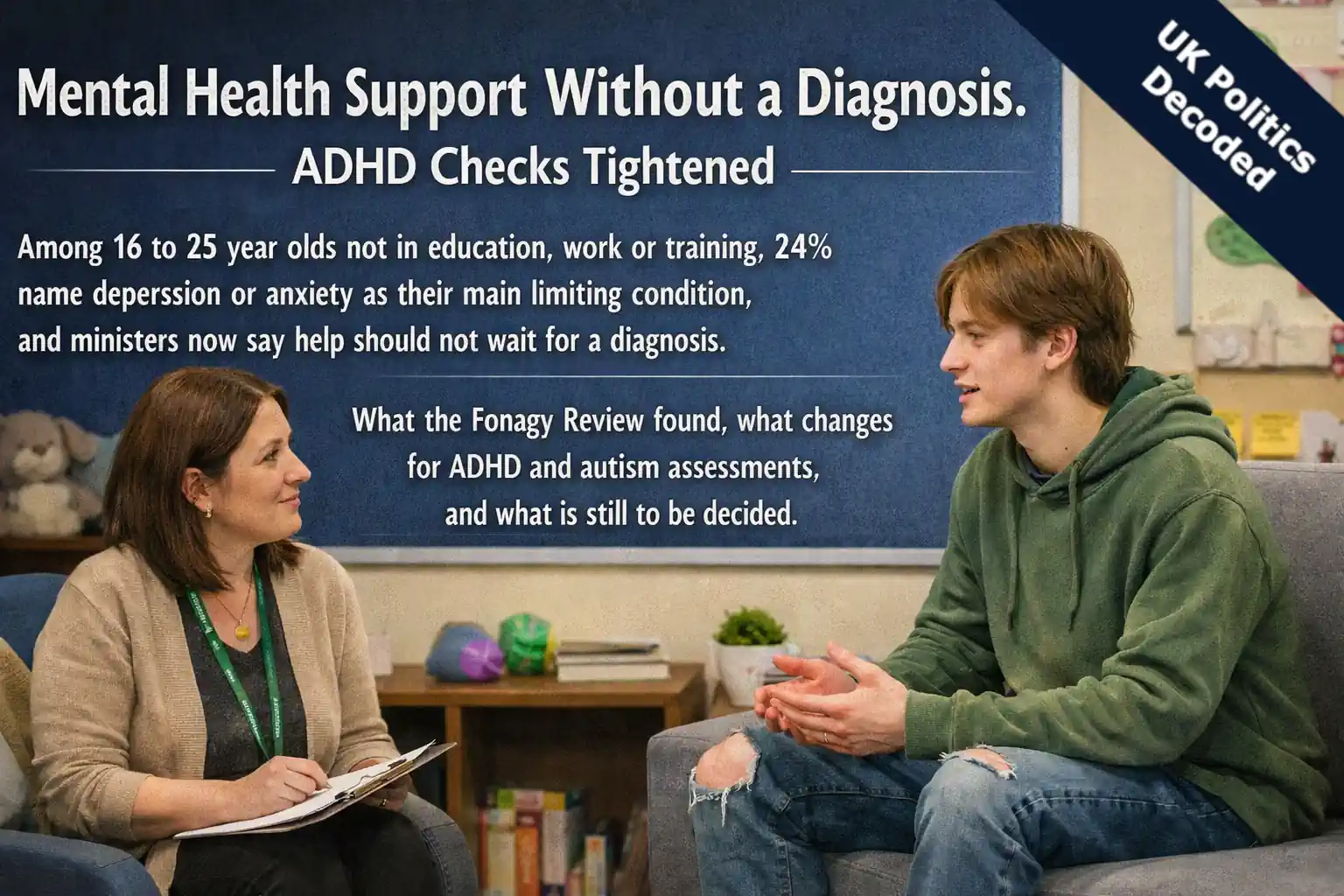
Separate figures from the interim report of Alan Milburn's review of Young People and Work add to the picture. Among 16 to 25 year olds who are not in education, employment or training, 24% cited depression or anxiety as their main limiting condition. A further 22% named autism, and 18% another mental illness.
Why Ministers Want Help to Start Before a Diagnosis
Professor Fonagy described a system under strain, in which diagnosis has become "a very narrow pathway to finding support". The review's recommendations, he said, offer a roadmap from a diagnostic labelling model to a flexible, needs led one. He was clear that diagnosis "remains essential and must be protected", but argued it should no longer be the only door to help.
Health and Social Care Secretary Yvette Cooper said mental health services need to focus more on the early support young people require to stay in education or work. She said the Government's full response will come in the new Mental Health Strategy "in the coming months". The press release later says the strategy will arrive later this year.
In practice, the Government says support will be more widely available in schools, colleges and communities, with a focus on reducing long waits and helping people before and without a diagnosis. Where it is clinically appropriate, timely diagnosis and treatment, including medication, will continue. The Health and Social Care Secretary has also asked NHS leaders to urgently examine how people can access advice, assessments and treatment more easily.
Dr Nick Broughton, National Priority Programme Director for Mental Health, Learning Disability and Neurodevelopmental Conditions at NHS England and DHSC, called the review a landmark moment. He said six million pupils can now access NHS mental health support in schools, and that the NHS is "ready to play its part".
Tougher Rules for ADHD and Autism Assessments
The review recommends overhauling how mental health and neurodevelopmental services are commissioned, funded, overseen and regulated. That includes making all ADHD and autism diagnostic assessments a CQC regulated activity, and banning direct to public advertising of NHS funded assessments. The Government says it is working towards the first of those, and is exploring ways to strengthen oversight more broadly.
The CQC rules would apply to NHS funded, non-NHS funded and self funding patients alike. They would sit alongside a requirement for every Integrated Care Board to improve oversight of the ADHD and autism assessment services it commissions. Ms Cooper said the aim is to give people confidence that assessments are high quality, and that the NHS is not being overcharged by independent or private providers.
How Oversight of ADHD and Autism Services Would Change
- The Secretary of State will write to the Advertising Standards Authority about adverts for autism and ADHD services, to stop people being encouraged to seek assessments they may not need.
- NHS England will consult on a national tariff for NHS funded autism and ADHD services, covering assessment, post diagnostic support and follow ups, with new payment arrangements intended from April 2027.
- The Government will work with the National Institute for Health and Care Excellence to urgently consider what the report means for its autism and ADHD guidance.
- The Government will work with NHS England and the CQC on regulating all diagnostic assessments, alongside stronger Integrated Care Board oversight.
Mental Health Support Teams, Talking Therapies and Early Support Hubs, What Is Funded?
Ministers say action has already started. Building on the Healthy Babies programme, which operates in 75 local authorities, every family in England is to get access to practical help during the first 1,001 days, from pregnancy to age two. That covers infant feeding, parental mental health and bonding, and the Government says it will end the postcode lottery.
In education, Mental Health Support Teams are due to reach every school and college by 2029, covering nearly 800,000 additional children and young people this year. A £7 million investment in Early Support Hubs is planned for 2026/27. The reforms will run alongside a new £4 billion package for children with special educational needs, including training for every teacher, and £1.8 billion over three years for the Experts at Hand offer. That brings speech and language therapists, occupational therapists, specialist teachers and educational psychologists into mainstream settings. We reported on the first stage of that teacher training in our explainer on the SEND training overhaul.
For adults and older young people, the Government is expanding NHS Talking Therapies so that 915,000 people can complete a course of treatment by March 2029. It is also rolling out 159 new mental health centres and mental health emergency departments in communities. Mental health spending is forecast to reach a record £16.1 billion this year.
What the Review Recommends
- A shift from a diagnostic labelling model to a needs led system.
- All ADHD and autism assessments regulated by the CQC.
- A ban on direct to public advertising of NHS funded assessments.
- Overhauled commissioning, funding and oversight of services.
What the Government Has Said So Far
- It is working towards CQC regulation of all assessments.
- It will write to the ASA about adverts rather than announce a ban.
- A national tariff is subject to NHS England consultation.
- Full details are left to the Mental Health Strategy.
The two columns are not identical. The press release describes the advertising ban and the CQC regulation as review recommendations, but its own commitments are narrower, and the Government says it is "exploring" ways to strengthen oversight.
Charities Welcome the Review but Press on Waiting Lists and Specialist Care
Reaction from the sector, quoted in the Government's release, was broadly welcoming, with caveats. Andy Bell, chief executive of the Centre for Mental Health, said there is "no longer any doubt" about rising prevalence of mental ill health in England and called for the strategy to put the recommendations into practice. Alexa Knight of the Mental Health Foundation said the crisis "was never down to overdiagnosis".
Several groups pressed on delivery. Rethink Mental Illness said specialist services for people with the most complex and acute needs must not lose out as wider support expands. The Royal College of Psychiatrists said long waiting lists for assessments must fall, and that expansion has to be backed by workforce growth and investment. Barnardo's said children face long waits for assessments, diagnoses and support, and asked for an action plan with clear metrics. The NHS Alliance said the review strikes a welcome balance between prevention and prompt access to specialist care.
Mental Health Innovations, which runs Shout and The Mix, said it supported over 300,000 young people through its digital services in the last year and argued for a national digital service alongside schools and community support.
What Happens Next With the Mental Health Strategy
The detail is still to come. The Government has not published a date for the Mental Health Strategy beyond "later this year", nor said when CQC regulation of assessments would take effect. The only firm date in the announcement is April 2027, when NHS England intends to bring in finalised payment arrangements for NHS funded autism and ADHD services, once its consultation is complete.
For families waiting on an assessment, nothing changes immediately. The announcement describes a direction of travel and a set of reviews, and it does not set out a timetable for shorter waits. This article draws on the Government's announcement and quoted responses, so the review's full recommendations are not examined here beyond what that summary sets out.
Key Takeaways
- The Fonagy Review found mental distress among children and young people has genuinely increased, while the prevalence of ADHD and autism appears broadly stable despite rising diagnoses.
- The Government says people should be able to get support in schools, colleges and communities without waiting for a clinical diagnosis, while diagnosis remains available where clinically appropriate.
- Ministers are working towards making all ADHD and autism diagnostic assessments CQC regulated, covering NHS, private and self funded routes.
- NHS England intends new payment arrangements for NHS funded autism and ADHD services from April 2027, following a consultation on a national tariff.
- The full response will come in the Mental Health Strategy, which the Government says will be published later this year.