AI Use: AI tools were used to support source discovery and to structure the article for clarity. All research, verification, drafting, and final editorial decisions are fully human led. Learn about our AI policy.
UKPoliticsDecoded is an IMPRESS regulated public interest publisher. Read our editorial standards.
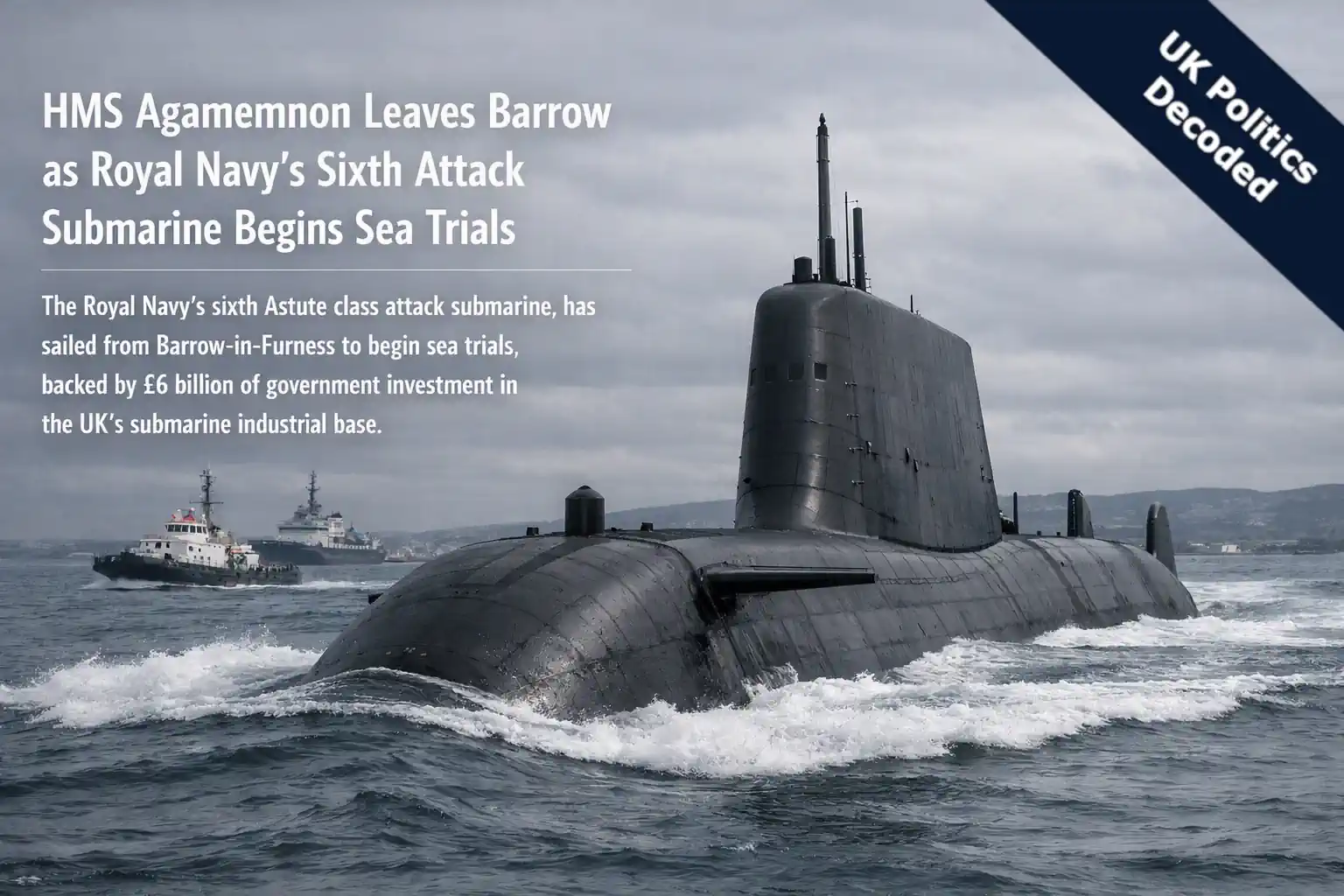
HMS Agamemnon, the Royal Navy's sixth Astute class attack submarine, left the BAE Systems shipyard in Barrow-in-Furness on 25 September to begin sea trials. The Ministry of Defence describes the departure as a major step toward delivering the submarine into active service, where it will join the fleet supporting the UK's continuous at sea nuclear deterrent and wider NATO operations.
The 7,400 tonne submarine, nicknamed "Awesome Aggie" by her crew, is powered by a Rolls Royce nuclear reactor built in Derby and will not need refuelling for the rest of her service life. Her departure comes as the government continues a £6 billion investment programme in the submarine industrial base over the current Spending Review period, work that the Ministry of Defence says sustains thousands of jobs across Britain.
At a glance
- HMS Agamemnon is the sixth Astute class submarine built for the Royal Navy and has now sailed from Barrow-in-Furness to begin sea trials ahead of joining the active fleet.
- The submarine measures 97 metres long and weighs 7,400 tonnes, making it one of the largest and most advanced attack submarines the Royal Navy has ever operated.
- It is armed with Spearfish torpedoes and Tomahawk IV land attack missiles capable of striking targets more than 1,000 miles away.
- The government's submarine industrial base is receiving £6 billion of investment over the current Spending Review period, part of a £298 billion Defence Investment Plan.
- More than 14,000 jobs in Barrow-in-Furness are supported by defence nuclear work, with 1,800 additional roles created under the current government.
Inside the Astute Class, Britain's Most Powerful Attack Submarine
The Astute class is, according to the Ministry of Defence, the largest, most advanced and most powerful class of attack submarine ever operated by the Royal Navy. At 97 metres long, roughly the length of two Olympic swimming pools placed end to end, HMS Agamemnon carries capabilities spanning stealthy precision strike, anti submarine warfare and intelligence gathering.
Her weapons load includes heavyweight Spearfish torpedoes and Tomahawk IV land attack missiles, giving her the ability to strike targets more than 1,000 miles away. Beyond her deterrent role, the submarine is also expected to support maritime task groups and contribute to UK, NATO and coalition operations once she completes trials and formally joins the fleet at HMNB Clyde.
HMS Agamemnon was formally commissioned by the King in a ceremony on 22 September 2025, and is the sixth Royal Navy vessel to carry the name. Her departure for sea trials marks the next stage before she takes up operational duties, a process the Ministry of Defence says will now test her systems and performance ahead of entering service.
Why £6 Billion Is Flowing Into Barrow-in-Furness's Submarine Yards
HMS Agamemnon's build reflects years of work by engineers, technicians and specialists at BAE Systems and the Ministry of Defence's Defence Nuclear Enterprise, alongside the ship's company who will take her into service. Maddy McTernan, Chief of Defence Nuclear, said the departure demonstrated "the engineering and industrial excellence of the Barrow workforce and across the wider UK supply chain," adding that submarine production would continue to boost British industry for decades, backed by commitments in the recent Defence Investment Plan.
The Investment Behind the Submarine Programme
- £298 billion committed over the next four years under the Defence Investment Plan.
- £47 billion of that total earmarked for submarine build programmes, covering maintenance and infrastructure.
- £200 million Barrow Transformation Fund supporting the town's 10 year growth plan.
- Over 47,000 jobs across the UK supported by the Defence Nuclear Enterprise, including thousands of highly skilled submarine production roles.
Recognising Barrow's status as a strategic national asset, spending through the Defence Nuclear Enterprise is fuelling growth and expansion in the town, underpinned by the economic certainty that comes with a long term commitment to continuous submarine production. Part of that £47 billion allocation is intended to enable the UK to produce a submarine every 18 months in support of the SSN-AUKUS programme, the trilateral effort with the United States and Australia to develop a new generation of nuclear powered attack submarines.
What's Next? Achilles, AUKUS and the Submarines Set to Follow
Prime Minister Andy Burnham, who has visited the Barrow workforce, said the milestone would mean a great deal to the "thousands of people who work across our submarine supply chain in the United Kingdom." Defence Secretary Wes Streeting described deterrence as "the bedrock of our national security," saying another attack submarine going to sea "strengthens that deterrence and demonstrates how we are stepping up to meet the threats of a more dangerous world."
The seventh and final submarine in the Astute class, named Achilles, is at an advanced stage of construction in Barrow. Once complete, the Astute class will begin to be succeeded from the late 2030s by up to 12 new SSN-AUKUS nuclear powered attack submarines, with steel due to be cut for the first vessel in Barrow next year. Royal Navy First Sea Lord General Sir Gwyn Jenkins said the submarine fleet remained "fundamental to keeping our country and people safe" in what he called an increasingly dangerous world.
HMS Agamemnon's sea trials will now test her systems in open water before she is expected to arrive at HMNB Clyde and formally join the Royal Navy fleet. The timeline for that transition has not been specified by the Ministry of Defence, though the department has framed the milestone as continuing evidence of the strength and reliability of British submarine engineering.
Why HMS Agamemnon Is as Much About Jobs as Defence
For Barrow-in-Furness, HMS Agamemnon's departure is as much an economic story as a military one. The government has tied the submarine programme directly to local jobs and industrial capacity, framing continuous production as a source of long term employment rather than a one off contract. That approach mirrors how the Ministry of Defence has presented other recent investment announcements, treating shipbuilding and submarine construction as engines of regional growth alongside their strategic purpose.
The next marker to watch will be the start of steel cutting on the first SSN-AUKUS submarine in Barrow, expected next year, which will signal the beginning of the programme meant to succeed the Astute class from the late 2030s onward.
Key Takeaways
- HMS Agamemnon has left Barrow-in-Furness to begin sea trials, the sixth Astute class submarine built for the Royal Navy.
- The submarine is armed with Spearfish torpedoes and Tomahawk IV missiles capable of hitting targets over 1,000 miles away.
- Her build is backed by £6 billion of government investment in the submarine industrial base during the current Spending Review period.
- More than 14,000 jobs in Barrow are supported by defence nuclear work, with 1,800 new roles created under the current government.
- The final Astute class submarine, Achilles, is under construction, ahead of up to 12 new SSN-AUKUS submarines planned from the late 2030s.