AI Use: AI tools were used to support source discovery and to structure the article for clarity. All research, verification, drafting, and final editorial decisions are fully human led. Learn about our AI policy.
UKPoliticsDecoded is an IMPRESS regulated public interest publisher. Read our editorial standards.
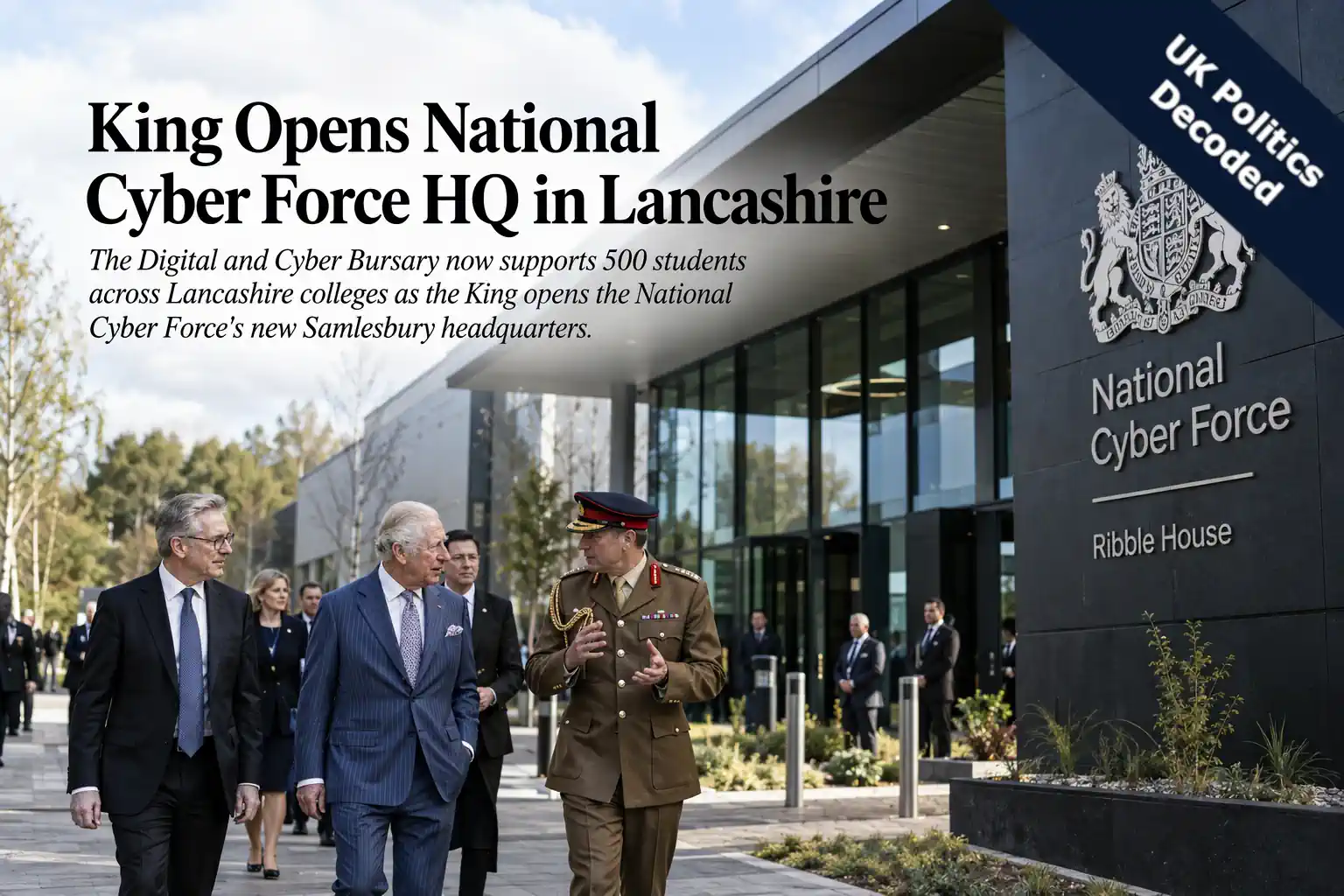
King Charles III has officially opened Ribble House, the new Samlesbury headquarters of the National Cyber Force, the joint defence and intelligence organisation that runs the UK's cyber operations against hostile states, terrorists and criminals.
The government announced the opening on 16 November 2026. It describes the site in Lancashire as a boost to national cyber capability and a source of jobs, skills and growth across the North West.
At a Glance
- The King officially opened Ribble House, the National Cyber Force's new headquarters in Samlesbury, Lancashire, with the government announcing the opening on 16 November 2026.
- The National Cyber Force brings together GCHQ, the Ministry of Defence, the Secret Intelligence Service and the Defence Science and Technology Laboratory.
- The Digital and Cyber Bursary, introduced in 2025, now supports 500 students across local colleges in Lancashire.
- The National Cyber Force works in secrecy and does not routinely share details of its operations because doing so could help adversaries strengthen their defences.
- GCHQ Director Anne Keast-Butler said the Samlesbury site is well placed to boost the North West Cyber Corridor with jobs, skills and innovation.
Who the King Met at the National Cyber Force's New Lancashire HQ
His Majesty heard how the National Cyber Force (NCF) strengthens the UK's cyber capability at a time when, in the government's words, hostile actors are weaponising a rapidly changing technology landscape. The headquarters in Samlesbury is the base for that work, which the government says is strengthening national cyber capability and capacity.
The King met leaders from the NCF's partner organisations, including Anne Keast-Butler, Director of GCHQ, and General Sir Rob Magowan, Commander of Cyber and Specialist Operations Command (CSOC). He also spoke to staff already working in the building. Some are local recruits, others came through the Armed Forces Cyber Direct Entry Scheme, and he was briefed on the NCF's mission, its capabilities and its work to counter threats to the UK and its allies.
The visit also took in local figures, among them members of the Lancashire Cyber Partnership. According to the government, the partnership has helped grow the county's cyber economy and shown people the careers available in national security.
What Is the National Cyber Force and What Does It Actually Do?
The NCF is a defence and intelligence partnership between GCHQ and the Ministry of Defence. It carries out cyber operations to support the military, prevent state threats, and disrupt criminals and terrorists. On its GOV.UK page, the force describes its role as conducting offensive cyber effects operations to make it harder for adversaries to exploit technology to harm the UK.
Four bodies feed into it. GCHQ provides global intelligence capabilities, while the Ministry of Defence contributes operational planning expertise. The Defence Science and Technology Laboratory (Dstl) supplies science and technology, and the Secret Intelligence Service, better known as MI6, brings agents and clandestine operational technology. The government says this mix lets the NCF keep developing cyber capabilities in response to real world events.
Its targets, as listed in the announcement, include state threats, terrorists, child sex offenders and criminals operating online. What it does not do is say much about specific operations. The government states that the NCF operates in secrecy and does not routinely disclose operational details, because that could reduce their effectiveness and help adversaries tighten their defences.
The NCF also works closely with the Defence Cyber and Electromagnetic Force, which sits inside CSOC and coordinates Defence demand for offensive cyber operations. CSOC itself develops and coordinates joint capabilities for UK Defence, from intelligence and cyber to special forces and overseas bases.
What Samlesbury Means for the North West Cyber Corridor and Lancashire Jobs
The regional argument runs through the government's announcement. Ahead of the opening, Defence and its partners invested in local skills and in specialist capability in the area. The Digital and Cyber Bursary, introduced in 2025, now supports 500 students across local colleges, giving young people in Lancashire cyber and digital training and qualifications.
Keast-Butler tied the headquarters to a wider regional plan. "Here in Samlesbury, the NCF is perfectly placed to boost the development of the North West Cyber Corridor, bringing jobs, skills and innovation to the region," she said. The announcement gives no jobs total for Ribble House and no figure for the investment behind the site.
What the government has set out
- Ribble House is now the NCF's official headquarters, with staff already working there.
- The Digital and Cyber Bursary supports 500 students at local Lancashire colleges.
- Recruits include local people and entrants from the Armed Forces Cyber Direct Entry Scheme.
The government calls the opening a long term investment in regional growth and in the future cyber workforce of the nation, and a significant milestone in strengthening the UK's offensive cyber capability.
What Wes Streeting, Ed Miliband and GCHQ's Director Said About the NCF HQ
Keast Butler said the NCF delivers "high impact cyber operations every single day against those who threaten our interests". She added that as Defence and Intelligence increasingly fuse their capabilities to prepare for a future crisis or conflict, the new headquarters is "a powerful symbol of partnership, pace and innovation".
General Sir Rob Magowan called the opening "a significant milestone in strengthening the UK's ability to combat threats in an increasingly contested world". He said the UK must be ready to "confront, deter and prevail in the cyber domain".
Foreign Secretary Ed Miliband said hostile actors use cyberattacks to disrupt the British way of life and cause harm, and that the country's intelligence agencies ensure those threats can be tackled head on. Defence Secretary Wes Streeting said the threat environment is "fundamentally different from that of recent decades". He described the Samlesbury opening as "a major investment in the North West, in defence innovation, and in keeping our country safe".
What Is Still Unknown About Ribble House and the National Cyber Force
The sources describe an opening, not a new policy or a funding package, so there are no fresh deadlines or legislation attached. What the announcement confirms is a permanent headquarters in Lancashire for a partnership that draws on four organisations.
The government has not said how many staff the site will eventually hold or how the bursary will expand. Because the NCF keeps its operations confidential, further detail on its work is limited to what it chooses to publish, including on its GOV.UK page.
Key Takeaways
- King Charles III has opened Ribble House in Samlesbury, Lancashire, as the new headquarters of the National Cyber Force.
- The National Cyber Force is a partnership of GCHQ, the Ministry of Defence, MI6 and Dstl that runs cyber operations against state threats, terrorists and criminals.
- The Digital and Cyber Bursary now supports 500 students at colleges across Lancashire.
- The government has not published a jobs figure or a cost for the headquarters, and the NCF does not routinely disclose operational details.
- Ministers and security chiefs describe the site as an investment in the North West and in the UK's offensive cyber capability.