AI Use: AI tools were used to support source discovery and to structure the article for clarity. All research, verification, drafting, and final editorial decisions are fully human led. Learn about our AI policy.
UKPoliticsDecoded is an IMPRESS regulated public interest publisher. Read our editorial standards.
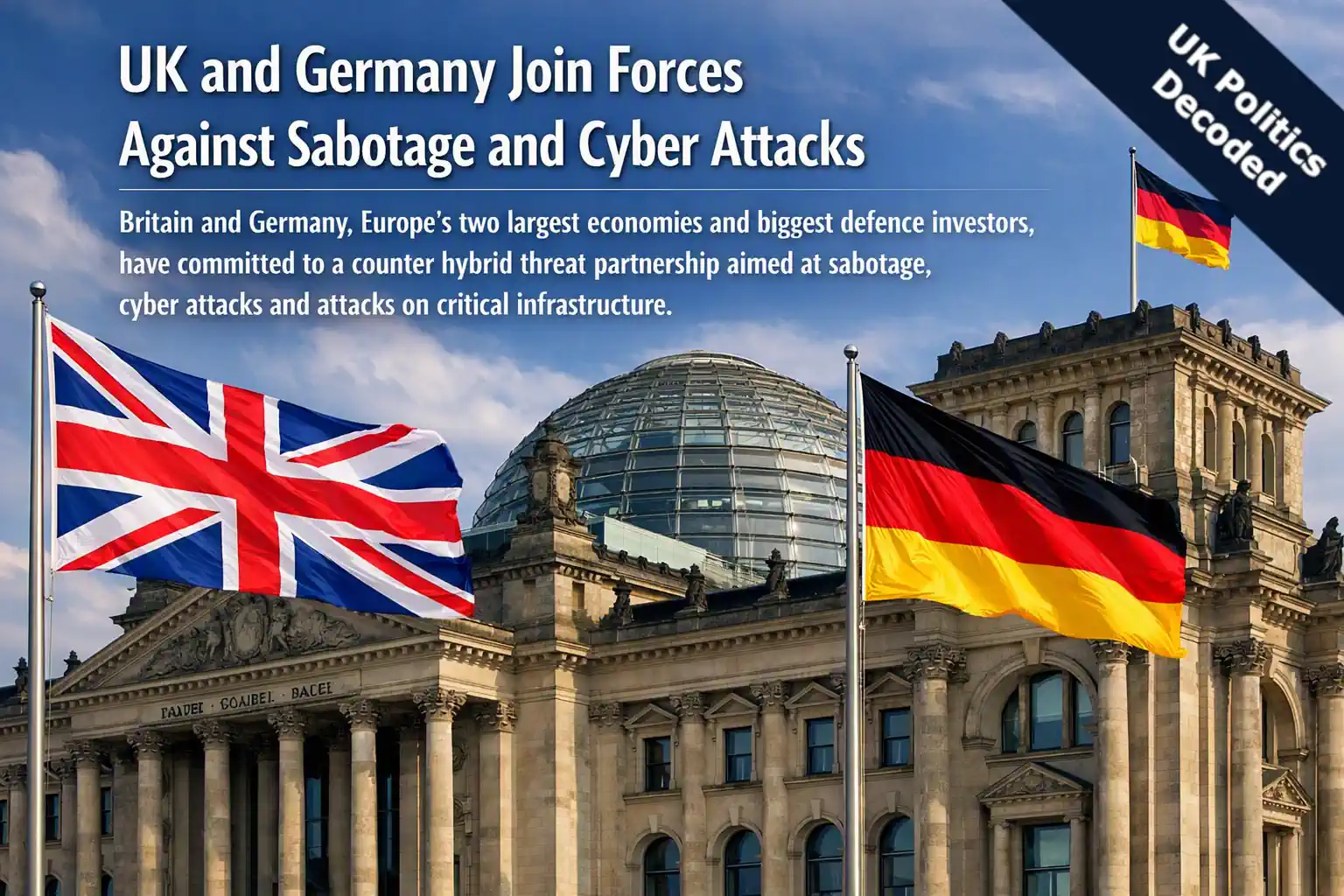
The UK and Germany have agreed to work together to find and disrupt hostile activity aimed at both countries. The new counter hybrid threat partnership was announced on 8 October 2026, as Prime Minister Andy Burnham travelled to Berlin for talks with Chancellor Friedrich Merz.
The two leaders were meeting face to face for the first time. According to the Prime Minister's Office, the partnership covers cyber attacks, sabotage and other hybrid threats, a category of hostile activity that falls short of open conflict but can still damage infrastructure, businesses and democratic institutions.
At a Glance
- The UK and Germany have committed to a counter hybrid threat partnership to tackle cyber attacks, sabotage and other hostile activity.
- The government says the partnership will build resilience against threats to critical infrastructure and degrade the ability of hostile actors to operate in Europe.
- Prime Minister Andy Burnham and Chancellor Friedrich Merz held their first face to face meeting in Berlin on 8 October 2026.
- The announcement builds on the 2025 Kensington Treaty, which the government says was formally ratified on the same day.
- UK-Germany trade in goods and services was worth £155.4 billion in the 12 months to the end of March 2026, according to official statistics.
What the UK-Germany Hybrid Threat Partnership Commits Both Countries To
The government's announcement is short on operational detail, but clear on purpose. Britain and Germany will share information and coordinate action to monitor, deter and disrupt hybrid threats. The stated aim is to degrade the capacity of hostile actors to operate in Europe and to build resilience against cyber attacks, sabotage and threats to critical infrastructure.
The press release names Russia directly. It describes the hybrid threat from "our adversaries", "especially Russia", as extending across Europe and beyond. The UK and Germany say they will jointly identify and disrupt hybrid activity "wherever it comes from", which suggests the partnership is not framed around a single country, though Russia is the only state the announcement singles out.
No budget, staffing levels or start date for the partnership were published in the announcement. Nor does it say which agencies on either side will lead the work. Those details may follow, but they were not in the material released on 8 October.
The Prime Minister put the threat in domestic terms. "Attacks on our infrastructure, our businesses and our democracies are not a distant threat," Burnham said. "They reach into people's homes and workplaces, and they are designed to make us weaker and more divided." He added that Britain and Germany were "joining forces to find, expose and disrupt this activity".
Why the UK and Germany Are Teaming Up on Security
The government's case rests on scale. It describes the UK and Germany as Europe's two largest economies and its biggest investors in defence, and says the hostile activity it is targeting extends "across Europe and beyond", threatening collective security.
The talks were not confined to security. Burnham and Merz were also due to discuss support for Ukraine, instability in the Middle East, and the effect of disruption to global trade routes such as the Strait of Hormuz. The government says the leaders would also look at how closer cooperation with European partners can strengthen security and economic resilience, as the UK "resets its relationship with Europe".
The two leaders will also convene a UK-Germany Regional Growth Forum, bringing together British and German chief executives. The government says the forum will focus on unlocking investment, strengthening industrial partnerships and making sure growth is felt in communities across both countries. The announcement frames security and growth as linked, with Burnham saying they "go hand in hand".
Kensington Treaty and the UK's Wider Response to State Threats
The partnership builds on the Kensington Treaty, signed in 2025, which commits the UK and Germany to deeper cooperation on science, technology, defence, security and growth. The government says the treaty was formally ratified on the day of the Berlin talks.
It also sits alongside two domestic measures set out in the notes to the announcement. The first is legislation the government says it has already fast tracked, giving the Home Secretary proscription like powers to designate state backed organisations and proxy groups that threaten national security. The aim, according to the government, is to help police and intelligence agencies disrupt those working on behalf of designated organisations.
The second is a proposed National Centre for Information Defence. The Prime Minister has asked security chiefs to establish it to detect, attribute and disrupt hostile state information attacks, and to identify disinformation and deepfakes that damage British interests. The announcement does not give a timetable for the centre.
Our earlier coverage of the UK-Poland defence and security treaty, which also addresses cyber threats and hybrid warfare, and of the updated National Risk Register, which lists democratic interference and cyber attacks on critical infrastructure, gives wider context.
How Closely Tied Are the UK and German Economies? £155.4bn in Trade
The press release says Germany is the UK's second largest trading partner. Official statistics bear that out. The Department for Business, Innovation, Science and Trade's factsheet, published on 24 September 2026, puts total UK-Germany trade in goods and services at £155.4 billion in the 12 months to the end of March 2026. That was up 3.9%, or £5.9 billion, on the previous 12 months, and equal to 8.1% of all UK trade.
The press release itself says Germany "already contributes some £155 billion to the UK economy". That figure is described in the government's notes to editors, and it is close to the factsheet's total for two way trade. The factsheet does not use the phrase, and the announcement does not explain how the £155 billion figure was calculated, so it is worth treating the two numbers as related rather than identical.
The balance of that trade is uneven. UK exports to Germany came to £63.8 billion in the period, while imports from Germany reached £91.7 billion, leaving a total trade deficit of £27.9 billion. The UK runs a services surplus of £12.5 billion with Germany, but a goods deficit of £40.4 billion. Cars are the largest single item on the import side, at £18.8 billion, or 25% of all UK goods imports from Germany.
Investment ties are similar in size. At the end of 2024, the stock of German foreign direct investment in the UK stood at £50.2 billion, up 14.7% on a year earlier. UK investment stock in Germany was £48.5 billion, down 21.1% over the same period. The factsheet notes that Germany accounted for 2.4% of the total UK inward investment stock.
What Happens Next for the UK-Germany Security Partnership
The announcement sets out intent rather than a delivery plan. It does not list specific joint operations, legal changes needed in either country, or measures of success. The government has not said when the National Centre for Information Defence will open, or whether the UK-Germany partnership will feed into it.
What is confirmed is the political commitment. Both governments have agreed to share information and coordinate action against hybrid threats, the Kensington Treaty is now ratified, and a growth forum involving British and German business leaders will follow. No further detail on how the partnership will work in practice had been published at the time of writing.
Key Takeaways
- The UK and Germany announced a counter hybrid threat partnership on 8 October 2026 to share information and coordinate action against cyber attacks, sabotage and threats to critical infrastructure.
- The government names Russia as the main source of the hybrid threat to Europe, while saying the partnership will act against hostile activity wherever it originates.
- The announcement builds on the 2025 Kensington Treaty, which the government says was formally ratified on the day of the Berlin talks.
- The government has also said it has fast tracked new powers to designate state backed organisations and has asked security chiefs to set up a National Centre for Information Defence.
- Germany is the UK's second largest trading partner, with £155.4 billion of two way trade in the 12 months to the end of March 2026, and no operational detail or timetable for the new partnership has yet been published.
Sources & Further Reading
- GOV.UK - UK and Germany launch joint partnership to counter sabotage and cyber attacks Archived copy (OGL): archived page
- GOV.UK - Germany trade and investment factsheet (24 September 2026) Archived copy (OGL): archived page