AI Use: AI tools were used to support source discovery and to structure the article for clarity. All research, verification, drafting, and final editorial decisions are fully human led. Learn about our AI policy.
UKPoliticsDecoded is an IMPRESS regulated public interest publisher. Read our editorial standards.
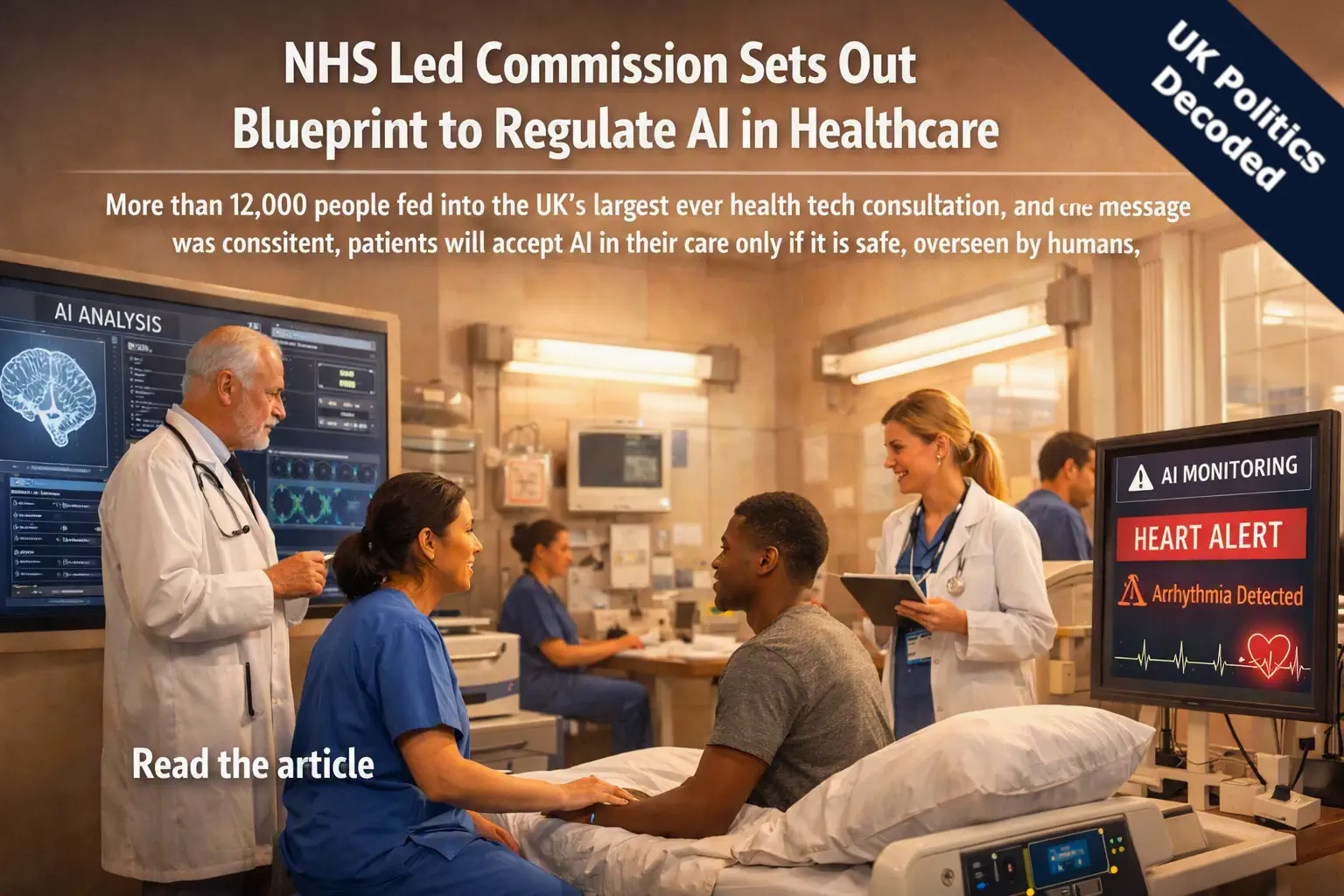
A commission of NHS doctors has told the government how it believes AI should be regulated across the health service. The National Commission into the Regulation of AI in Healthcare published its recommendations on 10 September 2026, following a year long inquiry that gathered evidence from more than 12,000 patients, clinicians and technology developers, the largest exercise of its kind ever carried out in the UK on health technology regulation.
The Commission was established by the Medicines and Healthcare products Regulatory Agency in September 2025 to work out how far safety rules should evolve to keep pace with AI. Its report responds to what that evidence found, broad public support for AI in healthcare, but only if safety standards are strong, a human stays in charge, and patients are told when AI is part of their care.
At a Glance
- The National Commission into the Regulation of AI in Healthcare, established by the MHRA in September 2025, published its recommendations for regulating AI in the NHS on 10 September 2026.
- The Commission gathered evidence from more than 12,000 patients, clinicians, healthcare leaders and technologists over a year, the largest engagement exercise ever undertaken on the regulation of health technology in the UK.
- It recommends staged authorisation for new AI models, comparable to L plates for learner drivers, allowing systems to prove themselves under supervision before gaining full approval.
- AI enabled medical devices should be monitored continuously throughout their working life rather than approved once and left unchecked, according to the report.
- The Commission also wants stronger enforcement powers for the MHRA and a public facing tool letting patients search the safety record of specific AI devices.
How 'L Plates' for AI Could Speed Up Safe NHS Adoption
The centrepiece of the report is a proposal for staged authorisation, a system the Commission compares to learner driver plates. New AI models would be deployed under close supervision and tight guardrails rather than full authorisation from day one, giving them room to demonstrate real world safety before wider rollout.
The Commission argues this would let UK patients access promising AI tools faster than under a traditional all or nothing approval process, while keeping risk under tighter control at each step. AI already helps NHS clinicians spot conditions such as strokes and skin cancers earlier, and the Commission wants more patients to benefit without weakening safeguards.
Professor Alastair Denniston and Professor Henrietta Hughes, the NHS doctors who led the Commission, said the work was about shaping an AI enabled but people centred health service, rather than adopting new technology for its own sake.
Why AI Medical Devices Will Be Monitored for Life, Not Just Once
Traditional medical devices are typically approved once. The Commission says that model doesn't fit generative AI, which can behave differently across settings and keeps evolving after deployment in a hospital or GP surgery.
Its recommendation is continuous, real world monitoring throughout a device's working life, rather than a one off approval. Professor Neil Lawrence, who chaired the Commission's Technology Working Group, said this reflects the reality that AI systems change after deployment, so regulators cannot assume the job is done once a product first passes muster.
MHRA powers the Commission wants strengthened
- Enhanced enforcement powers to act decisively when an AI system falls short of expected standards.
- A public search tool for safety information and adverse incidents, building on the MHRA's Drug Analysis Profiles.
- A proportionate system for keeping patients informed when AI is used in their care.
- Continuous lifecycle monitoring that applies even after a device has already been authorised.
What 12,000 Patients Told the Commission About Trusting AI
The Commission's findings draw on more than a year of engagement, including polling with Ipsos and deliberative research the Health Foundation carried out with 78 members of the public in Cardiff, Milton Keynes and York between March and April 2026.
What patients said they wanted
- Strong safety standards before AI tools are trusted with their care.
- Meaningful human oversight, so AI supports rather than replaces a clinician's judgement.
- Clear transparency about when AI is used in their diagnosis or treatment.
What the Commission is recommending
- Staged authorisation modelled on learner driver plates, so new AI models earn full approval gradually.
- Continuous, real world monitoring of AI devices throughout their working life, not just at approval.
- A proportionate approach to keeping patients informed when AI is part of their care.
The Health Foundation's parallel report, also published on 10 September 2026, found that accuracy is patients' top priority, human oversight is a critical condition for using AI, and regulation should be proportionate to risk without leaving any group of patients worse off.
What Happens Next, Will Ministers Adopt These AI Rules?
The Commission's recommendations are not binding. The government and the MHRA say they will consider the findings carefully, with a formal response to follow in due course.
The report sits within the government's wider ambition, set out in the 10 Year Health Plan for England, to make the NHS one of the most AI enabled health systems in the world. MHRA chief executive Lawrence Tallon said the agency needs a modern, dynamic framework that accelerates safe adoption while protecting patients and commanding public confidence.
Reaction from professional and industry bodies has been broadly supportive. The Royal College of Radiologists urged ministers to act without delay, while the BioIndustry Association said UK life sciences firms need clear, predictable routes from regulation to adoption.
Why This Report Could Shape AI at Your Next GP or Hospital Visit
The report's significance lies less in any single recommendation than in the model it proposes, regulation that adapts alongside AI rather than freezing a technology's risk profile at the point of approval, a real departure from how medical devices have traditionally been assessed in the UK.
Whether it delivers faster, safer access to AI for patients depends on what the government and MHRA choose to adopt, and how quickly. The Commission has set out the ambition, the formal response now due from ministers will decide how much of it becomes practice.
For now, the report gives the clearest sense yet of the conditions under which the public will accept a bigger role for AI in its care, proportionate safeguards, visible human oversight, and honesty about when the technology is being used.
Key Takeaways
- The National Commission into the Regulation of AI in Healthcare, established by the MHRA in September 2025, published its recommendations on 10 September 2026 after gathering evidence from more than 12,000 people.
- It recommends staged authorisation for new AI models, similar to L plates for learner drivers, so systems prove their safety under supervision before gaining full approval.
- AI enabled medical devices should be monitored continuously throughout their working life, not just approved once, according to the Commission's recommendations.
- The report calls for stronger MHRA enforcement powers and a public search tool for safety information and adverse incidents linked to specific AI devices.
- The government and MHRA will consider the recommendations and issue a formal response in due course, none of the proposals are binding yet.
Sources & Further Reading
- GOV.UK - Independent Commission led by NHS doctors sets out blueprint to accelerate safe AI adoption in healthcare Archived copy (OGL): archived page
- GOV.UK - National Commission into the Regulation of AI in Healthcare: Recommendations for a future regulatory framework Archived internally for verification
- GOV.UK - National Commission into the Regulation of AI in Healthcare: research, engagement and call for evidence findings
- GOV.UK - Medicines and Healthcare products Regulatory Agency