AI Use: AI tools were used to support source discovery and to structure the article for clarity. All research, verification, drafting, and final editorial decisions are fully human led. Learn about our AI policy.
UKPoliticsDecoded is an IMPRESS regulated public interest publisher. Read our editorial standards.
The Medicines and Healthcare products Regulatory Agency (MHRA) has launched a programme to close the evidence gaps on how medicines and medical devices work for women. The Women's Health Programme was announced on 16 November 2026 at the first DIA-MHRA Global Summit in London.
The regulator says women make up 51% of the population but remain underrepresented in the research behind the products they use. The programme runs from 2026 to 2030 and is organised around four themes, covering data, innovation, pregnancy and breastfeeding, and communication.
At a Glance
- The MHRA launched its Women's Health Programme on 16 November 2026 to address gaps in the evidence on how medicines and medical devices affect women.
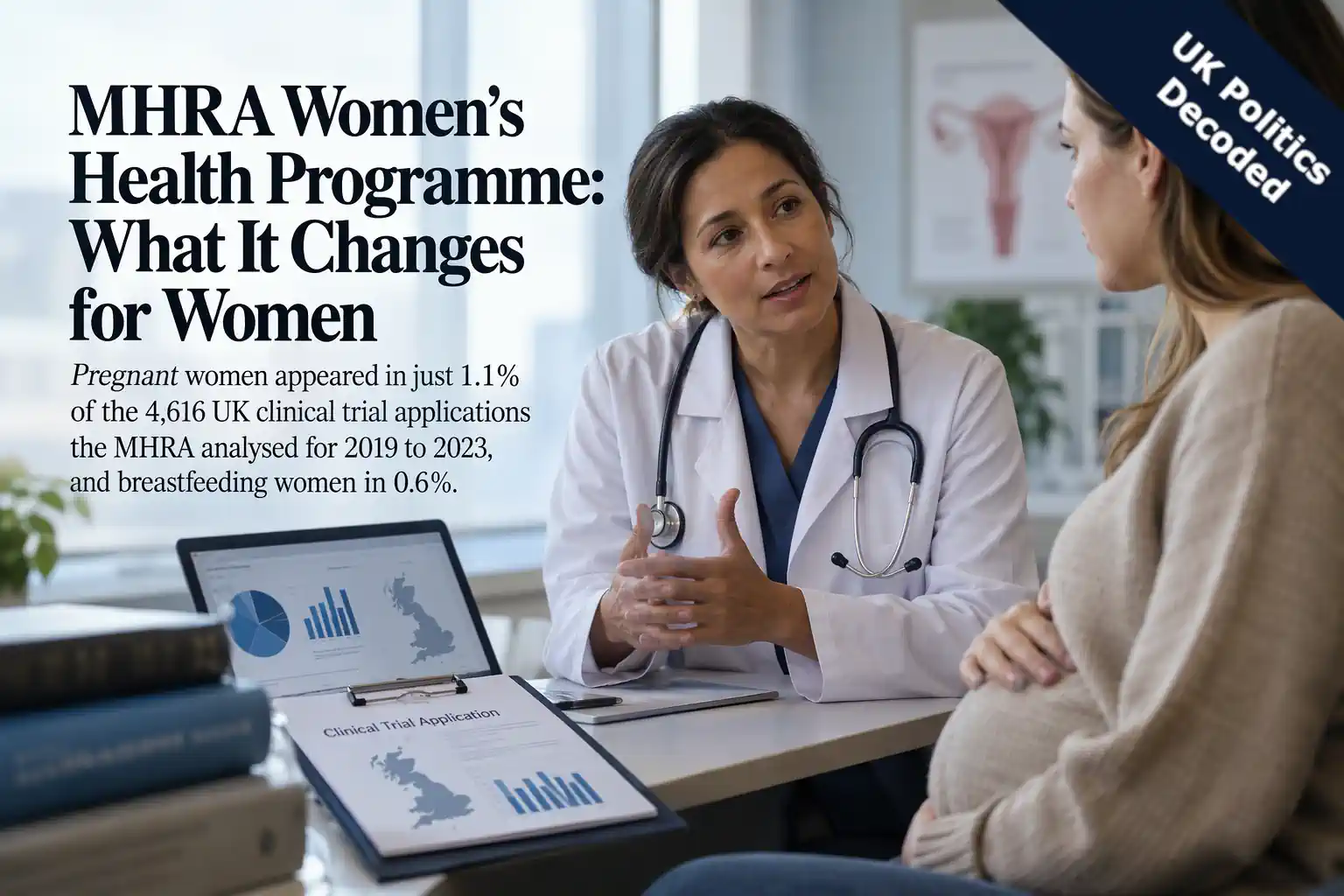
- An MHRA analysis of 4,616 UK clinical trial applications from 2019 to 2023 found pregnant women in 1.1% of trials and breastfeeding women in 0.6%.
- The programme is built on four strategic themes, data, innovation and quality, informed decisions in pregnancy and breastfeeding, and the agency's reach and impact.
- The MHRA says the UK FemTech sector has an annual turnover of nearly £300 million and that the programme will support proportionate regulation of it.
- The MHRA will hold a webinar introducing the programme on Wednesday 9 December from 11am to 12pm.
Why is the MHRA launching a Women's Health Programme?
The regulator's argument is straightforward. Women have historically been underrepresented in clinical research, which limits what is known about medicines and devices in pregnancy and across reproductive health. Conditions that affect only women, or that appear differently or more often in women, still have unmet needs.
Medicines and devices are complicated, the MHRA says, and factors such as biology, age, pregnancy and other health conditions can change how a person responds. The programme will bring together patients, researchers, healthcare professionals and industry to strengthen the evidence, while keeping what the agency calls its robust standards of safety, quality and effectiveness.
The agency also describes the programme as its regulatory contribution to the government's wider aim of improving women's health. It forms the first part of a broader MHRA effort to tackle health inequalities, set out in the agency's recently launched 2030 Strategy.
How many pregnant women are in UK clinical trials? What the MHRA found
The MHRA looked at all 4,616 UK clinical trial applications submitted between 2019 and 2023. Pregnant women were represented in 1.1% of them, and breastfeeding women in 0.6%. Those are the figures in the MHRA's announcement.
The programme document itself puts the pregnancy figure slightly differently, saying fewer than 1% of UK clinical trials include pregnant women. It adds that only 33% of trials approved in the same 2019 to 2023 period included women of childbearing potential, and that women are often missing from early phase studies, where doses are usually set.
The gap does not end at approval. The document says adverse events after a product reaches the market disproportionately affect women, though it adds that it remains unclear whether this reflects a genuine susceptibility. It also cites published data showing worse outcomes for women than men on tolerance and effectiveness, which it links to a lack of attention to biological differences in how products are developed.
The consequences reach patients directly. The document warns that missing evidence can leave pregnant and breastfeeding women unsure about treatment, which it says can lead to the unnecessary rejection or discontinuation of potentially important treatments.
What will the MHRA Women's Health Programme actually do?
The first theme is data. The MHRA plans to build sex specific evidence across the life of a healthcare product, using real world data and a wider analytical toolkit that includes patient reported outcome and experience measures. The aim is to put data broken down by sex into regulatory assessments, so that more sex based information can appear in product information. The document says artificial intelligence will support this work, subject to validation and governance, and it flags the risk of bias carrying through emerging modelling techniques and synthetic data.
The second theme is innovation and quality. Here the focus is on FemTech, the term for technologies aimed at women's health and wellbeing. The MHRA wants clear regulatory frameworks, backed by guidance, so that innovation can move forward without lowering standards. It also plans to publish topics of regulatory interest to encourage early engagement from developers.
The third theme concerns informed treatment decisions in pregnancy and breastfeeding. The document commits to new guidance for industry and researchers, pilots of new ways to generate evidence in these groups, and clearer reflection of available data in product information leaflets. It also proposes testing regulatory approaches that could encourage companies to gather evidence on pregnancy and breastfeeding exposure at the time of approval.
The fourth theme is about reach. The MHRA says it will publish guidance on how to communicate sex based differences in outcomes to patients and clinicians, and set up frameworks for working with partners across the health system and internationally.
What the Women's Health Programme means for FemTech and industry
Alongside the safety argument sits an economic one. The MHRA says the UK's FemTech sector already has an annual turnover of nearly £300 million. The programme document adds that the sector has received £544 million of investment and is growing by 2.7% a year, citing a 2026 industry report. It also cites a separate report estimating that closing the gap in health outcomes between women and men could add at least £36 billion a year to the UK economy by 2040.
Michelle Riddalls OBE, chief executive of PAGB, the consumer healthcare association, welcomed the focus on closing evidence gaps while supporting responsible innovation. She said better evidence could widen access to appropriate treatments through the reclassification of medicines, and pointed to low dose estradiol vaginal products and estriol cream, which she said have transformed access to hormone replacement therapy for thousands of women.
Women's Health Minister Baroness Gillian Merron said women have been underrepresented in the research that shapes the medicines and devices they rely on. In her words, that "is not good enough, and we are determined to change it." She described the programme as a welcome step which, together with the renewed Women's Health Strategy, would mean "better evidence, better treatments, and a health system that listens to women and works for them."
MHRA Chief Executive Lawrence Tallon called closing the gaps "both a challenge and a huge opportunity", saying better evidence can show where important differences exist and support researchers and innovators.
How the programme links to the Women's Health Strategy and HRA research guidance
The programme is designed to sit alongside existing national plans. The Department of Health and Social Care published a 10 year Women's Health Strategy for England in 2022, and a renewal followed in April 2026. According to the programme document, Phase Two of the Scottish Government's Women's Health Plan has launched, the Women's Health Plan for Wales is being implemented, and a Women's Health Action Plan for Northern Ireland is under development.
It also builds on work with the Health Research Authority (HRA). Naho Yamazaki, the HRA's Deputy Director of Policy and Partnerships, said the joint HRA and MHRA guidance on developing an Inclusion and Diversity Plan gives researchers a practical way to consider, from the earliest stage of study design, whether participants reflect the people who may benefit.
That guidance has been through a pilot. Seven studies took part, five from commercial sponsors and two from non-commercial sponsors. Five were phase III clinical trials of investigational medicinal products, and two involved medical devices. The pilot launched in May 2025 and closed at the end of 2025.
The findings were mixed. Commercial sponsors found a plan useful for thinking about inclusion more systematically, while non-commercial sponsors found it less helpful because funding applications had already pushed them to consider the issue. Research ethics committee members were divided on whether reviewing a plan added value. The biggest practical challenge for sponsors was getting reliable UK specific epidemiological data. The HRA says the guidance has since been updated with a clearer layout, and from early 2027 more researchers and sponsors will be asked to volunteer to submit a plan, with feedback gathered over 12 months.
The pilot covered inclusion and diversity in research generally rather than women alone. The MHRA's programme document describes it as one of the projects aimed at involving groups, including women, who have been overlooked in studies.
What happens next for the MHRA Women's Health Programme?
The programme was shaped with input from patients, including through the MHRA's Patient and Public Community and a focus group run by the Patients Association. Patients, the MHRA says, wanted the programme to cover product information on sex based differences, equal access to trials and priority for pregnant and breastfeeding women. The document says each of these shaped the final themes.
The next fixed date is the webinar on 9 December, where the MHRA will outline its plans to strengthen evidence and support women's health technologies. Register interest through the event listing on Eventbrite, as linked from the announcement.
The announcement and the text of the programme document do not set out a budget or dates for individual deliverables, such as when new guidance on pregnancy and breastfeeding studies will appear. The MHRA says the programme will be evaluated with ongoing patient involvement, but no measures of success are given in the published text.
Key Takeaways
- The MHRA says women make up 51% of the UK population but remain underrepresented in the research behind medicines and medical devices.
- Pregnant women featured in 1.1% of the 4,616 UK clinical trial applications analysed from 2019 to 2023, and breastfeeding women in 0.6%.
- The programme's four themes cover sex specific data, FemTech innovation, evidence for pregnancy and breastfeeding, and clearer communication of differences in outcomes.
- The programme sits alongside the renewed Women's Health Strategy for England and corresponding plans in Scotland, Wales and Northern Ireland.
- The published material does not give a budget, delivery dates for individual actions or measures of success.
Sources & Further Reading
- MHRA launches new programme to tackle evidence gaps on women's health - GOV.UK Archived copy (OGL): archived page
- MHRA Women's Health Programme 2026-2030 - GOV.UK Archived copy (OGL): archived page
- The HRA and MHRA inclusion and diversity pilot findings summary - Health Research Authority Archived internally for verification (17 November 2026)