AI Use: AI tools were used to support source discovery and to structure the article for clarity. All research, verification, drafting, and final editorial decisions are fully human led. Learn about our AI policy.
UKPoliticsDecoded is an IMPRESS regulated public interest publisher. Read our editorial standards.
The Department of Health and Social Care has teamed up with Breast Cancer Now, the UK's largest breast cancer charity, on a three year programme to help women recognise the signs of breast cancer and know where to turn for help. Announced on 5 October 2026, at the start of Breast Cancer Awareness Month, it is the first partnership to come out of the government's Renewed Women's Health Strategy.
The timing rests on a gap the charity has measured. Its new research found that almost a third of women who check their breasts regularly still do not feel confident about what a change would look like, and that a fifth of UK adults would not know where to find trustworthy information if they were worried.
At a glance
- The Department of Health and Social Care will work with Breast Cancer Now for three years to help women check their breasts, recognise changes and seek advice sooner.
- New Breast Cancer Now research found that 29% of women in England who check regularly do not feel confident noticing a change.
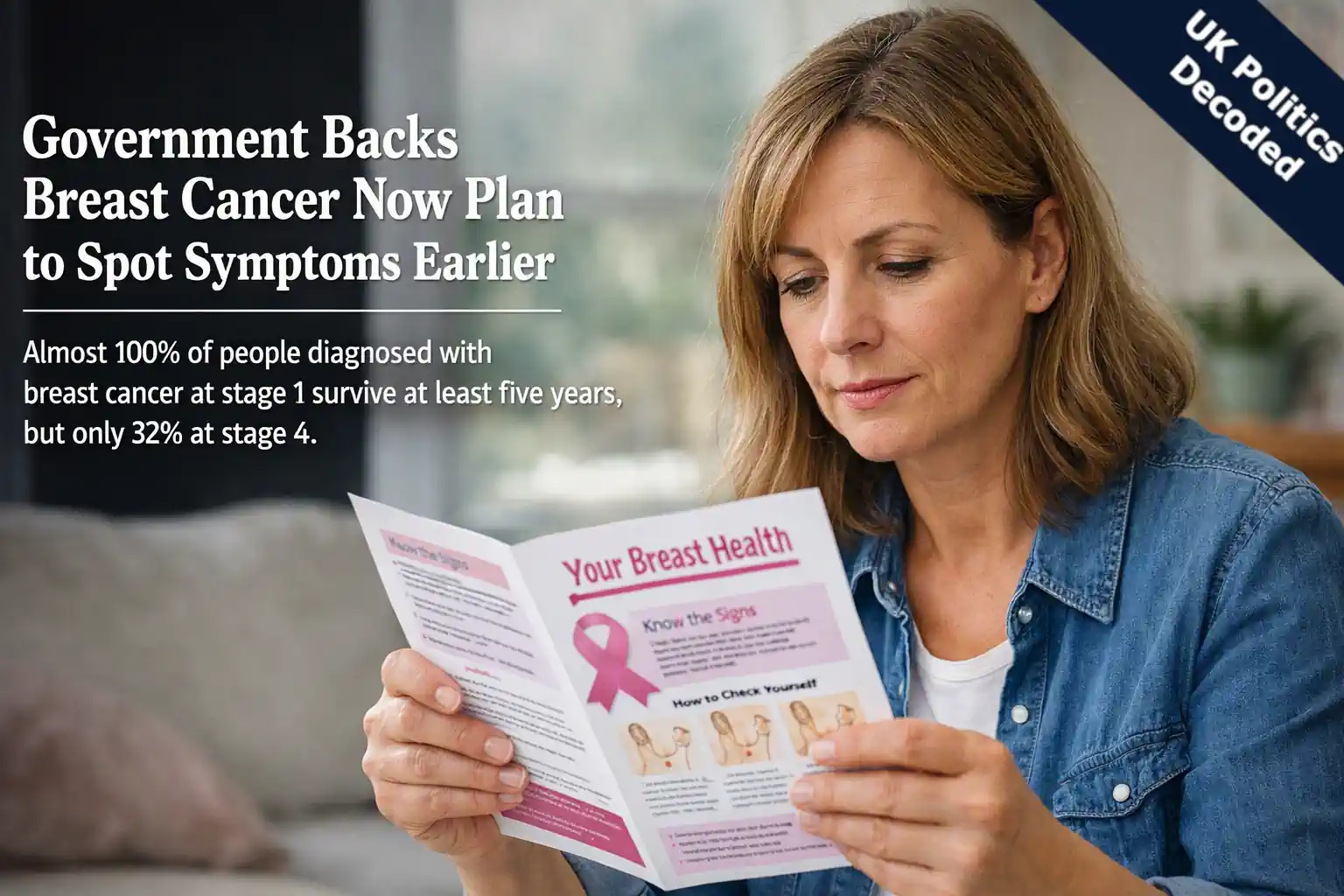
- Almost 100% of people diagnosed at stage 1 survive for at least five years, compared with 32% when breast cancer is found at stage 4.
- The partnership will also provide post treatment information and training for healthcare professionals, including a practical toolkit for healthcare teams.
- It is the first partnership announced under the Renewed Women's Health Strategy, published in April 2026.
What the Breast Cancer Now Partnership Will Deliver Over Three Years
The government has framed the partnership around three outcomes. Women should be able to find trusted information on breast health without difficulty. They should make checking a habit, recognise the signs and symptoms, and go straight to a GP if they notice anything unusual. And women finishing primary treatment should be supported with clear information about spotting signs of the cancer returning.
Practical help is aimed particularly at underserved areas, according to the announcement. The government has not published a detailed delivery plan, budget or list of target areas alongside the partnership, so how the work will be rolled out locally is not yet clear.
Healthcare professionals are part of the plan too. They will receive additional training and a toolkit designed to help them advise women who are adjusting to life after treatment. That includes information on possible signs of breast cancer returning or spreading, and on living a healthy lifestyle after treatment.
Why 29% of Women Don't Feel Confident Checking for Breast Cancer
Breast Cancer Now's research is the evidence the government cites. It found that 29% of women in England who regularly check their breasts do not feel confident noticing a change. Among women who check less than once a month, 11% said the reason was that they did not know what to look out for. Separately, 20% of UK adults said they were not confident they would know where to find trusted information about breast cancer if they had concerns.
The figures matter because of what the stage of diagnosis does to survival. One in seven women in the UK will be diagnosed with breast cancer in their lifetime, and around 11,500 women still die from the disease each year, according to the announcement. Caught at stage 1, almost 100% of people survive for at least five years. At stage 4, when the cancer has spread, that falls to 32%.
Baroness Merron, Minister for Women's Health and Maternity, said survival rates have improved enormously but that early diagnosis remains vital to each individual's chances. She said the aim is for every woman to feel confident checking her breasts and to get any new or unusual change looked at by a GP.
Rachael Franklin, Deputy Chief Executive at Breast Cancer Now, said the charity was proud to be the first partner of the strategy. She said better serving women means meeting them where they are and making sure every woman has the information and support to spot breast cancer sooner.
Where This Fits in the Renewed Women's Health Strategy
The Renewed Women's Health Strategy for England was published in April 2026, and it commits government to working with voluntary and commercial organisations. Its action on partnerships says the government will share health information and advice with women and girls through such groups, and that more than 50 commercial and voluntary sector organisations had already joined market testing events to explore the idea. Breast Cancer Now is the first named result.
The strategy also sets out a wider package on breast cancer. It commits to rolling out breast pain and post menopausal bleeding clinics nationally by the end of 2026, as part of the National Cancer Plan for England, and to investing £2.3 billion over three years in diagnostics transformation, including more community diagnostic centres. It says genomic testing for inherited causes of disease, including the BRCA1 and BRCA2 genes linked to a higher lifetime risk of breast and ovarian cancer, will be expanded within a year.
On screening, the strategy is candid about the starting point. It says breast screening rates are lower than they were ten years ago, and that screening rates for breast, cervical and colorectal cancers are lower among women from ethnic minority groups. To help, it says all adult screening invitations, reminders and results will be offered through the NHS App. It also describes a new cloud based AI research screening platform, first used in breast cancer, with nearly 700,000 women taking part in a study.
What to Do if You Notice a Change in Your Breasts
The government's message is unchanged by the new partnership, any new or unusual breast change should be checked by a GP. Neither the announcement nor the strategy sets out a symptom checklist, so anyone looking for detailed guidance on what to watch for should consult NHS and Breast Cancer Now information directly rather than rely on a news summary.
What the partnership adds is a three year, charity backed effort to make that advice easier to find and easier to act on, including for women who have finished treatment and are watching for signs of recurrence. Whether it shifts the numbers on confidence will depend on delivery details the government has yet to publish.
Key Takeaways
- The government announced a three year partnership with Breast Cancer Now on 5 October 2026, marking the start of Breast Cancer Awareness Month.
- Breast Cancer Now research found 29% of women in England who check regularly lack confidence in noticing a change, and 20% of UK adults do not know where to find trusted information.
- The partnership targets three outcomes, easy access to trusted information, regular checking and early GP visits, and support for women finishing treatment.
- Healthcare professionals will receive extra training and a practical toolkit to advise women after treatment.
- The government has not yet published a budget or detailed local delivery plan for the partnership.