AI Use & Transparency: AI tools were used to support source discovery and to structure the article for clarity. All research, verification, drafting, and final editorial decisions are fully human led. Learn about our AI policy.
UKPoliticsDecoded is an IMPRESS regulated public interest publisher. Read our editorial standards.
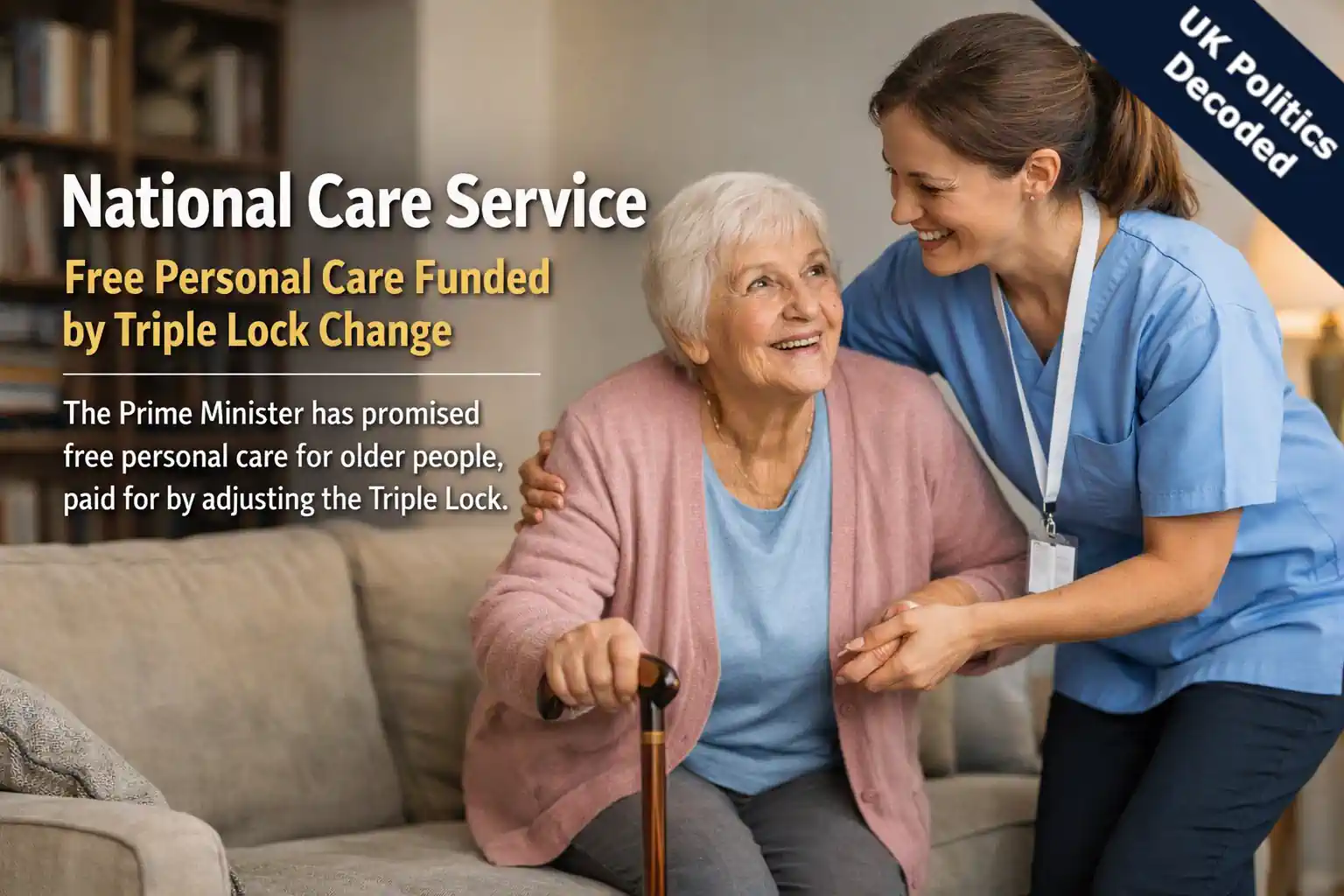
Prime Minister Andy Burnham announced on 29 September 2026 that England will get a National Care Service offering free personal care to older people, based on need rather than ability to pay. The government says it will be paid for by adjusting the State Pension Triple Lock from April 2030, not by borrowing.
No start date has been set beyond "the next Parliament", and the detail of how the money will be raised and spent has been handed to Baroness Casey's independent commission, which reports in summer 2027. What has been announced is a set of principles and a funding route. The mechanics come later.
At a glance
- A National Care Service providing free personal care for older people will be established in the next Parliament, according to the Prime Minister's Office.
- The current State Pension Triple Lock stays in place until April 2030, after which the pension will rise by at least inflation or 2.5% each year, with a new link to earnings.
- Savings from adjusting the Triple Lock are estimated at £15 billion a year by the end of the 2030s and £50 billion a year by 2050.
- The service will not cover bed and board, and councils will keep their existing means tested contributions for those costs.
- Baroness Casey's commission is due to report in summer 2027 on how and when the service is built up.
What Is the National Care Service and Who Will Get Free Personal Care?
The government describes the National Care Service as a new settlement for older people, sitting alongside a State Pension that rises every year. Its central promise is that personal care, meaning help with things like eating, bathing and using the toilet, will be free at the point of need.
Under the current system, the government says, who pays for care depends heavily on the type of need. Two people needing the same help with everyday tasks may face different rules if one has support linked mainly to a health condition and the other to social care. Ministers describe the result as a system where the most vulnerable risk losing everything just to access basic care.
The scale of the problem, as the government puts it, is large. Around three in four adults over 65 are expected to need care and support later in life, and one in seven will face costs of more than £100,000.
The service will arrive in phases. Its scope is meant to grow as savings build up and as workforce and provider capacity expands, so the first version will not be the final one. The Prime Minister's Office says the plan is fully funded and will not rely on borrowing.
How Will the National Care Service Be Paid For? The Triple Lock Link
The funding rests on changing the Triple Lock. The government says the current version will be maintained throughout this Parliament, and that it will increase the State Pension by over £2,000. From April 2030, the adjusted version takes over. The pension will continue to rise by 2.5% or inflation, whichever is higher, and by more if that is needed to keep its value relative to earnings.
The press release gives an example. If the State Pension is worth around a third of average earnings by 2030/31, it will then rise in line with earnings to hold that ratio. The government says nobody's pension will go down, and that pensioners are protected if inflation spikes and share in gains if wages rise.
The savings come from what the adjusted version stops doing. It no longer pushes the pension ahead of earnings indefinitely. The government estimates the change will reduce State Pension spending by £15 billion a year by the end of the 2030s, rising to £50 billion a year by 2050, and says the UK will still have one of the most generous approaches to increasing the State Pension in the world.
Those savings will be directed to the National Care Service. Exactly how and when they are built up is one of the questions Baroness Casey has been asked to answer. The government also says it will legislate for the Triple Lock change during this Parliament. UK Politics Decoded has covered the department's long run modelling of the adjusted Triple Lock separately, including why the department describes its projections as illustrative rather than forecasts.
What Free Personal Care Won't Cover Bed, Board and Your Home
The announcement is specific about the limits. Free personal care is not free residential care. The service will not cover bed and board, and the existing means tested contributions from councils for those costs will stay.
Two protections in the current rules continue. Councils will keep excluding the value of a person's home from financial assessments where a partner or dependent relative lives there. Deferred payment agreements will remain available too, helping eligible people avoid selling their home during their lifetime to meet care costs.
Promised under the National Care Service
- Free personal care, including help with eating, bathing and using the toilet.
- Access based on need rather than ability to pay.
- Phased introduction, growing as savings and capacity build.
Staying as it is
- Bed and board costs, with means tested council contributions.
- Exclusion of the home's value where a partner or dependent relative lives there.
- Deferred payment agreements for eligible people.
Because the announcement is a statement of principles rather than a set of eligibility rules, it does not say how need will be assessed, how the phasing will work or when free personal care will reach any given group. Those points sit with the commission's work.
How Bad Is Social Care in England? What the CQC Found
Any new service would be built on a sector already under strain. The Care Quality Commission's 2024/25 State of Care report, laid before Parliament in October 2025, describes health and social care as fragmented and under severe strain. It is the regulator's most recent annual assessment.
On demand, the CQC found that new requests for local authority funded adult social care were 4% higher in 2023/24 than the year before and 8% higher than in 2019/20. Over the last 20 years, the share of older people receiving local authority funded long term social care has fallen from 8.2% to 3.6%.
Workforce is the other pressure point. Vacancies in adult social care have fallen to prepandemic levels but remain three times higher than in the wider job market, and homecare vacancy rates are more than double those in care homes. The regulator said the ending of new care worker visas will likely add to recruitment pressure, and it reported that some homecare providers are handing contracts back to councils because of rising costs.
The consequences reach the NHS. On a single day in March 2025, nearly six in ten patients who were ready to leave hospital experienced a delay, and the CQC said capacity in bed based rehabilitation, reablement or recovery services was consistently the biggest cause of delayed discharge nationally. That echoes the Prime Minister's own warning that failing to fix social care would eventually break the NHS too.
The CQC has also said it has long called for a sustainable long term funding solution for adult social care, with clear career pathways and better pay and conditions for staff. In its foreword, it said the early focus of the Casey Commission on productivity, quality, digital services, workforce and integration was important, but would not by itself settle the sector's core sustainability.
When Will the National Care Service Start? What Happens Next
Baroness Casey's independent commission continues its work. It is informed by public deliberation and ongoing cross party talks, and will soon begin the next phase of its "Big Conversation on Care" to give people a chance to feed in their views. Its report is due in summer 2027.
Two things are then needed to make the promise real. The National Care Service itself is to be established in the next Parliament, and the Triple Lock adjustment is to be legislated for during this one. The government has not said when the Triple Lock legislation will be introduced.
Ministers present the plan as part of a pledge to tackle problems politicians have long avoided, alongside work on youth unemployment and ending rough sleeping. The detail of who qualifies, in what order and from what date remains to be set out.
Key Takeaways
- The Prime Minister has committed to a National Care Service offering free personal care based on need, to be established in the next Parliament.
- The plan is funded by adjusting the State Pension Triple Lock from April 2030, which the government estimates will reduce pension spending by £15 billion a year by the end of the 2030s and £50 billion a year by 2050.
- Bed and board costs stay means tested, and existing home protections and deferred payment agreements continue.
- The Care Quality Commission reports social care vacancies three times higher than the wider job market and nearly six in ten discharge ready patients delayed on a day in March 2025.
- Baroness Casey's commission is due to report in summer 2027 on how and when the service is built up, and the Triple Lock change requires legislation in this Parliament.