AI Use & Transparency: AI tools were used to support source discovery and to structure the article for clarity. All research, verification, drafting, and final editorial decisions are fully human led. Learn about our AI policy.
UKPoliticsDecoded is an IMPRESS regulated publisher. Read our editorial standards.
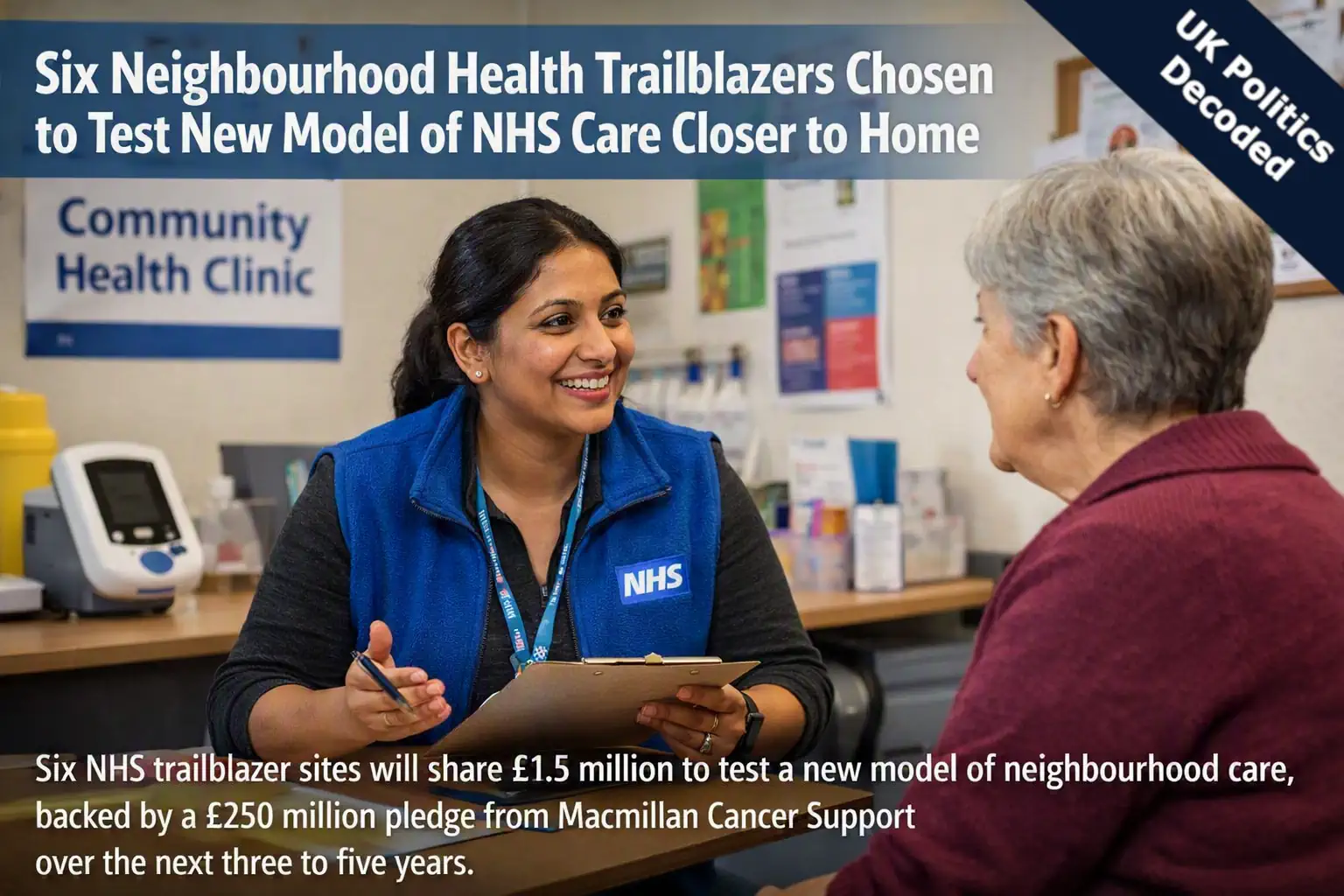
Six health and care partnerships across England have been chosen to pilot a new model of neighbourhood care, the Department of Health and Social Care announced on 16 September 2026. The trailblazer sites will share £1.5 million in seed funding from the Office for the Impact Economy, intended to help them redesign services around local communities rather than individual hospitals or GP surgeries.
The scheme brings the government together with Macmillan Cancer Support, Social Finance and West Hertfordshire Teaching Hospitals NHS Trust, pooling expertise in cancer care, system change and innovative finance. Integrated Care Boards and local councils across England were invited to apply, and the six chosen sites will now develop and test their own versions of a neighbourhood health model, bringing NHS services, social care and community organisations into a single, locally coordinated offer.
At a glance
- Six health and care partnerships across England will share £1.5 million to pilot neighbourhood health models, the Department of Health and Social Care announced on 16 September 2026.
- The funding comes from the Office for the Impact Economy, working alongside Macmillan Cancer Support, Social Finance and West Hertfordshire Teaching Hospitals NHS Trust.
- Macmillan Cancer Support has committed to invest £250 million in neighbourhood health across the UK over the next three to five years, acting as a cornerstone investor in the trailblazer sites.
- The sites span Bristol, Lewisham and Greenwich, North East Lincolnshire, 19 London boroughs, North Nottinghamshire, and York and Scarborough, each testing a different local model of care.
- Ministers say the programme supports the 10 Year Health Plan's shift from treating sickness to preventing it, and from hospital care to care closer to home.
Inside the Six Trailblazer Sites, From Bristol to Scarborough
Each site is building on services it already runs, rather than starting from scratch. Bristol NHS Foundation Trust is developing what it calls a "1,000 Days Neighbourhood Model", using population health data and community networks to improve end of life care and support people living with frailty and multiple long term conditions outside hospital. In Lewisham and Greenwich, the Lewisham Health and Care Partnership and Healthier Greenwich Partnership are building an integrated neighbourhood model covering long term conditions, frailty, cancer and end of life care, expanding on existing Integrated Neighbourhood Teams with a sharper focus on cancer.
In North East Lincolnshire, Navigo Health and Social Care CIC is setting up a Proactive Neighbourhood Care and Coordination Service, bringing together primary care, community services, mental health and social care so people with complex needs get support before they reach crisis point. RM Partners and the North Central London Cancer Alliance are running a larger scheme across 19 London boroughs, offering neighbourhood cancer prehabilitation and rehabilitation support with digital navigation to improve equity of access. In North Nottinghamshire, a partnership led by Sherwood Forest Hospitals NHS Foundation Trust is scaling up a proactive model for people with severe frailty, cancer and multiple long term conditions. York and Scarborough Teaching Hospitals NHS Foundation Trust is expanding an existing frailty model that uses proactive identification and geriatric assessment, aiming to carry successful approaches from York into rural and coastal areas including Scarborough and Bridlington.
Why Macmillan Is Putting £250 Million Behind Community Care
The involvement of Macmillan Cancer Support goes well beyond this initial funding round. The charity has committed to invest £250 million in neighbourhood health across the UK over the next three to five years, and intends to act as a cornerstone investor in the trailblazer sites, a role designed to attract further partners and investors and increase the total funding available for care closer to home. Gemma Peters, chief executive of Macmillan Cancer Support, said the six sites were "doing something special" and described neighbourhood health as redesigning care around people's lives, bringing health services, local organisations and communities together to create support that is more connected and personal.
Social Finance is providing the specialist expertise in innovative finance and investment models needed to make that kind of blended funding work in practice. Caroline Gadd, the organisation's chief executive, said neighbourhood health was crucial both to improving care for communities and to helping the NHS become financially sustainable, and that the real significance lay not just in the first six sites but in what could follow.
How the Trailblazers Fit the Government's 10 Year Health Plan
Ministers have framed the trailblazers as part of a broader push to shift power away from Whitehall and into local communities, alongside efforts to mobilise private and charitable investment behind public services. Dame Diana Johnson, Minister of State for Health, said neighbourhood health was about bringing services together locally so people get the right care at the right time, closer to home, and that the pilots would help show how locally led services can work together in areas of greatest need. She linked the programme directly to the government's 10 Year Health Plan, which sets out an ambition to move from treating sickness to preventing it and to shift more care out of hospitals and into communities.
Minister of State Stephanie Peacock said the trailblazers showed how government, local services, communities and impact investors working together could help build a healthier nation and stronger local economies. The department says the six pilots are intended to create the foundations for larger scale investment and wider adoption across the NHS, rather than remaining one off local projects. If the models prove successful, officials say they will pave the way for other areas to apply similar approaches, though no timetable has yet been set for a wider rollout beyond the initial trailblazer phase.
Key Takeaways
- Six trailblazer sites in Bristol, Lewisham and Greenwich, North East Lincolnshire, London, North Nottinghamshire, and York and Scarborough will pilot new neighbourhood health models from 2026.
- The Department of Health and Social Care is backing the programme with £1.5 million from the Office for the Impact Economy.
- Macmillan Cancer Support has pledged £250 million for neighbourhood health across the UK over the next three to five years, acting as a cornerstone investor.
- Each site is adapting an existing local service, from frailty and end of life care in Bristol to cancer prehabilitation across 19 London boroughs.
- The government says the pilots support its 10 Year Health Plan aim of shifting NHS care from hospitals into local communities and from treatment towards prevention.
Sources & Further Reading
- GOV.UK - Six neighbourhood health trailblazers to transform care Archived copy (OGL): archived page