AI Use: AI tools were used to support source discovery and to structure the article for clarity. All research, verification, drafting, and final editorial decisions are fully human led. Learn about our AI policy.
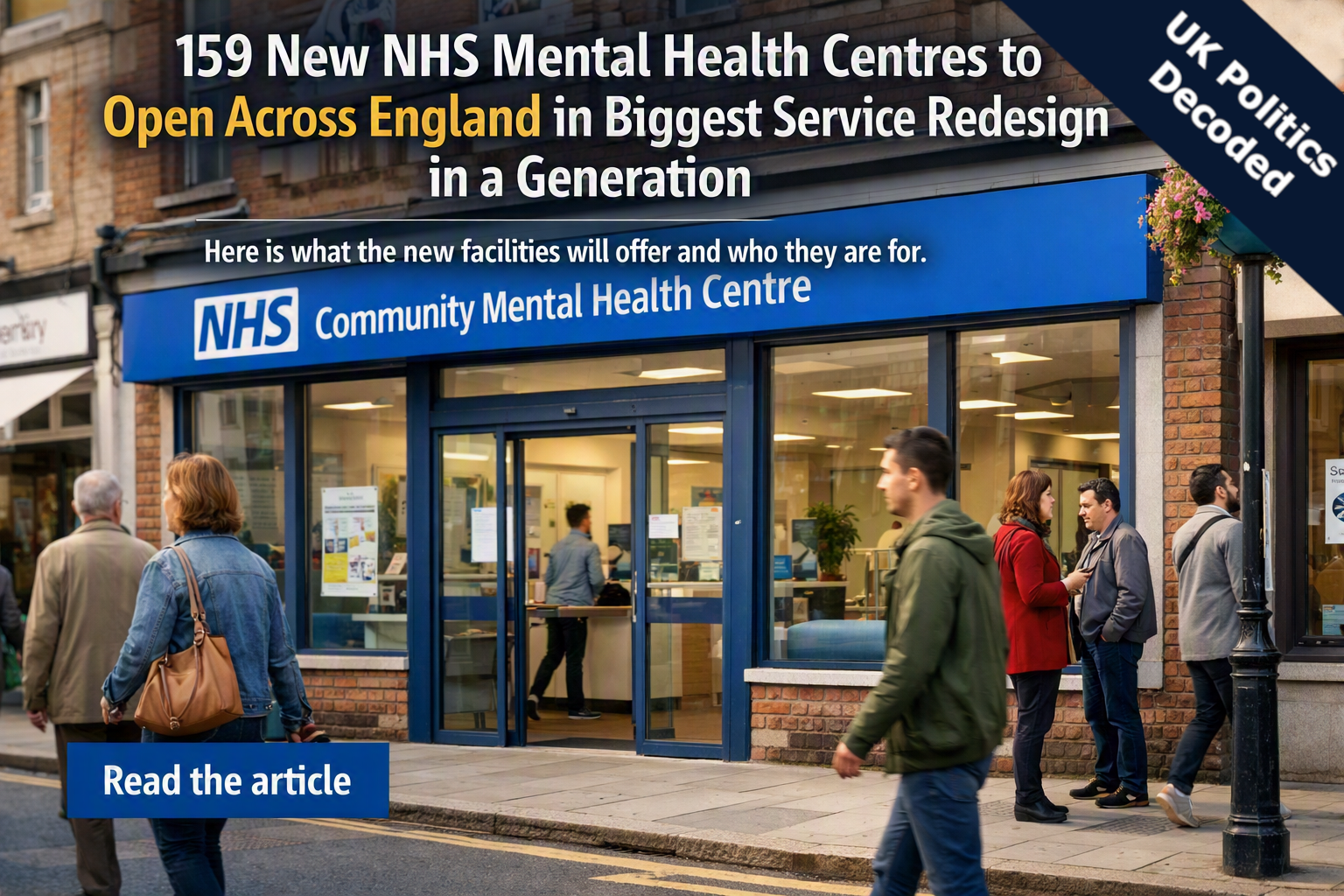
Up to 159 new NHS mental health facilities will open across England from this autumn, in what the government has described as the biggest redesign of mental health services in a generation. Backed by £343 million, the rollout was announced by Prime Minister Andy Burnham and Health and Social Care Secretary Yvette Cooper on 5 August 2026.
The programme includes two distinct types of facility, community mental health centres offering walk in support, and dedicated mental health emergency departments providing same day crisis care. Together they are designed to catch problems earlier and reduce the number of people reaching crisis point and ending up in standard A&E.
At a glance
- Total new facilities: 159 comprising 100 community mental health centres and 59 mental health emergency departments
- Funding: £343 million, £187 million for community centres, £156 million for emergency departments
- Timeline: First sites open from autumn 2026, further facilities from March 2027
- Access model: Community centres will offer walk in support without a GP referral or a long wait
- Existing provision: There are currently six community based mental health centres and 23 mental health emergency departments in England
The announcement covers two separate but connected types of NHS service. Each addresses a different point in the mental health pathway, one focused on early intervention, the other on crisis response.
The 100 new community mental health centres are designed to be the first port of call for people struggling with their mental health before they reach crisis:
- Walk in access: People will be able to access support without a GP referral and without waiting months for an appointment
- Neighbourhood locations: Centres will be based in libraries, former banks, and other community or high street buildings not clinical hospital settings
- Integrated services: Mental health and specialist teams will work alongside GPs, councils, the voluntary sector, and families under one roof
- Linked support: Direct connections into housing and employment support, recognising that wider social factors affect mental health
- Non-clinical design: Facilities are intended to have a welcoming, non-clinical appearance to reduce barriers to people seeking help
The 59 new mental health emergency departments (MHEDs) are a dedicated alternative to A&E for people experiencing a mental health crisis:
DHSC, 5 August 2026
- Same day care: Dedicated specialist support for people in crisis who are medically fit and do not need treatment in a standard A&E
- Location: Based with emergency departments, working closely with ambulance and police services
- Environment: A calm, therapeutic setting where people can be assessed quickly, rather than a busy A&E waiting room
- Scale: The rollout will more than double the current number of dedicated mental health emergency departments, taking the total across England to 82
Around one in five people in England experiences a common mental health condition each year. The government's stated case for the redesign is that demand has risen sharply particularly among children and young people while the existing system too often means people only get help once they are already in crisis.
The announcement cites several consequences of the current system:
Context from the government announcement
- Crisis led system: People typically only receive support once they reach crisis point, placing pressure on A&E and other urgent services
- Children and young people: Demand has risen most sharply in this group, though specific waiting times figures were not cited in the announcement
- Education and work impact: The government's stated aim is for earlier intervention to help more children stay in education and more adults remain in or return to work
- Existing pilots: Six community based mental health centres already operate in England, this rollout scales from those pilots
- Sheffield visit: Yvette Cooper visited one of the six existing centres in Sheffield on the day of the announcement
Several sector organisations responded positively to the announcement, while some noted that delivery and integration will be key to whether the ambition is realised in practice.
- Rethink Mental Illness: Called it a vital step, noting that bringing together treatment and wider support services under one roof could transform care experiences
- Mind: Described it as a promising step, adding that the plans signal a shift towards preventative, open access mental health support rooted in communities
- Barnardo's: Welcomed the rollout but called for children and young people to be placed at the heart of implementation
- Royal College of Psychiatrists: Welcomed the investment while stressing the importance of ensuring services deliver joined up care without compromising quality
- Mental Health Foundation: Emphasised that many drivers of poor mental health including debt, unemployment, and poor housing are best addressed through the kind of integrated, holistic support the centres aim to offer
Confirmed locations span all NHS regions in England. Final sites remain subject to designs, procurement, and business case approvals. A selection of confirmed sites across each region is set out below.
North and Midlands
- North East & Yorkshire: County Durham (2), Darlington, Hartlepool, Hull, Middlesbrough, Newcastle, Sheffield, Sunderland, and others
- North West: Cheshire & Merseyside (5), Greater Manchester (3), Lancashire & South Cumbria (3)
- Midlands: Birmingham (3), Coventry, Dudley, Leicester City (2), Lincolnshire (2), Stoke on Trent, multiple Nottinghamshire sites, and others
- Mix of builds: 57 of the 159 total facilities will be newbuilds, 102 will be conversions of existing sites
South and London
- London: Barking & Dagenham, Barnet, Brent, Camden, Croydon, Enfield, Islington, Lambeth, Newham, South West London (4), Wandsworth, Westminster, and others
- South East: Buckinghamshire, East Surrey, Hampshire or Isle of Wight (4), Oxfordshire, Slough, Sussex, West Sussex, and others
- South West: Bath/NE Somerset, Bournemouth, Central Cornwall, Devon, Weymouth, and others
- East of England: Cambridge South, Clacton on Sea, Luton, Milton Keynes, north and east Norfolk sites, and others
The 59 mental health emergency departments will be located alongside existing A&E facilities, covering all NHS regions. Selected confirmed sites include:
- London: Maudsley Hospital, The Royal London, Newham General, St George's (Wandsworth), Whipps Cross, and others
- North East & Yorkshire: St James's (Leeds), Longley Centre (Sheffield), Barnsley, County Durham, Hull, Wakefield, Sunderland, and others
- South East: John Radcliffe (Oxford), University Hospital Southampton, Royal County Hospital (Brighton), East Surrey, and others
- South West: Callington Road, Central Cornwall, Musgrove Park (Somerset), Plymouth (including a children and young people focused site), and others
- Midlands: Birmingham, Queen's Medical Centre (Nottingham), Leicester City, Chesterfield Royal, and others
The rollout forms the first phase of a wider programme set out in the government's 10 Year Health Plan for England, published in 2026. The plan frames the shift from treating people at crisis point to supporting them earlier as a central objective across NHS services.
The 5 August announcement sits within a broader policy framework still being developed:
- Mental Health Strategy: A forthcoming government strategy will look beyond the NHS to the role of schools, employers, local government, and the voluntary sector in supporting good mental health
- Independent review: Professor Peter Fonagy is leading a review into the prevalence of and support for mental health conditions, ADHD, and autism, its recommendations will inform the Mental Health Strategy
- 10 Year Health Plan: The community and emergency department expansion is described as part of the shift from hospital to community care set out in the plan
- Phase one scope: The 100 CMHCs and 59 MHEDs represent the first wave, final locations remain subject to business case approvals
- Further sites from March 2027: Additional facilities beyond the autumn 2026 openings are expected to follow from that date
The new centres do not replace existing NHS mental health services. They are intended to add capacity earlier in the pathway, so that fewer people reach the point of needing inpatient treatment or A&E. The emergency departments work alongside ambulance and police services and will be able to connect people to inpatient treatment, home support, or community services as appropriate after assessment.
- Current baseline: Six community based mental health centres and 23 mental health emergency departments are already operating in England
- After this rollout: The total number of MHEDs in England will reach 82, CMHCs will rise to at least 106
- Staffing: The announcement does not detail how many additional NHS staff will be needed to run the new facilities
- Funding split: £187 million has been allocated to trusts for the 100 CMHCs, £156 million for the 59 MHEDs
- Trust responsibility: NHS trusts will receive the capital funding and will be responsible for building or converting and then operating the facilities
The 159 new facilities represent the largest single investment in NHS mental health infrastructure in years. The stated intention is straightforward, get people help earlier, in their neighbourhood, rather than waiting until they arrive in crisis at an already stretched A&E.
Whether that ambition is met will depend on delivery. The six existing community centres and 23 emergency departments provide a starting point, but moving from 29 facilities to 188 is a significant operational task, and the announcement acknowledges that final sites are still subject to procurement and business case processes.
For people currently waiting months for mental health support, or whose only option in a crisis has been a busy A&E, the practical question is how quickly the new facilities open and whether they are staffed and funded to meet the demand in their area.
Key Takeaways
- 159 new NHS mental health facilities will open across England, backed by £343 million, 100 community walk in centres and 59 dedicated mental health emergency departments
- Community centres will offer walk in access without a GP referral, based in neighbourhood settings such as libraries and former high street buildings
- Mental health emergency departments will provide same day specialist crisis care alongside A&E, working with ambulance and police services
- First facilities open from autumn 2026, further sites follow from March 2027, final locations remain subject to procurement and business case approvals
- The rollout is part of the government's 10 Year Health Plan and will be complemented by a forthcoming Mental Health Strategy covering schools, employers, and local government