AI Use: AI tools were used to support source discovery and to structure the article for clarity. All research, verification, drafting, and final editorial decisions are fully human led. Learn about our AI policy.
UKPoliticsDecoded is an IMPRESS regulated public interest publisher. Read our editorial standards.
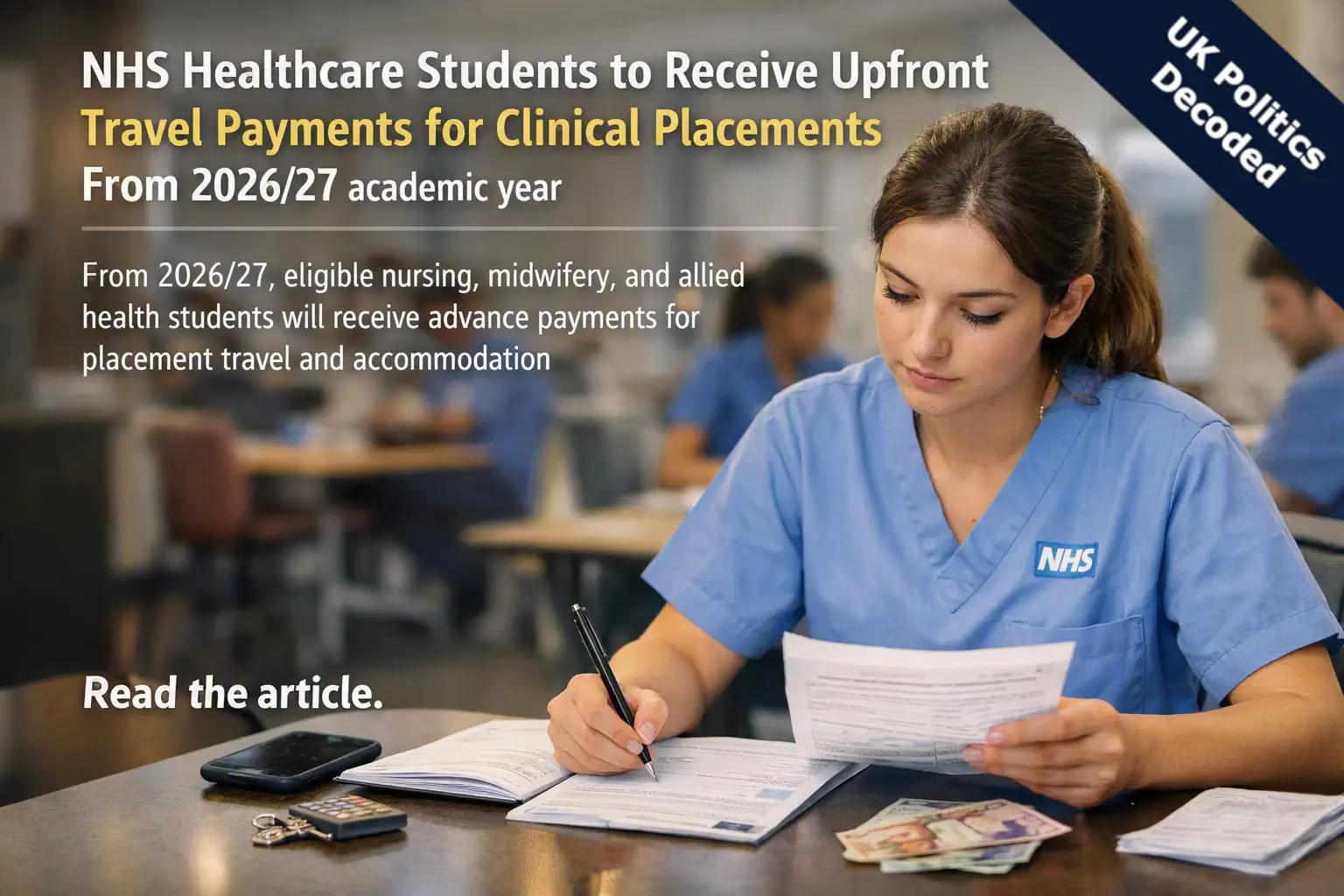
Thousands of student nurses, midwives, and allied health professionals will no longer have to find money upfront to reach their clinical placements under changes taking effect from the start of the 2026/27 academic year. The Department of Health and Social Care confirmed on 1 September 2026 that eligible students with full access to the NHS Learning Support Fund will be able to receive advance payments for placement travel and accommodation, receiving the money before costs arise, rather than paying out of pocket and waiting to claim it back.
The shift builds on a digital claims system the NHS Business Services Authority introduced in January 2025, which cut reimbursement processing times but left the underlying cash flow problem unchanged. Some students had still been left out of pocket for weeks while claims cleared. Advance payments remove that gap rather than narrowing it.
At a glance
- From 2026/27, eligible students with full access to the NHS Learning Support Fund can receive advance payments for placement travel and accommodation instead of paying costs and waiting to be reimbursed.
- Students receive a payment float administered by the NHS Business Services Authority, with approved claims automatically deducted from the balance as they are submitted.
- If a student's float balance falls below £50 at any point during a placement, they can request a top up to maintain continuous cover.
- Any unused float balance at the end of training is deducted from the student's final training grant instalment, not recovered separately.
- The government says the change will make high cost rural and coastal placements more accessible for students who could not previously afford the financial gap between paying out and being paid back.
How the New NHS Placement Payment Float Will Work From 2026/27
The mechanics are built around a payment float rather than a one off lump sum. Students apply to the NHS Business Services Authority for an advance, which sits as an available balance. As placement claims are submitted and approved, they are automatically deducted from that balance, there is no separate reimbursement transaction for each journey or overnight stay, and no waiting period once a claim is in.
The float includes a safety mechanism. If the available balance drops below £50 at any point, students can request a top up, which means cover is maintained even during longer or more intensive placement periods. At the close of a course, any remaining float balance is deducted from the student's final training grant instalment, keeping the process straightforward for both sides.
Health Minister Alison McGovern said the change would put money in students' pockets before costs hit rather than after. Chief Nursing Officer for England Duncan Burton said it addressed a real financial pressure and would be welcome news for the thousands of students working to gain clinical experience across the country.
How the float system works in practice
- Student applies to the NHS Business Services Authority for an advance payment float before or at the start of a placement.
- Approved placement travel and accommodation claims are automatically deducted from the float balance as they are submitted, no separate reimbursement transactions required.
- If the float balance falls below £50, the student can request a top up to ensure cover continues without interruption.
- Any unused float balance at the end of the course is deducted from the student's final training grant instalment.
Which Healthcare Students Can Apply and What the NHS Learning Support Fund Covers
The advance payment facility is available to students in nursing, midwifery, allied health professions, and dental therapy and hygiene. The eligibility condition is full access to the NHS Learning Support Fund, the government's announcement specifically refers to students with full access, meaning those on partial support do not appear to qualify under the current terms.
The Learning Support Fund is the existing framework through which eligible NHS funded healthcare students receive financial support beyond their core maintenance loan. It already covers some travel and accommodation costs on a reimbursement basis, the advance facility adds an upfront option without changing who qualifies for the fund itself. Students continue to submit claims in the usual way, the difference is that approved costs come off a loaded balance rather than triggering a separate payment process.
Rural and Coastal Placements, How Upfront Costs Have Been Holding Students Back
Travel costs for placements in rural and coastal areas can run substantially higher than for students commuting short distances in cities. A student placed at a hospital an hour or more from home faces train fares, accommodation, and potentially several return journeys a week, outgoings that accumulate quickly across a multi week rotation. For students without savings or financial support at home, the prospect of fronting those costs and waiting for reimbursement could make a more distant placement feel unviable.
After the change: from 2026/27
- Students receive a payment float before placement costs arise, with no need to self fund travel or accommodation upfront.
- Approved claims are automatically deducted from the float, no waiting period between paying and being reimbursed.
- Top ups are available if the float drops below £50, maintaining cover throughout longer placement periods.
- Rural and coastal placements become more accessible for students who could not previously afford the financial gap.
Before the change: current system
- Students pay placement travel and accommodation costs out of their own pocket before any support is available.
- Claims submitted and processed after costs incurred, leaving students potentially hundreds of pounds out of pocket mid training.
- Faster digital claims processing since January 2025 reduced waiting times but did not eliminate the upfront cost burden.
- Students without financial buffers were less likely to take on distant or rural placements, narrowing their clinical experience.
The Royal College of Midwives said it had been calling for this reform since its 2024 State of UK Midwifery Student Finance report, which found that financial hardship during training was a significant concern among student midwives. Chief Executive Gill Walton said no student should be paying to travel to their placements, particularly in rural and remote areas where costs are highest. The British Dietetic Association also welcomed the changes, noting the particular benefit for students from less advantaged backgrounds and those travelling the furthest.
10 Year Workforce Plan Due Later in 2026 as Government Targets Training Barriers
The announcement is framed as part of delivering the government's 10 Year Health Plan. Later in 2026, ministers expect to publish a 10 Year Workforce Plan that will set out a broader strategy for ensuring the NHS has the right staff in the right numbers and in the right places. The advance payment change is presented as one component of a wider effort to remove practical barriers that make training harder or less equitable than it should be.
The argument made by professional bodies like the Royal College of Midwives is that placement access during training is not separate from workforce supply at the end of it. If financial barriers push students towards cheaper, more convenient placements, the NHS loses the breadth of clinical experience that a more distributed training model would otherwise generate. Closing that gap while students are still in training is, the government argues, a more efficient use of workforce investment than trying to compensate for it later.
Key Takeaways
- From the start of the 2026/27 academic year, eligible nursing, midwifery, allied health, and dental therapy and hygiene students can receive advance payments for placement travel and accommodation through the NHS Learning Support Fund.
- The advance payment system works via a float administered by the NHS Business Services Authority, with claims automatically deducted from the balance and top ups available if it falls below £50.
- Any unused float balance at the end of training is deducted from the student's final training grant instalment rather than recovered separately.
- The change is designed to make high cost rural and coastal placements more accessible for students who could not previously absorb the gap between paying out and being reimbursed.
- The government says the reform forms part of its delivery of the 10 Year Health Plan, with a 10 Year Workforce Plan due later in 2026 to address NHS staffing more broadly.
Sources & Further Reading
- GOV.UK - Upfront help cuts placement costs for healthcare students (Department of Health and Social Care, NHS England, NHSBSA, 1 September 2026) Archived copy (OGL): archived page
- NHS Business Services Authority - NHS Learning Support Fund Archived internally for verification (1 September 2026)
- GOV.UK - The NHS 10 Year Plan Archived copy (OGL): archived page
- Royal College of Midwives - State of UK Midwifery Student Finance 2024 Archived internally for verification (1 September 2026)