AI Use: AI tools were used to support source discovery and to structure the article for clarity. All research, verification, drafting, and final editorial decisions are fully human led. Learn about our AI policy.
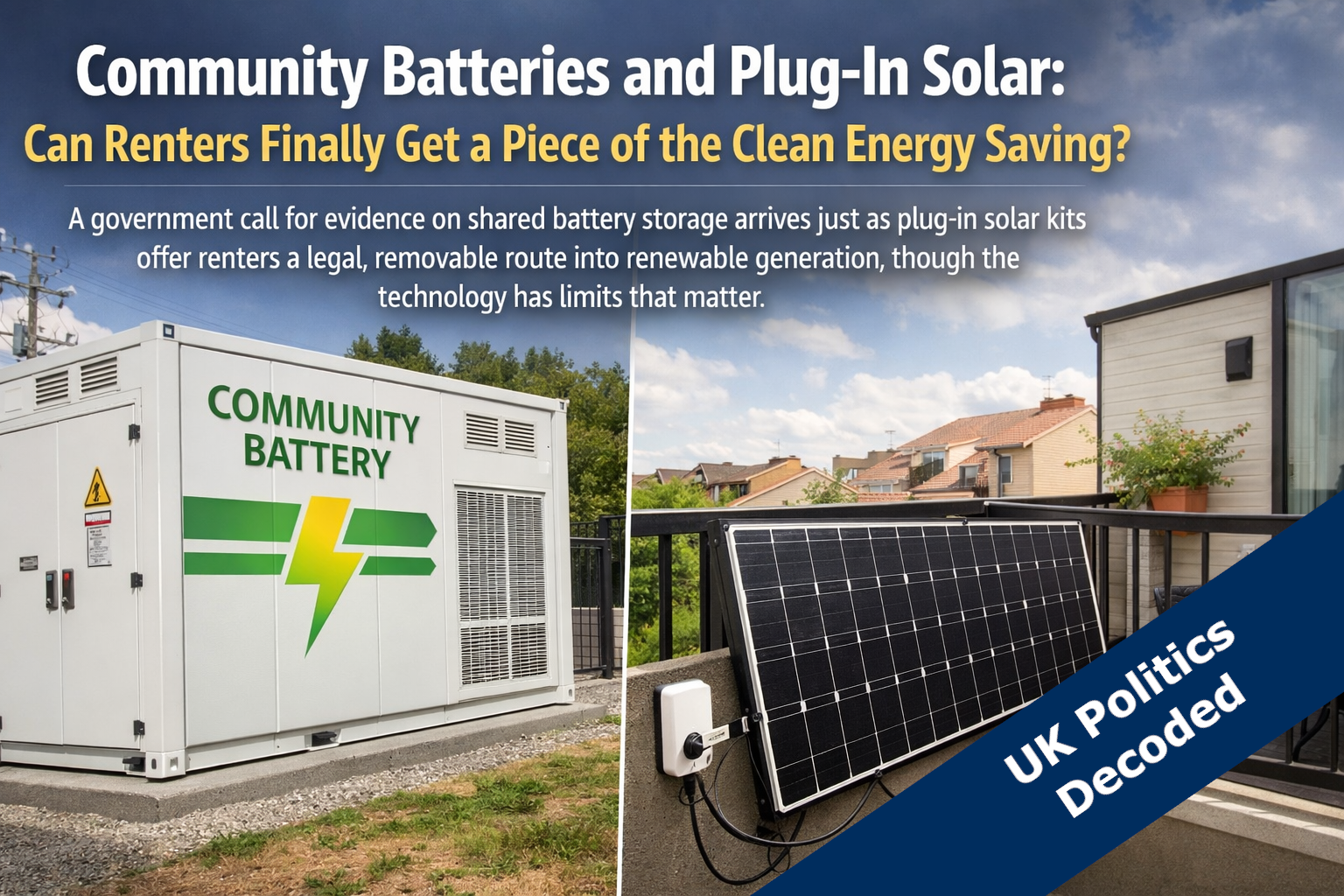
The government has launched a call for evidence on community batteries, shared storage units that allow multiple households to pool and draw from locally generated renewable electricity. Published on 4 June 2026, the consultation asks how shared battery storage can be scaled up across the UK, what regulatory barriers are in the way, and how to make the savings reach people who cannot install their own kit, specifically renters and those living in flats.
Energy Minister Michael Shanks said the scheme was about "putting power back into the hands of local people and ending our reliance on fossil fuel markets." The government cited two working examples, a Net Zero development in Bridport, Dorset, where a shared system cut energy costs by the equivalent of around £1,300 per home per year, and a community battery trial at a Lambeth Council block of flats in Brixton, where participating residents saved roughly £180 a year through a combination of solar generation and flexibility payments.
What the call for evidence covers
- Scale: How to expand community battery deployment beyond a small number of pilot projects
- Barriers: Regulatory and commercial obstacles preventing wider rollout
- Safety: Standards for shared battery installations in residential settings
- Inclusion: Ensuring renters and flat dwellers can access the same savings as homeowners
- Ownership: How communities can hold a stake in local clean energy infrastructure
Where Plug-In Solar Kits Already Fill the Gap
Community batteries address the storage side of the problem. But for renters who want to generate their own electricity now, a separate technology already exists, plug-in solar kits, sometimes called balcony solar or microgenerator kits.
These systems typically consist of one or two panels connected to a microinverter, which plugs directly into a standard household socket. They are designed specifically not to modify the existing electrical installation of a rented property. Nothing is wired in permanently. The panels can be mounted on a balcony railing, flat roof, or garden, and the whole system is removed when a tenant leaves, making them genuinely compatible with renting in a way that conventional rooftop solar is not.
Legal compliance: G98 and G100 certification
The legal foundation that makes plug-in solar workable in the UK is inverter certification. The relevant standards are:
- G98: The Engineering Recommendation for single phase connections up to 3.68 kW. A G98 certified inverter automatically disconnects from the grid if voltage or frequency moves outside safe parameters meaning it cannot push electricity back onto the network unsafely. Installations under 3.68 kW using G98 compliant inverters require only a notification to the network operator, not prior approval.
- G100: A newer standard that sets out requirements for small scale, low voltage embedded generation more broadly. G100 compliant devices meet the same protective function requirements and sit within the regulatory framework administered by Energy Networks Association.
A plug-in kit carrying a G98 or G100 certified inverter is operating within the legal framework for domestic generation in Great Britain. The tenant is not making an unauthorised modification to the electrical installation, the inverter handles grid protection automatically. Most reputable kits sold in the UK now carry one of these certifications, and the government's own consultation on microgeneration has acknowledged their growing use.
What plug-in solar kits typically offer a renter
- Typical output: 400-800W from a one or two panel kit, depending on panel size and orientation
- Annual generation: Roughly 300-600 kWh per year in an average UK location, subject to conditions
- Bill reduction: Savings depend on self consumption rate, electricity consumed directly from the panels displaces grid purchases at current unit rates
- Portability: The system moves with the tenant, no permanent alteration, no landlord permission required for the electrical installation itself
The Pricing Problem: Why Bills Stay High Despite Cheap Renewables
The government's community battery announcement is partly premised on the idea that households should be able to "store cheaper renewable electricity." That framing raises a question worth unpacking, if wind and solar are cheap to generate, why do electricity bills remain high?
The answer sits in two connected areas, market structure and policy costs.
Marginal pricing keeps wholesale costs tied to gas
The UK electricity market uses a marginal pricing system inherited from the 1990s. Every generator, wind, solar, nuclear, gas is paid the price set by the most expensive generator needed to meet demand at any given moment. In most hours, that is still a gas fired plant. So even when the grid is running on 80% renewables, the wholesale price paid to all generators, including the cheapest, tracks the cost of gas. Consumers and their suppliers pay that marginal price.
This is not a secret, but it rarely features in the political debate around clean energy. The government's own Electricity Market Reform programme (REMA) has been examining whether to decouple renewable pricing from the gas price for years. No significant structural change has yet been implemented. Until it is, wholesale electricity prices will continue to reflect gas market volatility, regardless of how much clean capacity is built.
Net Zero policy costs sit on electricity bills, not gas bills
A significant portion of what households pay per unit of electricity covers environmental and social obligations levied directly on electricity consumption. These include Contracts for Difference (CfD) levy costs, the Renewables Obligation (RO), and the costs of network upgrades required to accommodate distributed generation. Gas, by contrast, carries no equivalent carbon obligation at the household level, a disparity that makes electrification of heating and transport more expensive than it would otherwise be, and that concentrates the cost of the energy transition on electricity users rather than spreading it across all fossil fuel consumption.
Why electricity stays expensive: the short version
- Marginal pricing: All generators are paid the gas price, not the cost of renewables
- Policy levies: Net Zero obligations are charged per unit of electricity, not gas
- Network costs: Grid upgrade costs for renewable integration are recovered through electricity bills
- No structural reform yet: REMA has not delivered a pricing decoupling mechanism
- Self generation advantage: Generating your own electricity bypasses wholesale and levy costs at the point of use
This is the context in which community batteries and plug-in solar kits carry genuine value. Electricity you generate and use yourself is not subject to the wholesale price or the levies attached to grid supply. That is why even a modest plug-in kit can produce a meaningful bill reduction despite its limited output, every unit consumed directly from the panel is one unit not bought from the grid at the full unit rate.
The Real Constraint: What Microinverters Cannot Do
Plug-in solar kits are a practical, legal option for renters. But it is worth being clear about the ceiling they run into and it is built into the technology itself.
Conventional rooftop solar installations use string inverters, where multiple panels are connected in series and the whole array's output passes through a single, large inverter. This setup allows installers to deliberately oversize the panel array relative to the inverter, a technique called over panelling or clipping. In practice, a 5 kW inverter might be paired with 6 or 7 kW of panels. The panels exceed the inverter's rated output only during brief peaks of intense sunlight, so little real generation is lost, while the system produces closer to its rated output for longer each day, including during morning and late afternoon when irradiance is lower. The economics of over panelling are well established, and it is standard practice in properly designed UK solar installations.
Plug-in kits use microinverters, small, self contained inverters attached directly to the solar panels. The microinverter is rated to match, or closely match, the panels it serves. There is no string to oversize. The panel output and the inverter capacity are paired at the unit level, which means the headroom that allows over panelling simply does not exist in the same way. You cannot add extra panels to push more energy through the same inverter.
The consequence is predictable. On a bright summer day, a plug-in kit performs well. On a grey November morning, it generates very little and unlike a properly over panelled rooftop system, there is no design headroom built in to squeeze more generation from low irradiance conditions. The system is what it is, sized to its panels, capped by its microinverters, and limited by whatever light the sky provides.
Key Takeaways
- The government's community battery call for evidence, published 4 June 2026, is the first serious policy push to make shared storage accessible to renters and flat dwellers at scale.
- Plug-in solar kits with G98 or G100 certified inverters are already legal for renters, they require no permanent modification and can be removed when a tenant moves out.
- Batteries paired with plug-in generation could allow renters to store daytime solar and use it in the evening, improving the economics of small kits significantly but the constraints of micro inverters makes it likely that batteries would not charge fully, Community batteries may be the way forward for lower electricity bills.
- Electricity bills remain high not because renewables are expensive, but because the pricing system still follows the gas price, and Net Zero levy costs are concentrated on electricity rather than fuel broadly.
- The fundamental constraint of plug-in kits is the microinverter architecture, unlike rooftop systems, they cannot be over panelled to boost low light performance, making them less effective through winter and on overcast days.