AI Use: AI tools were used to support source discovery and to structure the article for clarity. All research, verification, drafting, and final editorial decisions are fully human led. Learn about our AI policy.
UKPoliticsDecoded is an IMPRESS regulated public interest publisher. Read our editorial standards.
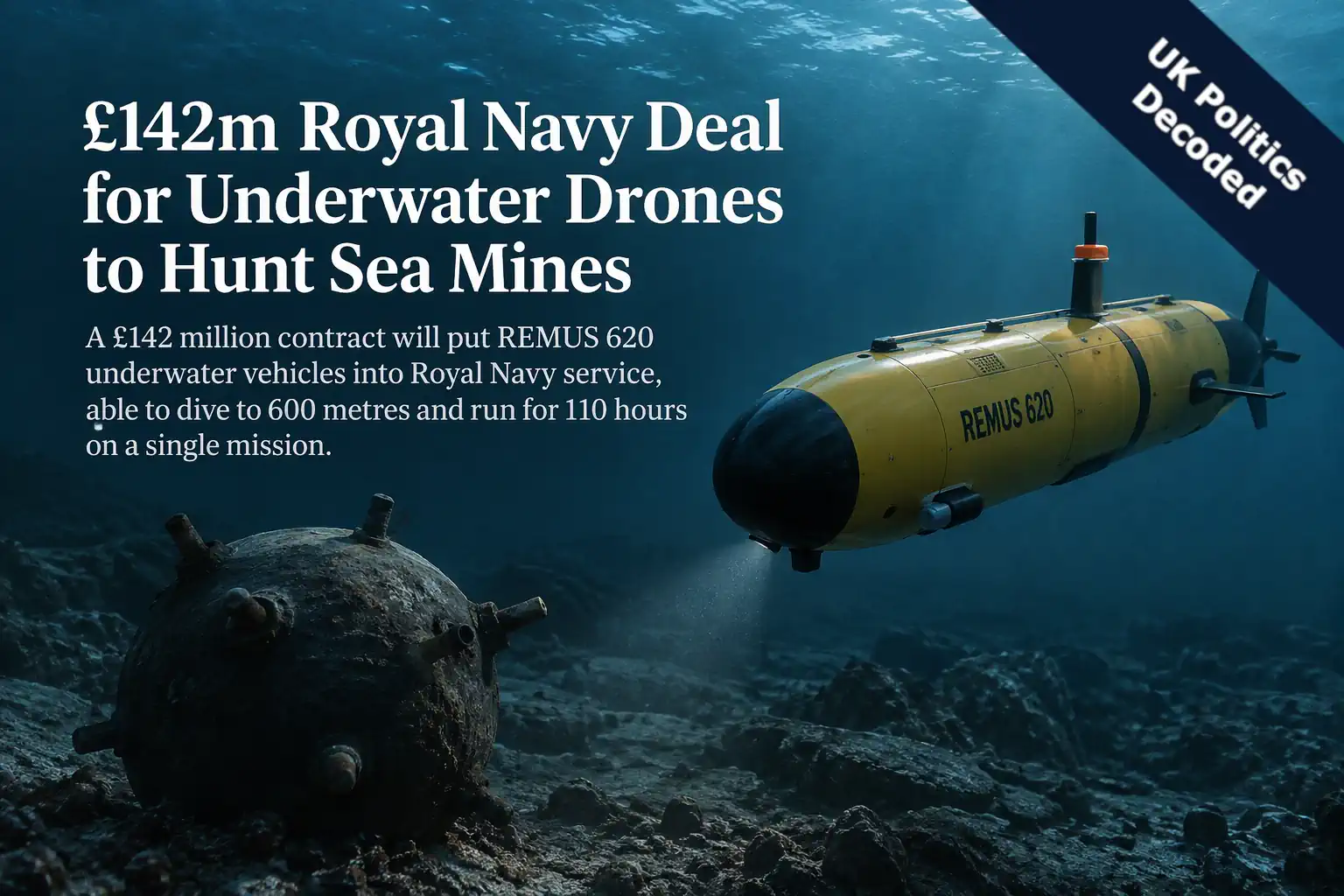
The Royal Navy is spending £142 million on a new fleet of uncrewed underwater vehicles designed to find and help dispose of sea mines. The Ministry of Defence announced the contract on 24 November 2026, saying it will also support jobs in the UK, including in Portchester.
The vehicles are REMUS 620 units built by HII, and the deal covers the vehicles themselves, associated equipment and support services. The government presents the purchase as a step towards what it calls the Hybrid Navy, in which crewed warships work alongside uncrewed and autonomous systems.
At a Glance
- The Ministry of Defence has awarded a £142 million contract to HII for REMUS 620 unmanned underwater vehicles for the Royal Navy.
- The vehicles can travel at up to eight knots, dive to 600 metres and operate for up to 110 hours on a single mission.
- The contract includes the vehicles, equipment and support services, and the government says it will support UK jobs, including in Portchester.
- The announcement follows a £90 million deal with Norway for three new mine hunting motherships earlier this month.
- The government says the Defence Investment Plan commits over £5 billion to autonomous systems to enable transformation by 2030.
What the £142m REMUS 620 Contract Actually Buys
The headline figure covers more than hardware. According to the Ministry of Defence, the contract bundles the REMUS 620 vehicles with equipment and a package of support services, and it was awarded to HII after an international competition.
The government has not said in its announcement how many vehicles the Navy will receive, so the £142 million cannot be divided into a per unit price. Nor has it published a delivery timetable in the release.
What it does give is a performance sheet. The vehicles can run at up to eight knots, dive to depths of 600 metres and stay out for up to 110 hours on one mission. They will work with SeeByte’s SeeTrack and Neptune software, which the department describes as UK developed and already in use across the Royal Navy, building on earlier British investment in its minehunting capability.
How Underwater Drones Take Sailors Out of the Minefield
Clearing mines has traditionally meant putting people and ships close to the danger. The new approach flips that. The vehicles can be sent ahead to search beneath the surface, so crews stay further from the immediate threat rather than operating crewed vessels near potentially mined waters.
The government says this makes minehunting operations safer, faster and more flexible. The Royal Navy already uses REMUS vehicles to find sea mines, survey the seabed and locate wrecks. They carry sonar to map large areas of water, and analysts then review the data from a safe distance, which keeps sailors and divers out of minefields.
The vehicles are small and portable. They can be launched quickly from boats or warships, in coastal waters and in the deep sea. Duane Fotheringham, president of HII’s Unmanned Systems group, said the company is proud that the Navy has selected the REMUS vehicle and Sea Launcher to support its mine countermeasures missions, calling it a reflection of the Navy’s confidence in “proven technology”.
Why Sea Mines Matter to Trade Routes and the UK Economy
The government’s case rests on freedom of navigation. The Ministry of Defence says the ability to find and dispose of sea mines is important for the freedom of navigation of the seas and for keeping trade routes open.
Defence Secretary Wes Streeting made the same link. He said the investment “strengthens our ability to protect freedom of navigation, which is critical to our security and our economy”. He also said the technology puts the latest equipment in sailors’ hands “in a more dangerous world” and described the funding as part of the biggest sustained increase in defence spending since the Cold War.
Those are the government’s characterisations of the security picture, and the announcement does not point to a specific incident or location where the vehicles will first be used.
What the £142m Contract Means for UK Jobs and Portchester
The second pillar of the announcement is industrial. The Ministry of Defence says the contract will bring specialist support services for the vehicles to Britain, supporting jobs in the UK, including in Portchester.
The release does not state how many jobs are involved or what share of the £142 million will be spent in the UK. Readers looking for those details will need to wait for further information from the department or the company.
How the Deal Fits the Royal Navy's Hybrid Navy Plan and Norway Motherships
The contract lands alongside another recent maritime announcement. The government points to its £90 million deal with Norway for three mine hunting motherships, which it says will make the detection and disposal of sea mines safer, quicker and more effective. We covered that agreement in our report on the Norway motherships deal.
Taken together, the two purchases give the Navy ships to carry uncrewed systems and the underwater vehicles to deploy from them, although the announcement does not say that the two programmes are formally linked. The government describes both as steps towards the Hybrid Navy, where crewed warships increasingly operate alongside uncrewed, autonomous and remotely operated systems in the air, on the surface and underwater.
The wider funding sits in the Defence Investment Plan. The government says it is making the largest ever drone investment in defence, with more than £5 billion going to autonomous systems to enable transformation by 2030. The REMUS contract is the latest in a series of awards under that plan, and the department describes it as adding to the commitment already made.
Key Takeaways
- The Royal Navy is buying REMUS 620 uncrewed underwater vehicles from HII in a £142 million contract announced on 24 November 2026.
- The vehicles are designed to search for sea mines ahead of crewed ships, so sailors and divers stay out of minefields.
- The government has not published the number of vehicles, a delivery date or a job total for the contract.
- The deal follows a £90 million agreement with Norway for three mine hunting motherships and forms part of the Hybrid Navy plan.
- The Defence Investment Plan includes more than £5 billion for autonomous systems aimed at transformation by 2030.
Sources & Further Reading
- £142 million Navy investment strengthens UK security and British jobs - GOV.UK Archived copy (OGL): archived page
- UK growth and security boosted as Royal Navy agrees export deal for new mine hunting motherships - GOV.UK Archived copy (OGL): archived page
- The Defence Investment Plan - GOV.UK Archived internally for verification (26-11-2026)
- Ministry of Defence - GOV.UK Archived internally for verification (26-11-2026)